
Every forex pair is two currencies pulling against each other. EURUSD can go nowhere because the euro is up and the dollar is up too. Look at 28 pairs one by one and you see fragments. A currency strength meter looks at all of them together and ranks the eight majors. Then you choose the pair. This guide uses the DuoFX Currency Strength Meter. Setup is in the user manual.
What a currency strength meter shows
- Eight majors: USD, EUR, GBP, JPY, CHF, CAD, AUD, NZD.
- For each pair, the % change over a lookback (in bars) is added to the base currency and subtracted from the quote currency. Each currency is averaged over its pairs.
- The result is a ranking from 1 to 8, on a 0-10 score or as % change.
- It tells you who has been strong, not who will be.
Step 1: match the lookback to how you trade
- Scalping: Short term group M1, M5, M15, with a shorter lookback.
- Day trading: the defaults are a reasonable start. Short M5/M15/M30, Medium H1/H4, Long D1/W1, lookback 12.
- Swing trading: lean on Medium and Long (H4, D1, W1). Long term can also take MN1.
- Use "Sort currencies by" to rank by the group you care about. The strongest, the weakest and the footer pair follow that choice.
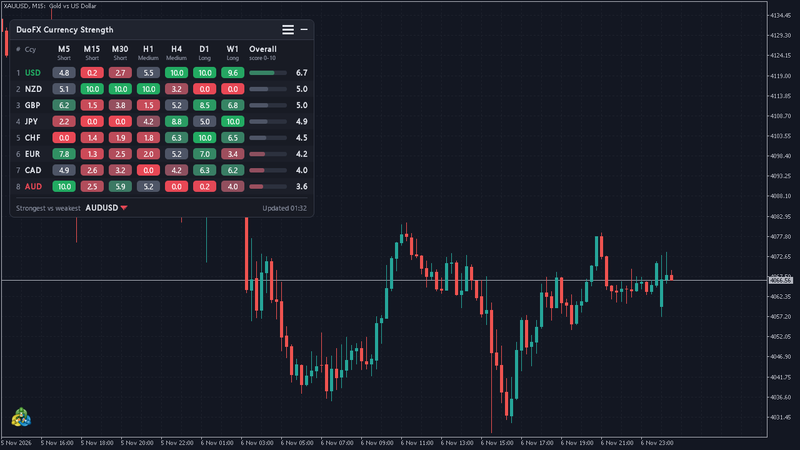
Step 2: read the heat map
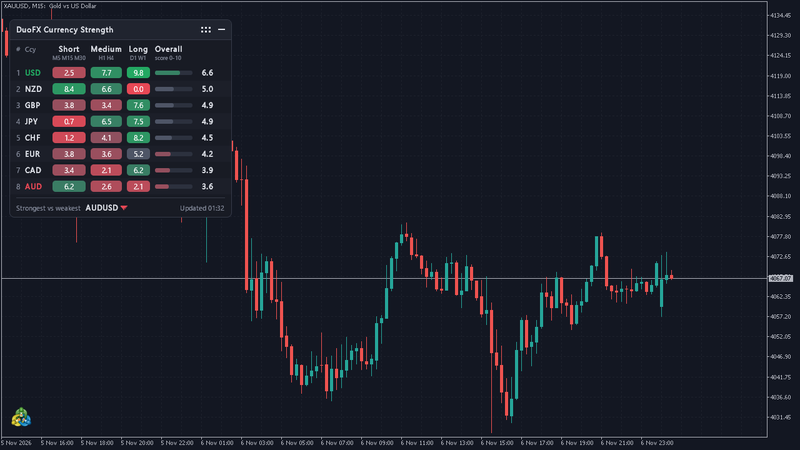
- Rank 1 is strongest, rank 8 weakest. Green is strong, red is weak.
- Look at the gap between the two. A wide gap is a clearer picture. Neighbours with almost the same score usually make a poor pair, so many traders skip them.
Step 3: check the horizons agree
- Is the same currency green in the Short, Medium and Long columns? That is alignment.
- If H1 is green and D1 is red, the move may be a bounce inside a bigger trend, or an early turn. Treat it as a different, riskier trade.
- Click the view button to open one column per timeframe when you need detail.
Step 4: turn two currencies into a pair
- Strong base vs weak quote: the bias is to buy. USD strongest, JPY weakest: USDJPY, arrow up.
- Weak base vs strong quote: the bias is to sell. EUR weakest, USD strongest: EURUSD, arrow down.
- The footer shows "Strongest vs weakest", the pair, and an arrow for that direction.
- Broker prefixes and suffixes (EURUSD.a, EURUSDm) are usually detected automatically. If not, set them in the Symbols inputs.
Step 5: time the entry with your own method
- The meter suggests a side. It does not time the entry.
- Use your own signal on that pair: a pullback to a level, a break, a candle pattern.
- Put the stop where your idea is wrong, not where a colour changes.
Pair selection mistakes
- Chasing a currency that has already moved for days. Check the Long column.
- Trading through central bank decisions and top-tier news. The table can flip in minutes.
- Reading the 0-10 score as a probability. It is a ranking of past movement: on each timeframe the strongest is 10 and the weakest 0, even on a quiet day.
- Using one timeframe only.
Risk note
Currency strength describes the past, and a strong currency can turn at any time. Any trade can lose, and spread, slippage, gaps and news can make losses larger than planned. Size each trade so a loss is one you can afford. The meter is an analysis tool for education, not financial advice, and promises no result. Try any approach on a demo account first.