A breakout EA is easiest to review when you can write the entry conditions down before looking at a winning trade. The point is to identify which boundary, price and timing rule the program was meant to use. A line on a chart is only one of those inputs.
A gold breakout strategy starts with a defined boundary
A breakout strategy specifies a price boundary and a rule for responding when the market crosses it. For XAUUSD, that boundary might be a previous high, low or time-defined range. The strategy still needs entry, exit, position-size and invalidation rules before it can be evaluated.
This guide explains those choices with a hypothetical example. It does not reveal proprietary SmiteFX entry rules or recommend a live gold trade. The hero illustration is conceptual and does not show current prices or a trading result.
Define the range before the trade
A description such as "buy when gold breaks resistance" leaves important questions unanswered. Which highs define resistance? Are they measured from completed candles? What timezone sets the range? Is an entry triggered by a tick, a completed candle or a retest?
These choices affect both historical and live behaviour. Define them before reviewing results; changing the definition after seeing the outcome can turn a test into an explanation of the past.
Common designs include a break of a previous period's high or low, a boundary measured during a fixed session, or a range adjusted using a volatility measure. These are different hypotheses. The word breakout alone does not identify an edge.
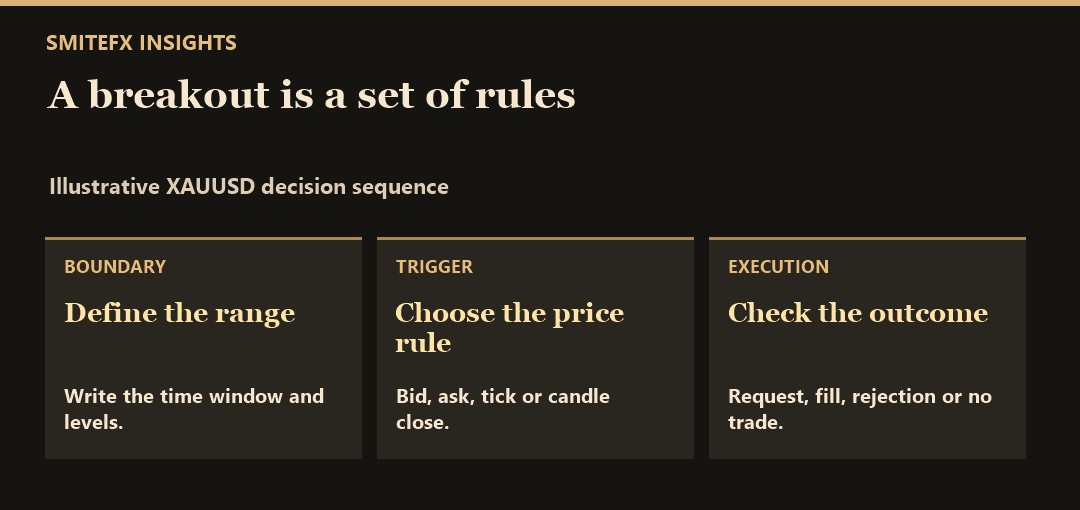
A worked example with hypothetical prices
Suppose a demonstration range runs from 2,350 to 2,360. An example rule waits for a completed candle above 2,360 before considering a long entry. A separate rule defines when the setup is invalid and how much exposure is allowed.
This example is not a current quote or a recommended configuration. It shows why four events must be kept separate:
- Boundary: The preselected 2,360 level is crossed.
- Signal: The completed-candle condition is satisfied.
- Order: The software sends its request using the permitted order type.
- Fill: The broker executes the request at the available price and conditions.
The fill need not equal the boundary or candle close. Calculate exposure from the actual account's contract details and intended loss distance, including relevant costs; never assume one lot or one point means the same amount at every broker.
False breakouts are part of the question
A move beyond a range can reverse back inside it. A candle-close filter, retest condition or volatility filter may change which signals are accepted, but each also changes entry timing and the trades missed. None removes losses.
Ask how a system handles a failed break, repeated attempts, simultaneous positions and a sharp move through its planned exit. Those rules are more informative than a chart showing only the entry that worked.
An exit order is a risk-control instruction, not a promise that every loss will equal the intended amount. Gaps and execution conditions can change the realised outcome.
Inspect the actual XAUUSD symbol
Before comparing results, inspect the symbol offered on the intended account. The MQL5 symbol-properties reference documents distinct values for point size, minimum tick size, contract size, tick value, volume step and permitted stop distances. Avoid treating these as interchangeable units.
The MetaTrader 5 order-execution guide explains that execution depends on the instrument and broker mode. Check the quote side, order type and allowed stops for that setup. A label such as XAUUSD or GOLD is not enough to establish identical specifications.
Record trading hours and broker-server timezone too. A session-based rule can select a different range when its clock assumptions change, including around daylight-saving transitions in the markets it follows.
What a useful backtest should reveal
Test the complete rule set rather than an attractive entry diagram. The MetaTrader 5 Strategy Tester guide describes the testing workflow; interpretation still depends on the chosen data and settings.
- Date coverage: Include different conditions rather than one favourable period.
- Data and timing: Check modelling, symbol, range timezone and information available at the decision time.
- Costs: Inspect spread, commission, swap and execution assumptions.
- Risk: Review equity drawdown, lot sizes, open exposure and losing sequences.
- Stability: Ask whether modest parameter changes materially alter the result and whether an untouched period has been evaluated.
- Operations: Compare forward behaviour with the test assumptions, including actual order handling and connection failures.
Keep optimisation and evaluation periods distinct. A parameter selected because it fits the same history has weaker independent evidence than a rule observed afterward without being retuned. Our backtesting versus forward-testing guide explains that distinction.
Review gold breakout systems without assuming a result
For product context, Fortune is presented by SmiteFX as a market-structure breakout system. That description does not establish the hypothetical settings in this article as Fortune's rules. Use the published product information and its source-account links to assess what evidence is actually available.
Compare the record with the drawdown framework and the EA evaluation checklist. Ask about broker compatibility and operating requirements before configuring a system.
Gold breakouts are a family of rules to investigate, not a promise that a price crossing a line will continue. Leveraged trading carries a risk of loss; historical results and conceptual illustrations do not predict future performance.
Review both a breakout and a failed break
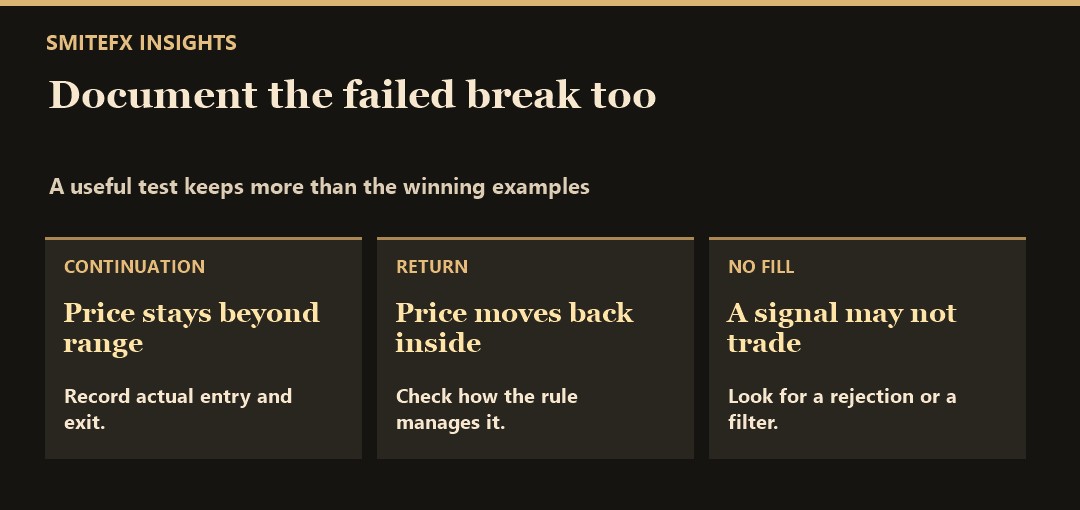
Imagine a range high of 2,350.00 and a hypothetical buy trigger of 2,350.50. In one observation the ask reaches that price while the bid is still below the trigger. In another, the candle closes above the boundary but the order request is rejected by the broker. These cases differ because a quote-based trigger, a candle-close condition and a fill are three separate events.
To compare them, write down the rule you are testing, the symbol name and specification, the time zone, both quote prices at the trigger, and the request and fill timestamps if a trade occurs. Include a failed breakout in the review alongside a continuation. A strategy test that shows only textbook continuations does little to explain how the system behaves around spread changes, news or a rapid return into the range.
For a SmiteFX product reference, see Fortune MT5. Use this listing as a reference for an example of a gold-focused EA, then use its documented settings in a demo test. The illustrative trigger above is not a description of its proprietary rules or a live trade signal.