
Why an MQL5 Signal May Copy Differently on Your Account: 8 Checks Before Subscribing

View MT5 Signal Sentinel in the MQL5 Market
An MQL5 signal page answers one important question: How has the provider traded so far? It does not automatically answer the second question: What can your own account actually copy under your broker's conditions?
This gap explains many of the complaints that repeatedly appear around copy-trading signals:
- “Not every trade was copied.”
- “My lot size is much smaller than the provider's.”
- “The provider shows a good result, but my account does not.”
- “My broker does not offer this symbol.”
- “The signal fee is higher than my return.”
These differences do not automatically mean that the Signals service is broken. In many cases, two different trading environments meet: the provider account and the subscriber account. Balance, account currency, leverage, minimum lot, symbol names, account mode, ping and copying settings can turn the same signal instruction into a different real execution.
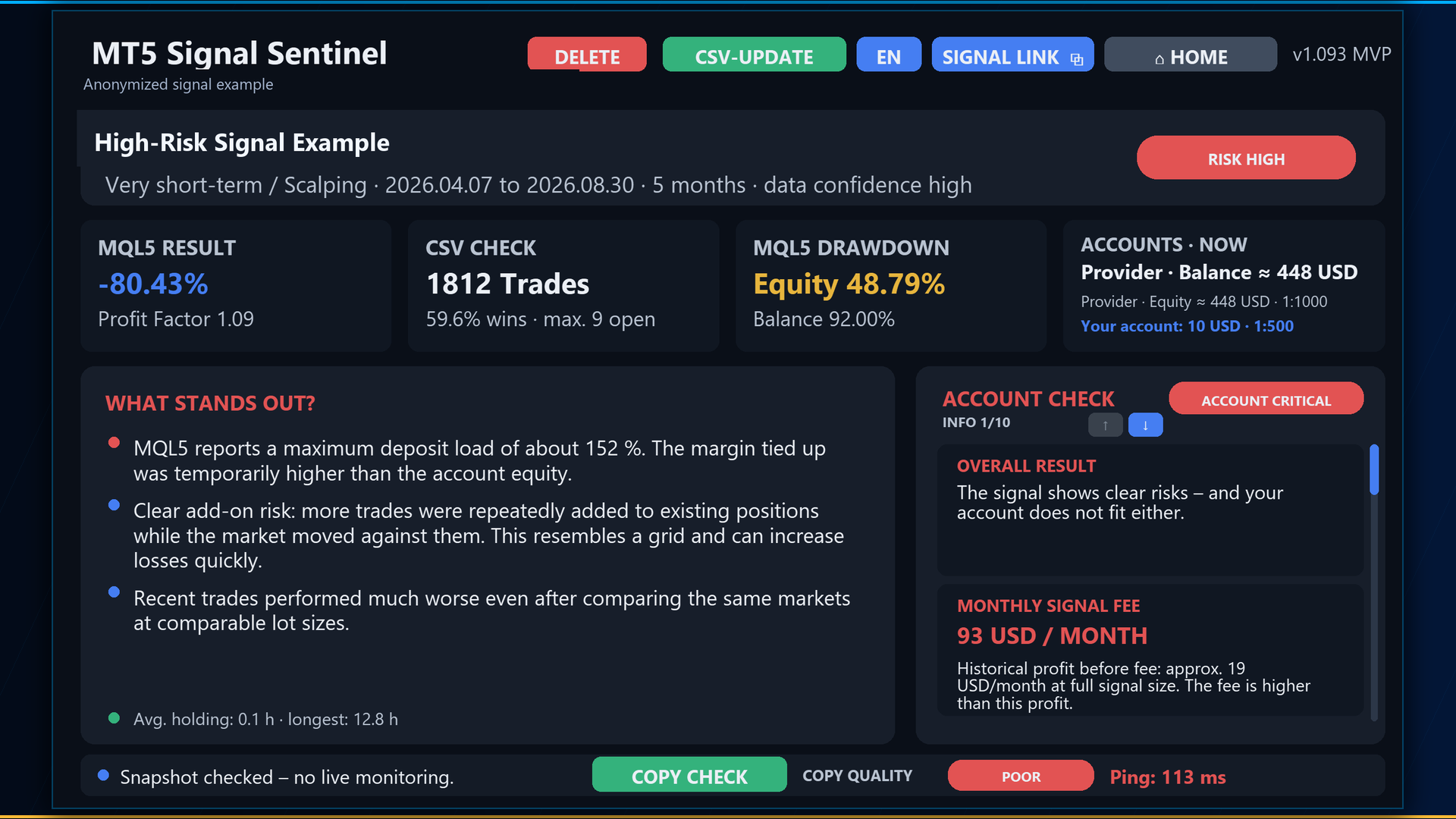
Why a good signal does not automatically fit every account
The public statistics belong to the provider's account. The subscriber does not trade on that account. The subscriber trades at another broker with different contract specifications, margin requirements, minimum volume and connectivity.
At least eight points should therefore be checked separately before subscribing.
1. How was the historical result created?
A large growth figure is easy to see. Understanding how that result was produced is more difficult.
Useful questions include:
- How long is the history that can actually be examined?
- Was a large part of the growth achieved in only a few days?
- How large were the equity and balance drawdowns?
- How many positions were open at the same time?
- Did the result come from many trades or a few outliers?
- Did recent trades perform differently from earlier trades?
A result built over several years provides different evidence from a similar percentage achieved in a few weeks. If 80 percent of all growth came from a very short period, the record may depend heavily on one particular market phase.
2. Is a grid or recovery risk hidden behind a smooth curve?
A high win rate can look reassuring. It can also occur when small profits are closed frequently while losing positions are held or expanded.
In a grid structure, additional positions may be opened while existing trades are already losing. In a recovery or martingale-like structure, the lot size may also increase. If the market turns in time, many trades can close successfully. If it does not, several positions can lose together.
The win rate is therefore not enough. Trade sequence, parallel positions, additions against the market and changes in lot size need to be reviewed together.
3. What lot size will reach the subscriber account?
MQL5 does not simply copy the provider's lots unchanged in every case. Its volume calculation considers factors including the balance ratio, account currencies, the permitted deposit percentage and leverage.
This explains why a provider may trade 0.10 lot while the subscriber receives 0.01 or 0.04 lot. A larger subscriber balance can result in larger copied positions. Lower subscriber leverage can reduce the copying ratio.
The official MQL5 explanation is available in General Information on Trading Signals.
The “Use no more than” setting is not a fixed loss limit. It affects the calculation of copied volume. Real risk still depends on the strategy, open positions, Stop Loss, margin and market movement.
4. Is the broker's minimum lot already too large?
This question is especially important for small accounts. A proportionally calculated position can be smaller than the broker's minimum lot. MT5 cannot open an arbitrarily small position.
If the proportional calculation requires 0.003 lot but the broker permits a minimum of 0.01 lot, the smallest executable position may already be too large relative to the account. Several simultaneous copied trades can amplify this distortion.
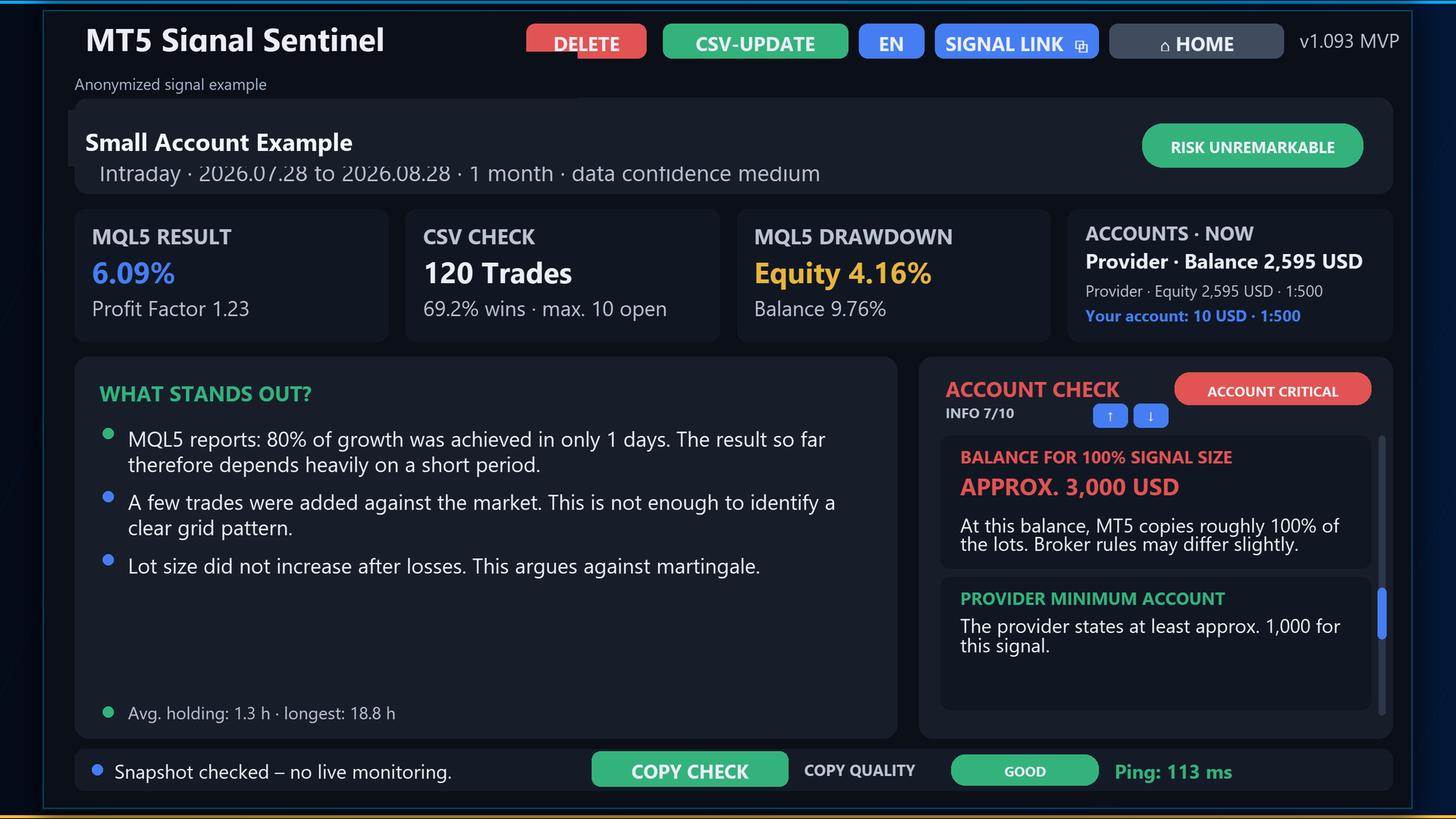
The important question is therefore not only, “Do I have enough money to subscribe?” It is also, “Can my broker execute the required positions at a sufficiently small and proportional size?”
5. Can the subscriber's broker map every market unambiguously?
The same market can have different names at different brokers. A Nasdaq index may be called USTEC, NAS100, US100 or use an additional prefix or suffix. Bitcoin may appear as BITCOIN, BTCUSD or a similar name.
A similar name is not yet a safe confirmation. Several broker symbols may look like the same market while using different contract sizes, currencies or trading conditions. If the required symbol is missing or the mapping remains ambiguous, trades can be skipped or executed differently.
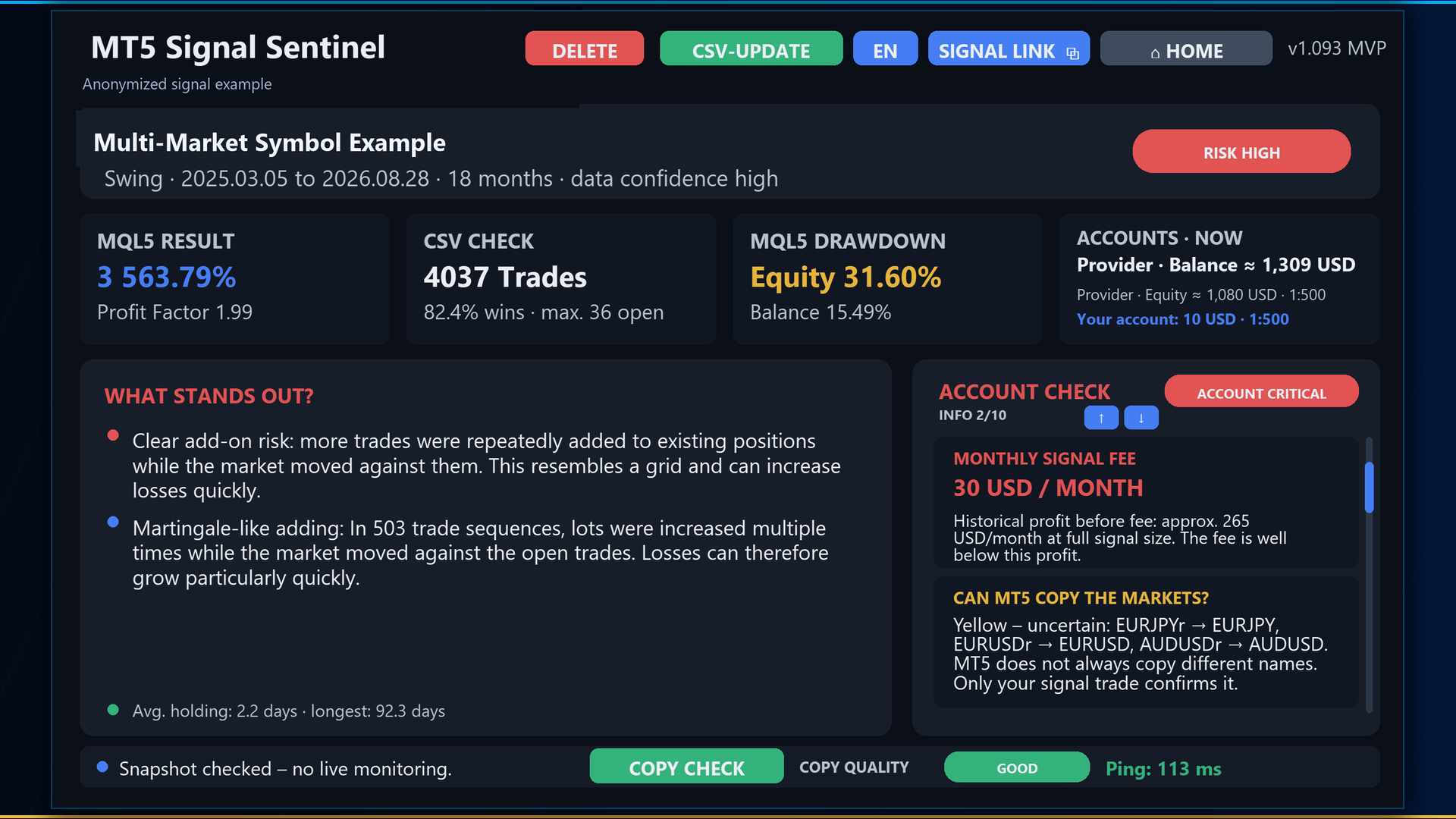
An honest pre-check should therefore distinguish between exact, likely, ambiguous and missing. A guess should never be displayed as a confirmed copy match.
6. Do leverage and hedging or netting mode fit?
A provider with high leverage ties up less margin for the same position than a subscriber with lower leverage. The provider may be able to hold a drawdown while the subscriber account is already approaching a margin limit.
Account mode matters as well. A hedging account can keep a buy and a sell on the same market open as separate positions. A netting account offsets both directions into one net position. A strategy that requires both sides at the same time cannot be reproduced with the same structure on a netting account.
7. Does the signal speed fit the connection?
A delay of a few seconds usually has a different meaning for a multi-day swing trade than for a scalper that holds positions for only a few minutes or seconds.
Ping, average holding time, longest holding time and possible differences between broker servers should therefore be considered together. There is no single “good ping” number for every signal. It must be judged against the speed of the strategy being copied.
8. How does the fixed monthly fee compare with the historical result?
The signal fee is a fixed amount of money. The copied result, however, scales with the actual copying ratio. The same signal can therefore make very different economic sense for a large account and a small account.
A clear check should compare:
- the monthly signal fee in USD;
- historical average monthly profit before the fee at full signal size;
- the subscriber account's actual or estimated copying ratio;
- the weight of the fixed fee relative to the subscriber's balance.
If a signal historically produced an average of approximately 19 USD per month before its fee but costs 30 or 93 USD per month, the central message is simple: the fee was higher than that historical profit. This is not a forecast. It is a necessary classification of past data.
What can be checked before and after subscribing?
Before subscribing, public signal data, the official positions CSV, trading patterns, costs, broker symbols, minimum lot, leverage and account mode can be examined.
After subscribing, the actual terminal status can also be checked: Is the MQL5 account signed in? Is the signal active on this trading account? Is signal copying enabled? Which copying percentage is selected? Are Stop Loss and Take Profit configured to be copied? Does the terminal appear ready for continuous operation?
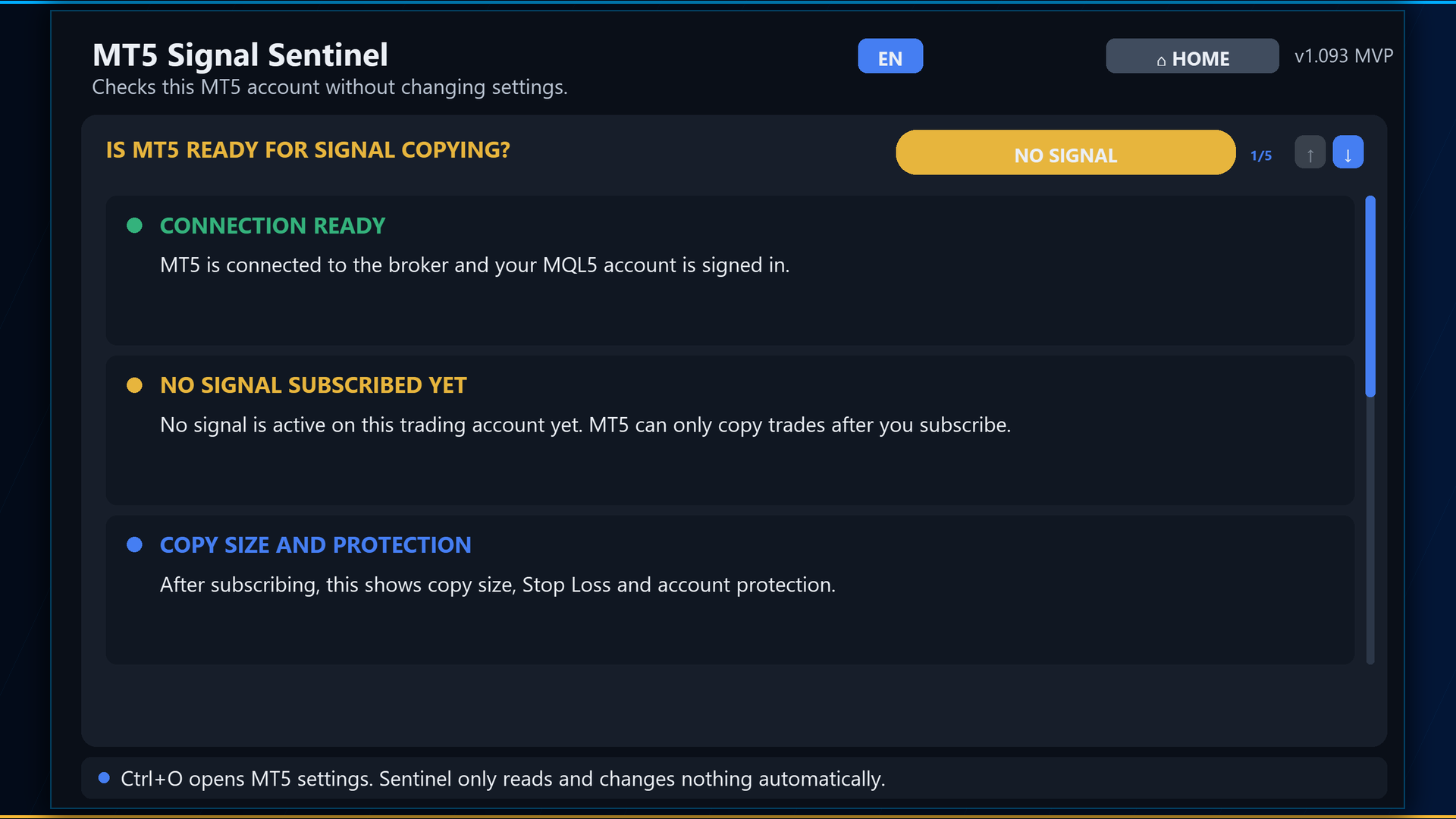
These two moments should not be mixed. A pre-subscription analysis can identify technical risks but cannot prove the first real copied trade. A later Copy Check can read the current settings, but it cannot make a risky trading strategy safe.
How MT5 Signal Sentinel brings the checks together
MT5 Signal Sentinel was developed as a read-only verification utility. It combines:
- public MQL5 overview data;
- the official positions CSV selected by the user;
- the conditions of the currently connected MT5 account;
- a separate Copy Check after subscription;
- locally archived snapshots for later CSV comparisons.
Signal risk and account fit are rated separately. The monthly fee is compared with the historical average monthly profit before the fee. Foreign-currency values are also shown as USD guide values. Symbol mapping, minimum lot, copying ratio, hedging or netting and leverage differences are explained in plain language.
Sentinel does not trade, copy trades itself, subscribe to a signal or modify orders or MT5 signal settings.
The demo deliberately includes bad cases
A demo that shows only a perfect green report would not explain the purpose of this utility. The Strategy Tester demo therefore contains eleven fully fictional cases. They include a good signal on an undersized account, missing or ambiguous symbols, a fee above the historical result, grid and recovery, a hedging signal on a netting account and a fast scalper with poor copy quality.
The demo uses no real providers, signal names, IDs or customer data. It demonstrates how the utility distinguishes between unremarkable, review carefully and critical.
What a verification utility cannot promise
No analysis can guarantee future profits. A downloaded CSV is a snapshot, not live monitoring. New or hidden trades may appear with a delay or may be absent. Copying ratio, guide balance and margin remain technical estimates because broker rules, prices, contract sizes, slippage and real execution can change.
A green status therefore means only unremarkable so far or technically compatible. It never means safe or profitable in the future.
Conclusion
The question before a signal subscription should not only be, “Was this signal profitable in the past?” An equally important question is, “Can my account copy it sensibly under my broker's conditions, and how much of the historical result would the fixed fee consume?”
Answering these questions first helps explain possible differences before the first real copied trade occurs.
View MT5 Signal Sentinel in the MQL5 Market and try the free Strategy Tester demo
Risk notice: Historical results do not guarantee future results. Trading leveraged financial instruments can result in a partial or complete loss of the capital used. This article and MT5 Signal Sentinel are not investment advice and do not recommend any particular signal.



![[iVISTscalp5]: EURUSD. Forecast First. Market Reaction Afterwards//October 12-16, 2026](https://c.mql5.com/6/1038/splash-preview-777972.png "[iVISTscalp5]: EURUSD. Forecast First. Market Reaction Afterwards//October 12-16, 2026")