MT5 Trade Copier: How to Configure a Trade Copier for Accounts with Different Balances

Product link:
https://www.mql5.com/en/ market/product/191385
One of the most important challenges in copy trading is managing multiple MT5 accounts with significantly different balances. A trade size that may be appropriate for a $100,000 account can be far too large for a $1,000 account.
If a trade copier simply sends the same lot size to every receiver account, the resulting risk can be dramatically different from one account to another. Smaller accounts may become over-exposed, while larger accounts may receive a position that represents only a small fraction of their available capital.
A properly configured MT5 Trade Copier can solve this problem by adjusting copied volume according to the size of each receiver account. COPYLATOR provides several lot-management methods that can be combined to create a suitable configuration for different account sizes.
Why Account Balance Matters in Copy Trading
Consider a sender account with a balance of $100,000 and a receiver account with a balance of only $1,000.
If the sender opens a 1.00-lot position and the copier sends exactly 1.00 lot to both accounts, the nominal position size is identical, but the relative exposure is not.
| Account | Balance | Copied Lot | Relative Position Size |
|---|---|---|---|
| Sender | $100,000 | 1.00 lot | 0.001% of balance per lot |
| Receiver A | $10,000 | 1.00 lot | 10× higher relative exposure |
| Receiver B | $1,000 | 1.00 lot | 100× higher relative exposure |
The exact monetary risk depends on the symbol, stop-loss distance, contract specifications, leverage, and broker conditions. Therefore, identical lot sizes should not automatically be considered equivalent risk across different accounts.
Balance-Ratio Scaling: The Best Starting Point
For accounts with different balances, balance-ratio scaling is often the most practical starting point.
The basic concept is straightforward:
Receiver Lot = Sender Lot × (Receiver Balance / Sender Balance)
For example, assume:
- Sender balance: $10,000
- Receiver balance: $1,000
- Sender trade volume: 1.00 lot
The balance ratio is:
$1,000 / $10,000 = 0.10
The resulting receiver volume would therefore be approximately:
1.00 × 0.10 = 0.10 lot
This approach allows the copied volume to adapt to the relative size of each account instead of blindly using the sender's absolute lot size.
Important: Balance Ratio Does Not Guarantee Identical Risk
Balance-ratio scaling is a powerful volume-management method, but it should not be interpreted as a guarantee that every account has exactly the same percentage risk.
Actual risk can also depend on:
- Stop-loss distance
- Symbol contract specifications
- Leverage
- Margin requirements
- Broker execution conditions
- Minimum and maximum lot sizes
- Lot-step restrictions
- Currency conversion
For this reason, balance-ratio scaling should be viewed as a proportional position-sizing mechanism rather than a complete risk-management system.
Using a Lot Multiplier for Additional Control
A multiplier can be combined with balance-ratio scaling when a trader wants an additional global adjustment.
For example:
Sender Volume = 1.00 lot
Balance Ratio = 0.10
Multiplier = 0.50

Final Volume =
1.00 × 0.10 × 0.50
= 0.05 lot
In this configuration, the receiver automatically follows its balance ratio while the multiplier reduces the resulting volume by another 50%.
This can be useful when different receiver accounts require different overall exposure levels.
Fixed Lot Size: When Should You Use It?
Fixed lot sizing takes a different approach. Instead of adapting the copied volume to the receiver's balance, the copier uses a predefined lot size.
Sender opens: 2.00 lots Receiver fixed lot: 0.10 lots Every copied trade: 0.10 lots
Fixed lot sizing can be useful when receiver accounts are approximately the same size or when the trader intentionally wants every account to receive the same absolute position size.
However, fixed lot sizing does not automatically adapt when account balances change. A fixed 0.10-lot position may represent very different exposure on a $500 account compared with a $10,000 account.
Maximum Lot Cap: An Important Safety Layer
A maximum lot cap provides another layer of protection.
Even when using automatic scaling, traders may want to define the largest position that can be opened on a receiver account.
Calculated Volume = 4.00 lots
Maximum Lot = 1.00 lot

Final Volume = 1.00 lot
This prevents the copier from exceeding the predefined maximum volume when the calculated size becomes too large.
A maximum lot cap can be particularly useful when managing multiple accounts with different balances, aggressive sender volumes, or changing account conditions.
Minimum Lot Size and Broker Restrictions
Different brokers can impose different trading-volume requirements. These may include:
- Minimum lot size
- Maximum lot size
- Lot step
- Symbol-specific volume restrictions
For example, a calculated volume might theoretically be 0.037 lots, while the broker may only accept increments of 0.01 lot.
The copier therefore needs to normalize the calculated volume according to the receiver broker's trading specifications. Proper volume normalization helps prevent rejected orders caused by invalid lot sizes.
Combining Balance Ratio, Multiplier and Maximum Lot
For accounts with very different balances, combining several controls can provide more flexibility.
A typical calculation can be visualized as:
Sender Lot │ ▼ Balance-Ratio Scaling │ ▼ Lot Multiplier │ ▼ Maximum Lot Cap │ ▼ Broker Volume Normalization │ ▼ Final Receiver Lot
This layered approach allows the copier to automatically adapt the position size while still maintaining predefined exposure limits.
Example: Managing Three Different Receiver Accounts
Suppose a sender account has a balance of $50,000 and opens a 1.00-lot trade.
| Receiver | Balance | Balance Ratio | Approx. Scaled Lot |
|---|---|---|---|
| Account A | $50,000 | 1.00 | 1.00 lot |
| Account B | $10,000 | 0.20 | 0.20 lot |
| Account C | $2,500 | 0.05 | 0.05 lot |
The same trading signal can therefore be distributed to all three accounts while the copied volume is adjusted according to each receiver's balance.
Using Different Multipliers for Different Account Tiers
When managing a large group of accounts, it may be impractical to treat every account identically.
One useful approach is to organize accounts into tiers.
| Account Tier | Example Balance | Multiplier | Purpose |
|---|---|---|---|
| Small | $500–$2,500 | 0.50 | More conservative exposure |
| Medium | $2,500–$10,000 | 0.75 | Moderate exposure |
| Large | $10,000+ | 1.00 | Full proportional exposure |
The exact multiplier should be determined according to the trader's strategy, risk tolerance, broker conditions, and account requirements. These values are examples rather than universal recommendations.
What Happens When Account Balances Change?
One major advantage of balance-ratio scaling is that the position-sizing logic can adapt as account balances change.
For example, if a receiver grows from $1,000 to $2,000 while the sender remains at $10,000, its balance ratio changes:
Before:
$1,000 / $10,000 = 0.10

After:
$2,000 / $10,000 = 0.20
The resulting position size can therefore increase proportionally according to the configured scaling method.
This is different from fixed-lot sizing, where the receiver would continue using the same predefined volume unless the setting is manually changed.
Best Practices for Different-Balance Accounts
- Start with balance-ratio scaling when receiver accounts have significantly different balances.
- Use a multiplier when a specific account or account group requires lower or higher overall exposure.
- Set a maximum lot cap to limit unexpectedly large calculated volumes.
- Respect broker volume rules, including minimum lot, maximum lot, and lot-step requirements.
- Test the configuration on demo accounts before deploying it to live accounts.
- Review settings periodically as account balances, brokers, and trading conditions change.
- Do not assume proportional volume means identical monetary risk; always consider the symbol and stop-loss configuration.
Configuration Example for COPYLATOR
A practical configuration for accounts with different balances might look like this:
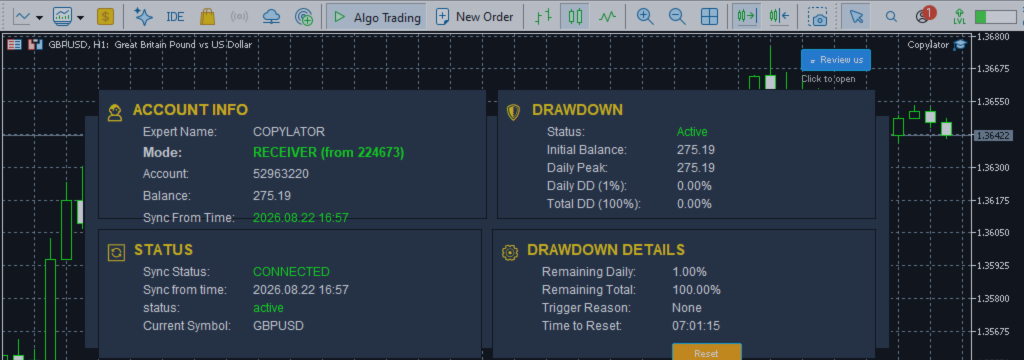
Lot Management: Balance Ratio Scaling = Enabled Additional Multiplier: 0.50 – 1.00 depending on account requirements Maximum Lot: Defined according to account risk limits Volume Normalization: Follow receiver broker specifications
The exact values should be selected based on the account's size and risk requirements rather than copied blindly from another configuration.
Balance-Based Scaling vs Fixed Lot
| Method | Adapts to Balance | Best Use Case | Main Consideration |
|---|---|---|---|
| Balance Ratio | Yes | Different account sizes | Risk still depends on trading conditions |
| Multiplier | Works with scaling | Fine-tuning exposure | Requires sensible configuration |
| Fixed Lot | No | Similar-sized accounts | Does not automatically adapt |
| Maximum Lot | Limits volume | Exposure protection | Can cap calculated volume |
Why Flexible Lot Management Matters in an MT5 Trade Copier
A professional MT5 Trade Copier should not be limited to simply duplicating the sender's lot size. Different receiver accounts can have different balances, leverage, broker specifications, and risk requirements.
Flexible lot management allows traders to decide whether copied positions should use fixed volume, proportional scaling, multipliers, or maximum-volume limits.
This becomes particularly valuable when one trading strategy is distributed across multiple accounts with substantially different capital sizes.
Conclusion
Configuring a trade copier for accounts with different balances requires more than simply copying the same lot size to every account.
Balance-ratio scaling provides a practical way to adjust copied volume according to account size. A lot multiplier can provide additional control, while a maximum lot cap can help prevent calculated positions from exceeding a predefined volume limit. Fixed lot sizing remains useful when accounts are similar in size or when consistent absolute position sizes are specifically desired.
For traders managing accounts ranging from a few hundred dollars to tens of thousands of dollars, combining proportional scaling with carefully selected risk controls can provide a more structured approach to trade replication.
As with any automated trading configuration, these settings do not guarantee profitability or identical risk across accounts. They should be tested carefully and reviewed as account balances, broker specifications, and trading conditions change.
Product link:
https://www.mql5.com/en/ market/product/191385