
 You caught 40 pips on one USD/JPY trade and lost 40 on another, with the same position size. Why might the dollar amounts differ? The missing piece is often currency conversion: a yen profit or loss still has to become dollars in a USD account.
Understanding that step makes your risk estimates easier to check. We will separate the price movement, the yen amount and the account-currency result. All prices and account figures below are hypothetical teaching examples, not live market quotes or trading recommendations.
Start with what USD/JPY actually measures
USD/JPY expresses Japanese yen per US dollar. At a hypothetical rate of 160.00, one US dollar exchanges for 160 yen. USD is the base currency, the first currency in the pair; JPY is the quote currency, the second.
A conventional pip on USD/JPY is 0.01 yen per dollar. A move from 160.00 to 160.01 is one pip. OANDA's introduction to pips explains this yen-pair convention.
Do not confuse that pip with the last digit your platform displays. If a broker quotes 160.001, the final 0.001 increment is one tenth of a conventional pip. Check the instrument's actual tick size and how the platform labels points. A calculator using points can give a very different answer from one expecting pips.
Calculate the yen value first
Assume a linear USD/JPY position with a base-currency quantity of USD 100,000. We specify units directly so there is no uncertainty about the broker's definition of a lot.
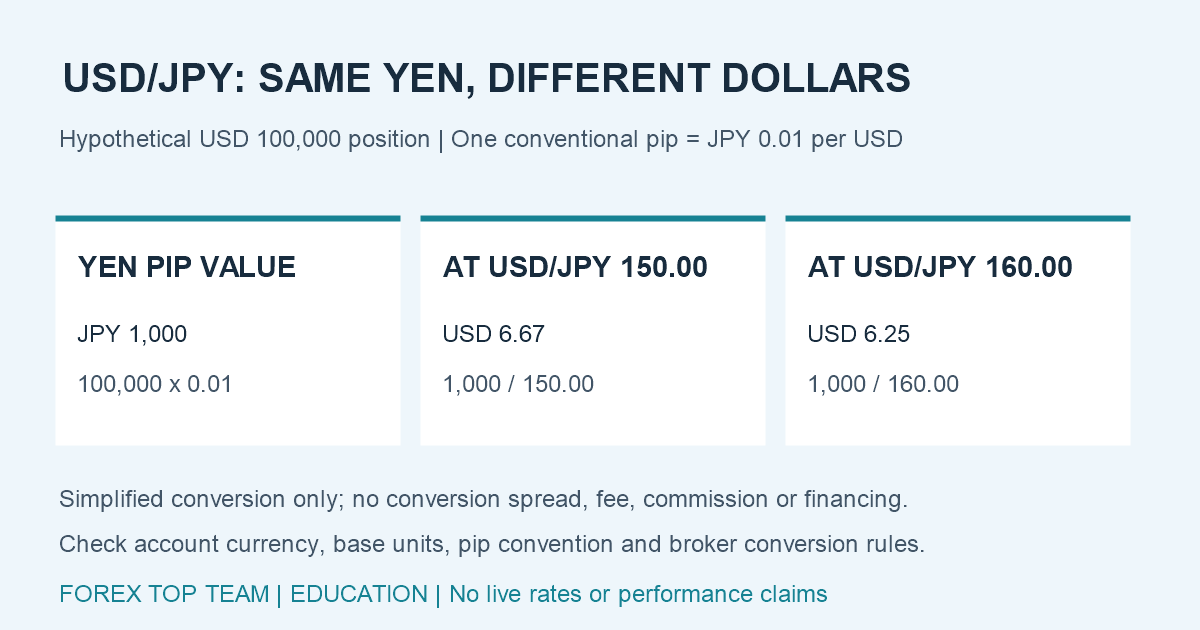
One-pip value = USD 100,000 × JPY 0.01 per USD = JPY 1,000.
That yen amount stays the same while the quantity and pip convention stay fixed. Now convert it to the account currency. In this simplified example, ignore conversion spreads and fees:
- At a hypothetical USD/JPY rate of 150.00: JPY 1,000 ÷ 150.00 = approximately USD 6.67.
- At a hypothetical rate of 160.00: JPY 1,000 ÷ 160.00 = USD 6.25.
The division matters. The quote says yen per dollar, so dividing yen by yen per dollar leaves dollars. Multiplying would leave the wrong units.
At a higher USD/JPY rate, the same JPY 1,000 converts into fewer dollars. The pip has not changed size. Its value in the USD account has changed. OANDA's profit-and-loss examples similarly calculate a USD/JPY result in yen before converting it into the account currency.
Why a 40-pip estimate is only an estimate
Imagine an actual buy fill of 160.00 and an actual sell fill of 159.60 for our hypothetical USD 100,000 position. The decline is 0.40 yen per dollar, or 40 conventional pips.
Price P/L = (159.60 − 160.00) × 100,000 = −JPY 40,000.
Assume the entire yen loss is converted at exactly 159.60, without a conversion spread or charge:
USD result = −40,000 ÷ 159.60 = approximately −USD 250.63.
Using the entry-rate pip estimate would instead give 40 × USD 6.25 = USD 250.00. The USD 0.63 difference comes from our conversion assumption, not an extra price movement.
This is a deliberately simplified illustration. Your broker can use different conversion quotes for positive and negative amounts and may apply a charge. OANDA's account-statement guide, for example, distinguishes unrealized valuation from realized P/L and explains that realized conversion includes its applicable conversion fee. Those are product-specific rules, so read the documentation for your own account.
Keep conversion separate from execution costs
Our calculation starts with executable entry and exit fills. Their difference already measures the price loss; do not automatically add the spread again. If your worksheet starts with a chart midpoint instead, first reconcile it with the prices at which you can actually trade.
Commission and overnight financing need their own entries when applicable. A figure labelled trading profit may not represent the final change in equity after every charge. Compare the statement's definitions with the fields in your journal.
Also, 159.60 in our example is an assumed actual fill, not a promise that a stop order will execute there. For planning, recalculate a worse exit and its associated conversion rate. A pip-value calculation cannot turn a stop into a guaranteed cash-loss ceiling.
Why copying a EUR/USD shortcut can mislead
For comparison, take a hypothetical EUR/USD position of EUR 100,000. With a conventional pip of USD 0.0001 per euro, one pip equals USD 10. In a USD account, that price P/L already uses the account currency.
USD/JPY needs the additional conversion because its price P/L is in yen. A EUR-denominated account introduces another conversion question. Before comparing two setups, convert both planned losses into the same account currency.
“Same pips” and “same lots” are therefore incomplete descriptions of risk. For the wider sizing process, see our guide to sizing a forex trade before you click buy. It connects the cash budget, stop distance, contract size and trading costs.
Your quick worksheet before the next trade
- Write the account currency and the pair's base and quote currencies.
- Confirm the base units, contract size, conventional pip and minimum tick.
- Calculate the price P/L in the quote currency first.
- Use the broker's applicable conversion method and identify any conversion charge.
- Check commissions, financing and a worse execution scenario separately.
- Compare the planned cash loss with your chosen budget, then round quantity down to an allowed increment if needed.
For a useful practice exercise, repeat the same hypothetical yen loss at two conversion rates. Then reconcile one closed trade in your journal with its broker statement. Learning to explain the difference is more valuable than memorizing a single dollar-per-pip shortcut.