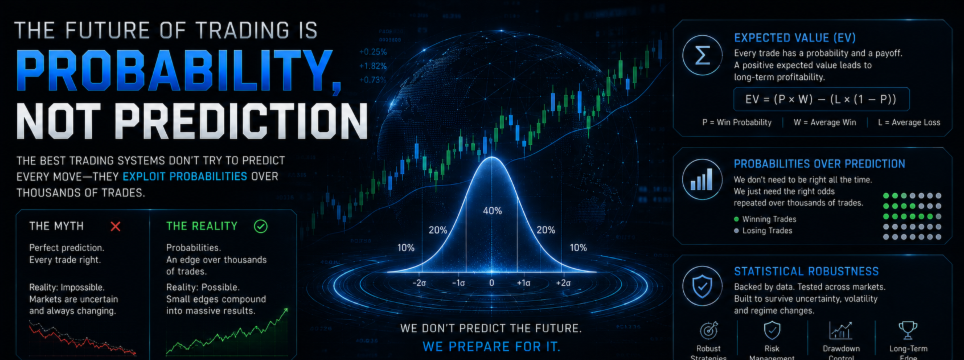

The Future of Trading Is Probability, Not Prediction
The best trading systems do not try to predict every move. They exploit probabilities over thousands of trades. Read that distinction until it actually changes how you think, because almost every retail trader, and an uncomfortable number of retail trading products, are still built around a fundamentally broken premise, that the goal of a trading system is to know what happens next. It is not, and it was never supposed to be. This is a long, deliberately exhaustive dismantling of the prediction myth, a rigorous walk through the actual mathematics of expectancy and statistical robustness, and a direct case for why genuinely professional algorithms are built as systematic probability engines rather than fortune tellers, verified against ICONIC BTC AI+ and the flagship ICONIC KYBERNETIC AI+ throughout.
Part One: Why Markets Are Fundamentally Probabilistic Systems, Not Predictable Ones
Say this plainly, because the entire rest of this article depends on you actually internalizing it rather than nodding past it. No individual trade outcome is knowable in advance, by anyone, regardless of skill, regardless of sophistication, regardless of how much data or computing power stands behind the decision. Markets are stochastic systems, driven by the aggregated, constantly shifting decisions of millions of independent participants reacting to information, sentiment, and each other in real time. Any single trade sits inside genuine, irreducible uncertainty, and no amount of analytical sophistication changes that fundamental fact about the system being traded.
What genuine skill, and genuine intelligence, can actually do is different, and considerably more modest sounding, even though it is the entire foundation of every durable trading edge that has ever existed. Skill shifts the underlying probability distribution favorably. It does not eliminate uncertainty on any individual trade. A system with genuine edge does not know whether the next trade wins or loses any more precisely than a system with no edge at all knows it. What it knows, with real, defensible confidence, is that across a sufficiently large number of trades, the aggregate outcome will lean favorably in a specific, quantifiable direction. This is not a lesser form of intelligence than prediction. It is the only form of intelligence that is actually honest about the system it is operating inside.
Part Two: Dismantling the Myth of Perfect Prediction, Directly
The prediction myth survives specifically because it feels intuitively satisfying in a way honest probability never quite manages to. A system that claims to predict the next move offers the comforting illusion of certainty, a clean, confident answer to an inherently uncertain question. A system that honestly states it is exploiting a favorable probability distribution over a large sample offers something less emotionally satisfying but considerably more truthful, and considerably more durable as an actual operating philosophy.
Here is the uncomfortable arithmetic prediction based marketing conveniently avoids. If a system genuinely could predict individual trade outcomes with high reliability, its win rate would approach certainty, not the sixty, seventy, or even eighty percent figures confidently advertised across this entire product category. Genuine, consistent prediction at that level of reliability does not exist in any liquid, competitive market, and any product implying otherwise is either badly misunderstanding its own results or deliberately obscuring the actual, honest mechanism producing them. What genuinely sound systems are actually doing, whether they market themselves this way or not, is exploiting a statistically favorable distribution of outcomes across a large sample, not predicting any individual outcome within that sample with meaningful reliability.
Part Three: The Law of Large Numbers, the Actual Mechanism Behind Every Durable Trading Edge
This is the statistical principle every genuinely professional trading operation is built around, whether or not its marketing ever explains it directly. The law of large numbers states, with mathematical rigor, that as the number of independent trials increases, the average outcome converges toward the true underlying expected value, even when any individual trial remains genuinely unpredictable in isolation. A coin with a fifty two percent bias toward heads will not reliably predict any single flip. Across ten thousand flips, however, the aggregate result converges toward that fifty two percent bias with mathematical certainty, a genuine, exploitable edge emerging entirely from volume rather than from any improved ability to call individual flips.
Trading operates on the exact same underlying mathematics. A system with a genuine, positive expectancy per trade cannot tell you whether trade number four hundred and twelve wins or loses. It can tell you, with real statistical confidence grounded in the law of large numbers, that across several hundred or several thousand trades, the aggregate outcome converges toward its calculated expectancy. This is not a limitation of the system's intelligence. It is the actual mathematical mechanism through which any genuine edge in a competitive, liquid market ever converts into real, durable profit at all.
Part Four: Expectancy, the Actual Mathematics Underneath Every Genuine Edge
Expectancy multiplies win rate by average win, then subtracts loss rate multiplied by average loss, producing what a system genuinely earns on average per trade over a sufficiently large sample. A system winning forty percent of the time with wins averaging three times the size of losses produces strongly positive expectancy despite losing on the majority of individual trades, while a system winning seventy percent of the time with losses twice the size of wins can quietly produce negative expectancy despite its impressive sounding win rate. This single distinction, obvious once explained yet consistently ignored by the overwhelming majority of retail traders, is the actual foundation everything else in this article builds on.
Here is why this matters so directly for the prediction versus probability distinction. A system optimized purely to maximize prediction accuracy, correctly calling direction as often as possible, is optimizing the wrong metric entirely. Expectancy and directional accuracy are related but genuinely distinct quantities, and a system built to maximize the former sometimes deliberately accepts a lower win rate in exchange for a meaningfully more favorable payoff structure, a tradeoff that makes no sense at all under a prediction focused mental model but makes complete, mathematical sense under a probability and expectancy focused one.
Part Five: Statistical Robustness, Why Not Every Probability Estimate Deserves Trust
A probability estimate is only as trustworthy as the evidence genuinely supporting it, and this is where most systems marketed around probability language quietly fail. A win rate calculated from twenty historical trades tells you almost nothing statistically meaningful, since a sample that small cannot reliably distinguish genuine edge from ordinary variance. A win rate calculated from several thousand genuinely independent, out of sample trades carries considerably more statistical weight, though even then, genuine robustness requires the underlying pattern to have been validated against data the system never touched during its own calibration, not merely repeated across a large in sample dataset the model was directly fitted to.
Statistical robustness also requires honest calibration, a system stating seventy percent confidence should, across a large enough sample of similarly confident predictions, actually be correct approximately seventy percent of the time. A system whose stated confidence does not honestly track its realized accuracy is not offering genuine probability information at all, it is offering a number that merely resembles probability language without the statistical discipline actually underpinning genuine, trustworthy calibration.
Part Six: How Genuine Systems Actually Implement Honest, Calibrated Probability
This is where theory becomes verified, working architecture rather than an abstract mathematical argument. The flagship ICONIC KYBERNETIC AI+ runs Adaptive Conformal Inference, a distribution free calibration technique that continuously regulates its own confidence gate online so that its realized error rate genuinely converges toward a stated target, rather than trusting a fixed number chosen once during development and never revisited. This is precisely the statistical robustness covered in Part Five, implemented as a live, ongoing process rather than a one time claim, the system's stated confidence is continuously checked against reality and adjusted to remain honest as conditions evolve.
ICONIC BTC AI+ applies genuine confidence gating at the point of decision itself, weighting every entry against calibrated confidence in current conditions. When that confidence falls below a defined threshold, position sizing automatically reduces into a defensive posture, and if confidence deteriorates further, the engine skips the setup entirely rather than proceeding on a conviction it does not genuinely hold. This is probability translated directly into action, not a static prediction claimed once and acted on with fixed conviction regardless of how the underlying evidence actually evolves moment to moment.
Part Seven: Why Position Sizing Is Where Probability Theory Actually Meets Real Capital
Understanding probability and expectancy in the abstract means nothing without translating that understanding into how much capital is actually deployed on any given trade, and this is precisely where the deepest, most consequential mathematics in this entire discussion lives. Returns compound geometrically, not arithmetically, meaning a system with genuinely positive expectancy per trade can still produce negative long run growth if position sizing is large enough that volatility itself erodes the compounding process, a phenomenon sometimes called volatility drag. ICONIC BTC AI+ addresses this directly through ATR based position sizing anchored to a defined percentage of account equity, allowing genuine expectancy to compound cleanly across hundreds of trades rather than allowing oversized bets to destroy the very compounding process a real edge depends on to eventually pay out.
Part Eight: Systematic Decision Tools, Not Fortune Tellers, and Why That Framing Matters
Reframing a professional algorithm as a systematic decision tool rather than a prediction engine changes everything about how it should genuinely be evaluated. A prediction engine is judged, naturally but incorrectly, on whether any individual call turned out correct, exactly the wrong standard for a fundamentally probabilistic system. A systematic decision tool is judged on whether its decisions, aggregated honestly across a statistically meaningful sample, produce the favorable expectancy its underlying probability framework claims to deliver. This is not a semantic distinction. It is the entire difference between evaluating a system fairly on the mathematics it actually operates on, and evaluating it unfairly on a standard, individual trade prediction accuracy, that no genuinely honest trading system was ever built to satisfy in the first place.
Both ICONIC BTC AI+ and ICONIC KYBERNETIC AI+ were engineered specifically around this systematic decision framing, applying consistent, calibrated logic across every single trade rather than claiming any special insight into what happens next on any individual one. This consistency, applied honestly across thousands of trades over time, is precisely the mechanism through which the law of large numbers covered in Part Three actually converts a genuine, modest statistical edge into real, compounding capital.
Part Nine: A Concrete Worked Example, Watching the Law of Large Numbers Actually Operate
Consider an honest, illustrative example rather than a specific performance claim. A system holds a genuine, validated positive expectancy of a modest amount per trade, small enough that no individual trade outcome reveals anything meaningful about whether the underlying edge is genuinely real. Over the first several dozen trades, results bounce around unpredictably, sometimes well above the theoretical expectancy, sometimes well below it, purely as a function of ordinary statistical variance operating on a sample still too small for the law of large numbers to meaningfully dominate.
As the sample grows into the hundreds, and eventually the thousands, the aggregate result begins converging visibly toward the system's calculated theoretical expectancy, exactly as the underlying mathematics predicts it must. This is not the system getting smarter over time in any meaningful sense, though genuine adaptive systems do also improve through learning, covered extensively elsewhere. It is simply the statistical convergence the law of large numbers guarantees, becoming visible as sample size grows large enough for it to dominate over short term noise. A trader evaluating this same system after only twenty or thirty trades, expecting individual trade level predictive reliability, would draw entirely the wrong conclusion in either direction, premature disappointment during an unlucky early stretch, or premature overconfidence during a lucky one, both mistakes stemming from applying a prediction based evaluation standard to a fundamentally probabilistic system.
Part Ten: Why This Framing Protects You From the Two Most Expensive Trading Mistakes
Internalizing probability over prediction directly protects against two of the most consistently expensive mistakes in all of retail trading. The first is abandoning a genuinely sound system after a normal, statistically expected losing stretch, mistaking ordinary variance for a broken edge simply because the prediction based mental model has no framework for expecting individual losses inside a genuinely favorable long run distribution. The second is trusting an unsound system after a lucky early winning stretch, mistaking ordinary variance for genuine skill for the identical reason in the opposite direction. Both mistakes stem from the same underlying error, evaluating a probabilistic system against an individual trade prediction standard it was never built to satisfy, and both are directly, structurally prevented by genuinely internalizing the mathematics covered throughout this article.
Part Eleven: Why Probability Itself Should Shift With Conditions, Not Remain Fixed Forever
A genuinely sophisticated probability framework does not calculate one fixed expectancy and trust it indefinitely regardless of changing conditions. The regime bucket learning inside ICONIC KYBERNETIC AI+ demonstrates precisely why this matters, tracking a genuinely separate, continuously updated probability estimate for each specific market condition bucket rather than one blended, averaged figure covering every condition indiscriminately. A condition that has recently proven more favorable than its original assumption sees its associated probability estimate adjust upward based on real, accumulated evidence, and a condition proving less favorable sees the reverse. This is probability treated as a live, evolving statistical estimate genuinely responsive to fresh evidence, rather than a single number calculated once and trusted forever regardless of how much the underlying conditions generating that number have since shifted.
Part Twelve: Portfolio Level Probability, Diversifying Across Genuinely Independent Sources of Edge
The law of large numbers covered throughout this article applies not only across many trades within a single strategy, but across genuinely independent sources of edge operating simultaneously. This is precisely where coordinated, multi asset architecture offers something a single asset system structurally cannot. ICONIC KYBERNETIC AI+ operates two genuinely distinct probability engines, one for Bitcoin, one for Gold, each converging toward its own independent expectancy through its own independent volume of trades, coordinated under one governing intelligence through Stochastic Tunneling capital allocation. When two genuinely independent sources of statistical edge operate together, the aggregate portfolio benefits from a form of diversification unavailable to any single source alone, reduced sensitivity to any one specific edge underperforming during a given period, since the two probability engines are not perfectly correlated with each other and do not necessarily experience unfavorable variance simultaneously.
Part Thirteen: The Honest Limits of Probability Based Trading, Stated Directly
Intellectual honesty demands acknowledging exactly what even a genuinely sound, statistically robust probability framework cannot promise. No amount of genuine expectancy eliminates the possibility of a losing streak considerably longer than intuition suggests is likely, ordinary statistical variance around a genuinely positive long run expectancy. No probability estimate, however honestly calibrated at the moment it was calculated, is guaranteed to remain accurate indefinitely as market conditions genuinely evolve, precisely why continuous recalibration, covered in Part Eleven, matters as much as the original calibration itself. And no system, regardless of how mathematically sound its underlying probability framework, replaces the need for hard, structurally enforced risk boundaries, since a genuinely favorable long run expectancy still requires an account to survive the short run variance long enough to actually realize that favorable long run outcome in practice.
Part Fourteen: Why Risk Enforcement Underneath a Probability Framework Is Not Optional
This is the most important practical consequence of everything covered in Part Thirteen, and it deserves to be stated as a hard, non negotiable principle rather than a soft suggestion. A genuinely favorable expectancy is a statement about the long run average across a large sample, and that statement is worthless to any specific trader if a single, statistically ordinary but unlucky sequence destroys the account before enough trades accumulate for the law of large numbers to actually deliver its promised convergence. This is precisely why ICONIC BTC AI+ pairs its probability driven decision framework with a categorical, verified rejection of grid and martingale, and why the flagship ICONIC KYBERNETIC AI+ enforces a Physics Informed margin axiom and a three tier portfolio drawdown framework as unbreakable structural law. Probability without survival is an academic exercise. Probability paired with genuine risk enforcement is the only version of this entire framework that actually converts into real, compounding capital over time.
Part Fifteen: Why Retail Trading Education Almost Never Teaches This Properly
Search through the overwhelming majority of retail trading content and you will find extensive coverage of entry patterns and technical setups, framed almost entirely in prediction language, this pattern predicts that outcome, this signal means price will do this specific thing next. Genuinely rigorous coverage of expectancy, the law of large numbers, and honest statistical calibration remains comparatively rare in mainstream retail education, despite being the actual mathematical foundation every durable trading edge has ever operated on. This is not an accident of educational priorities. Prediction language sells more easily than probability language, because prediction offers the comforting illusion of certainty a genuinely honest probabilistic framework can never promise, and an industry built substantially around selling confidence has every commercial incentive to keep emphasizing the more marketable, less mathematically honest framing.
Part Sixteen: What Genuinely Changes Once You Adopt This Mental Model Permanently
Adopting probability over prediction as your actual operating framework changes concrete, daily behavior, not merely abstract philosophy. You stop evaluating any single trade's outcome as meaningful evidence about a system's genuine quality, correctly recognizing that any individual result sits inside irreducible statistical noise regardless of how the underlying system's true expectancy actually stands. You start demanding genuine sample size and genuine out of sample validation before trusting any stated win rate or any stated edge, recognizing that a small sample tells you close to nothing reliable regardless of how impressive it happens to look. You start asking about maximum drawdown and risk enforcement with the same seriousness you ask about expected returns, correctly recognizing that survival through short run variance is the actual precondition for ever realizing a genuinely favorable long run expectancy at all. None of this makes trading emotionally easier in the moment. It makes trading considerably more honest, and considerably more durable, than the prediction based alternative most of the industry would rather keep selling you instead.
A Case Study: The Same Ten Trades, Read Two Completely Different Ways
Consider a genuinely illustrative sequence, ten consecutive trades from a system with a real, validated positive expectancy, producing four wins and six losses, a losing majority entirely consistent with a genuinely favorable long run edge given a sufficiently favorable payoff structure. A trader operating under prediction based thinking sees this sequence and draws an immediate, confident conclusion, the system is wrong more often than it is right, therefore the system does not work, a conclusion that feels intuitively obvious and is mathematically meaningless given how small this specific sample genuinely is.
A trader operating under probability based thinking examines the exact same ten trades entirely differently, checking whether the realized payoff structure, how much was won on the four winners relative to how much was lost on the six losers, remains consistent with the system's validated expectancy, and correctly recognizing that ten trades is far too small a sample for either strong confidence or strong doubt about the underlying edge either way. One trader abandons a genuinely sound system based on an entirely predictable, statistically ordinary early sequence. The other trader correctly withholds judgment until a genuinely meaningful sample has accumulated, precisely the discipline this entire article has been building toward.
Why This Distinction Becomes Even More Important as Systems Grow More Sophisticated
As trading architecture grows more genuinely intelligent, incorporating regime awareness, continuous adaptation, and coordinated multi asset reasoning, exactly the layers of sophistication covered throughout this broader series, the temptation to interpret individual outcomes as evidence of that intelligence succeeding or failing grows correspondingly stronger, and correspondingly more misleading. A more sophisticated system is not more sophisticated because it predicts individual outcomes more reliably, no genuinely honest system claims that capability regardless of its underlying architecture. It is more sophisticated because its underlying probability estimates are more genuinely calibrated, more honestly responsive to real, accumulated evidence, and more disciplined about surviving the variance every probabilistic system must inevitably pass through before its true expectancy becomes statistically visible. Judging sophisticated architecture by an unsophisticated, prediction based standard wastes the entire value that architecture was actually built to provide.
How to Verify Genuine Probability Discipline Yourself, Rather Than Trusting Marketing Language
Everything described throughout this article regarding BTC AI+ and KYBERNETIC AI+ was verified directly against working source code, and you deserve to know exactly what genuine verification looks like before trusting any similar claim from any other vendor in this category. A genuinely calibrated confidence mechanism shows up as a calculation continuously comparing stated confidence against realized outcomes, not a static number that never adjusts regardless of how reality actually unfolds. A genuine expectancy claim comes with a disclosed sample size and disclosed methodology, out of sample or walk forward validated, not merely a headline win rate presented without the payoff structure needed to determine whether that win rate actually translates into positive expectancy at all. A genuinely disciplined risk framework shows up as hard, structurally enforced boundaries with no override path, not a setting quietly disabled the moment a losing streak starts to feel uncomfortable. Demanding this level of specificity before trusting any probability based claim is precisely the discipline that separates an informed buyer from one relying purely on confident sounding language with nothing statistically rigorous underneath it.
Why Aggressive Marketing Around Prediction Accuracy Should Immediately Raise Suspicion
Be direct with yourself about this the next time a product leads with a headline win rate and nothing else. A win rate alone tells you nothing about genuine profitability without the accompanying payoff structure, and heavy emphasis on prediction accuracy specifically, rather than expectancy, statistical robustness, or disclosed sample size, is frequently a sign the underlying product is optimized for a marketable, prediction flavored narrative rather than for the honest, considerably less flashy mathematics that actually determines whether a system produces real, durable profit over time. This is not a claim that high win rate systems are inherently suspect, some genuinely sound systems do carry high win rates with well managed payoff structures. It is a claim that win rate presented in isolation, without expectancy, without sample size, without disclosed validation methodology, is marketing language dressed in statistical clothing rather than genuine statistical evidence.
The Deeper Philosophical Case for Why Probability Based Thinking Is Simply More Honest
There is a deeper case here worth making directly, beyond the purely mathematical argument already covered extensively throughout this article. Claiming to predict individual market outcomes reliably is, at a fundamental level, claiming a kind of certainty about a genuinely uncertain system that no honest participant, human or algorithmic, actually possesses. Probability based thinking is not a lesser, more hesitant alternative to confident prediction. It is the only intellectually honest way to operate inside a system that is genuinely, irreducibly stochastic at the level of any individual outcome. Systems and traders that internalize this honestly are not being modest or hedging their claims unnecessarily. They are describing the actual mathematical reality of the system they are operating inside, considerably more accurately than any confident prediction claim ever could.
Frequently Asked Questions
Why can't trading systems reliably predict individual trade outcomes? Markets are stochastic systems driven by the aggregated decisions of millions of independent participants, meaning any single trade sits inside genuine, irreducible uncertainty that no amount of analytical sophistication actually eliminates, regardless of the system's underlying intelligence.
What does it actually mean for a system to exploit probability rather than predict outcomes? The system shifts the underlying probability distribution favorably through genuine, validated expectancy, without claiming to know whether any individual trade specifically wins or loses, relying instead on the law of large numbers to convert that favorable distribution into real profit across a sufficiently large sample.
What is the law of large numbers and why does it matter for trading? A statistical principle stating that as the number of independent trials increases, the average outcome converges toward the true expected value, even when any individual trial remains unpredictable, meaning a genuine trading edge only reliably manifests across a statistically meaningful number of trades, not on any single one.
Why is win rate alone a misleading way to evaluate a trading system? Win rate says nothing about actual profitability without the accompanying payoff structure, average win size relative to average loss size, meaning a high win rate system can carry negative expectancy while a low win rate system can carry strongly positive expectancy, depending entirely on that structure.
What does genuine statistical robustness in a probability estimate actually require? A sufficiently large, genuinely out of sample validated dataset, combined with honest calibration, where stated confidence levels actually track realized accuracy across a large enough sample to distinguish genuine skill from ordinary statistical variance.
How does ICONIC KYBERNETIC AI+ keep its probability estimates honestly calibrated over time? Through Adaptive Conformal Inference, a distribution free technique continuously regulating its own confidence gate online so its realized error rate genuinely converges toward a stated target, rather than trusting a fixed calibration set once during development.
Why does position sizing matter as much as having genuinely positive expectancy? Returns compound geometrically rather than arithmetically, meaning oversized position sizing can produce negative long run growth even with genuinely positive per trade expectancy, a phenomenon known as volatility drag.
Why is a losing streak not necessarily evidence that a trading system is broken? Every genuinely valid system with positive expectancy still experiences losing streaks as an expected, mathematically inevitable feature of its probability distribution, and a small sample of losses provides no statistically meaningful evidence against a genuinely sound underlying edge.
Why does risk management remain essential even for a system with proven positive expectancy? A favorable long run expectancy is worthless if a statistically ordinary but unlucky short run sequence destroys the account before enough trades accumulate for the law of large numbers to deliver its promised convergence, making survival the actual precondition for ever realizing that favorable outcome.
How does regime aware probability differ from a single, fixed expectancy calculation? Regime aware systems track genuinely separate, continuously updated probability estimates for specific market conditions rather than one blended average, allowing the system's understanding of favorable conditions to evolve honestly as real, accumulated evidence changes rather than remaining fixed indefinitely.
Stop Asking What Happens Next. Start Asking What Happens Over Thousands of Trades.
Every trader chasing the next correct prediction is playing a game that was never actually winnable in the way they imagine, because no individual outcome in a genuinely stochastic system was ever knowable in advance, by anyone, regardless of sophistication. The traders and systems that actually win, consistently, over years rather than lucky weeks, are the ones honest enough to stop pretending otherwise, building genuine, calibrated statistical edge and trusting the law of large numbers to do exactly what it has always mathematically guaranteed it will do, given a sufficiently large, disciplined, and survivable sample.
ICONIC BTC AI+ was built around exactly this honest, probability first mathematics, calibrated confidence gating, disciplined position sizing, and a categorical rejection of the reckless techniques that guarantee an account never survives long enough to realize its true expectancy. The flagship ICONIC KYBERNETIC AI+ takes this same discipline further, continuously self calibrating confidence through Adaptive Conformal Inference and coordinating two genuinely independent probability engines under one unbreakable risk framework. Stop evaluating any system by whether its last trade felt right. Deploy architecture built on the actual mathematics that has determined every durable trading edge in history, and give it the one thing prediction based thinking never allows, enough trades for the truth to actually show up. Explore the complete lineup, including performance based copytrading, at iconicfx.tech.
Risk Disclaimer. Trading foreign exchange, cryptocurrencies, commodities and other leveraged financial instruments carries a high level of risk and may not be suitable for all investors. The high degree of leverage can work against you as well as for you. Past performance is not indicative of future results. Automated trading systems and Expert Advisors do not guarantee profits and can produce losses. Backtests and simulated results have inherent limitations and do not represent actual trading. ICONIC.FX provides software tools only and does not provide investment advice, portfolio management or financial recommendations. You are solely responsible for your own trading decisions. Seek advice from an independent licensed financial advisor if you have any doubts.
Why This Distinction Applies Well Beyond Trading Specifically
Probability over prediction is not a trading specific insight, it is a general property of how genuine expertise operates inside any sufficiently complex, stochastic system. Medicine does not promise a specific patient will recover, it offers probability estimates grounded in large scale clinical evidence, refined continuously as new evidence accumulates. Insurance does not predict which specific policyholder will file a claim, it prices risk based on aggregate statistical patterns across large populations, converging toward genuine profitability across enough policies regardless of any individual outcome. Recognizing this as a general property of expertise operating inside complexity, rather than a trading specific curiosity, is what allows the underlying lesson of this entire article to be taken seriously as genuine mathematical wisdom rather than dismissed as a narrow, domain specific technicality.
The Uncomfortable Truth About Why Prediction Language Persists Despite Being Mathematically Dishonest
If probability based thinking is this mathematically superior, and this article has made the case in real depth that it genuinely is, the honest question worth asking directly is why prediction based language continues dominating retail trading marketing despite that superiority. The answer is uncomfortable but straightforward. Prediction language sells more effectively, because it offers the emotionally satisfying illusion of certainty a genuinely honest probabilistic framework structurally cannot provide. A product promising to predict the market's next move taps directly into a deep, natural human desire for certainty in an inherently uncertain situation, while a product honestly describing itself as a calibrated probability engine exploiting statistical edge across large samples asks something considerably harder of its audience, trust built on genuine mathematical understanding rather than trust built on a comforting but dishonest promise of foreknowledge.
What Separates a System That Genuinely Understands This From One That Merely Uses the Right Vocabulary
Plenty of products in this category have learned to use probability flavored language without genuinely building the underlying statistical discipline that language implies. A genuine system shows real, disclosed sample sizes behind any expectancy claim. A genuine system demonstrates honest calibration, where stated confidence actually tracks realized accuracy over time rather than remaining a fixed, unverified number. A genuine system pairs its probability framework with hard, structurally enforced risk boundaries, recognizing directly that a favorable long run expectancy means nothing to an account that does not survive long enough to realize it. A system merely borrowing probability vocabulary without any of this underlying discipline is doing exactly what prediction based marketing does, offering comfortable sounding language without the mathematical substance actually required to back it up.
Bringing Every Layer Together, One Final Synthesis
Step back across everything this article has covered and the complete picture becomes unmistakable. No individual trade outcome is knowable in advance, by anyone, and pretending otherwise is either a misunderstanding or a marketing choice, never a genuine mathematical achievement. Genuine edge operates through expectancy, a favorable payoff structure converging toward its true value across a statistically meaningful sample through the mathematical guarantee of the law of large numbers. Genuine statistical robustness requires honest calibration and genuine out of sample validation, not a headline number presented without the methodology needed to trust it. And genuine, durable profit requires all of this paired with hard, non negotiable risk enforcement, since even the most mathematically sound probability framework produces nothing without an account that survives long enough for its true expectancy to actually show up.
No single layer alone would justify the claims made throughout this article. Together, verified directly in working code across ICONIC BTC AI+ and the flagship ICONIC KYBERNETIC AI+, they represent the honest mathematical foundation every durable trading edge has ever actually operated on, whether or not the marketing surrounding it ever bothered to explain that foundation directly.
Why the Traders Who Internalize This Framework Gain a Genuine, Durable Advantage of Their Own
Here is the final, uncomfortable irony worth sitting with, the same one that makes this article worth reading at the depth it was written. Genuinely understanding probability over prediction is, in itself, a form of edge, and a considerably more durable one than any single pattern or setup could ever provide. A specific technical pattern can be discovered, popularized, and eroded through competitive exploitation, exactly the decay mechanism covered in depth elsewhere in this series. Genuine statistical discipline, the ability to correctly interpret a small sample as statistically meaningless noise, to demand genuine out of sample validation before trusting any claimed edge, to size positions in a way that survives ordinary variance long enough for genuine expectancy to actually manifest, does not erode the same way. It is not a specific technique to be copied and exhausted through diffusion. It is a durable operating philosophy, and traders who genuinely internalize it hold a structural advantage over the considerably larger population still evaluating every system through the comfortable but mathematically dishonest lens of individual trade prediction.
This is precisely why this article was written at the depth it was, not because every reader needs to memorize the specific architecture of any particular system, but because the underlying discipline taught throughout, expectancy over win rate, statistical sample size over anecdote, honest calibration over confident sounding claims, hard risk enforcement as the actual precondition for realizing any favorable long run outcome, is knowledge that continues paying returns regardless of which specific strategy or which specific market you eventually apply it to. Most retail trading content teaches you to look for the next winning pattern. This has been an attempt to teach you the actual mathematics underneath every pattern that has ever genuinely worked, a considerably more valuable and considerably more permanent lesson than any single setup could ever provide on its own.
The Question to Carry Forward Into Every Future Evaluation
Before trusting any trading system again, whether the ones verified throughout this article or any other product you eventually encounter, carry forward the single question this entire discussion has been building toward. Not does this system correctly predict what happens next, a standard no genuinely honest system was ever built to satisfy, but does this system demonstrate genuine, disclosed statistical evidence of favorable expectancy, honestly calibrated confidence, and disciplined risk enforcement sufficient to actually survive long enough for that expectancy to manifest across a real, meaningful sample. Almost every product in this category can tell a confident story about prediction. Vanishingly few can honestly answer the harder, more mathematically grounded question, and that gap, more than any single feature or any single backtest, is the real, durable line separating systems built on genuine statistical discipline from systems built to sound impressive for exactly as long as it takes you to deposit real capital.
Why Coordinated Probability Engines Represent the Actual Frontier of This Entire Framework
Everything covered throughout this article about a single probability engine converging toward its true expectancy through the law of large numbers applies with even greater force once genuinely independent probability engines operate together under coordinated governance. ICONIC KYBERNETIC AI+ represents exactly this frontier, two statistically distinct sources of edge, Bitcoin and Gold, each converging independently toward its own validated expectancy, while a governing intelligence continuously reallocates capital between them based on real, current conditions rather than a fixed, arbitrary split decided once and never revisited. This is probability theory applied at the portfolio level, not merely the individual strategy level, and it represents a genuinely more sophisticated application of everything this article has argued than any single asset system, however statistically disciplined, can structurally provide on its own.
Consider what this means concretely for the variance a trader actually experiences. Two genuinely independent probability engines, each converging toward its own favorable expectancy but not perfectly correlated with each other in their short term variance, produce a combined portfolio outcome with genuinely reduced aggregate volatility relative to either engine operating in isolation, a real, mathematically grounded benefit of diversification that exists specifically because the underlying sources of edge are genuinely statistically independent rather than merely nominally different labels applied to what is actually the same underlying risk. This is not a marketing claim about diversification in the abstract. It is a direct, structural consequence of combining two genuinely distinct probability engines under one coordinated framework, exactly the architecture ICONIC KYBERNETIC AI+ was built around from the outset.