In an earlier post we called Tefkir a glassbox: every position it takes comes with the full reasoning behind it, visible to the person whose account it is. We also said that has to include the trades that don't work, because a glassbox that only opens on the winners isn't one. This is us keeping that promise, and doing the thing that makes it worth keeping, learning from a loss.
This is a losing trade. Tefkir went long Chevron on a sound thesis, and it stopped out. We said from the start that showing our reasoning means showing it on the losses too, so here is one, start to finish: what the thesis was, why it was reasonable, and what went wrong.
THE REASONING
It starts with the catalyst. In late July, hostilities between the US and Iran resumed, and oil spiked above 100 dollars a barrel on fears of supply disruption through the Strait of Hormuz.
- The event
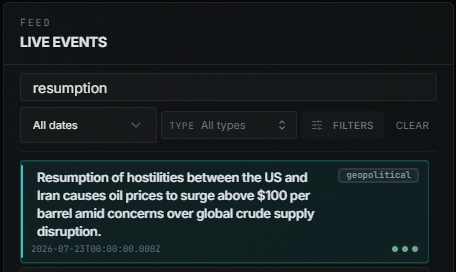
From that event, Tefkir reasoned outward to who was exposed. The logic on Chevron was direct: Chevron is a major oil producer, its upstream revenue rises and falls with crude, so a sharp move up in oil should lift Chevron. Higher prices, higher realized revenue per barrel, a straightforward long.
- The verdict

The reasoning runs in a straight line. Oil supply out of the Middle East is under threat, so crude spikes.
Chevron is a major oil producer, and a producer sells its oil at the market price. So when crude goes up, the same barrels bring in more money.
Chevron's own earnings history confirms it: its upstream profits rise and fall with the price of crude. Tefkir checked the other side too, whether anything offset that link, and found nothing material. No company-specific problem, no reason Chevron wouldn't benefit from higher prices like every other producer.
Event, exposure, and impact all lined up in the same direction, so the position was a long.
- The reasoning
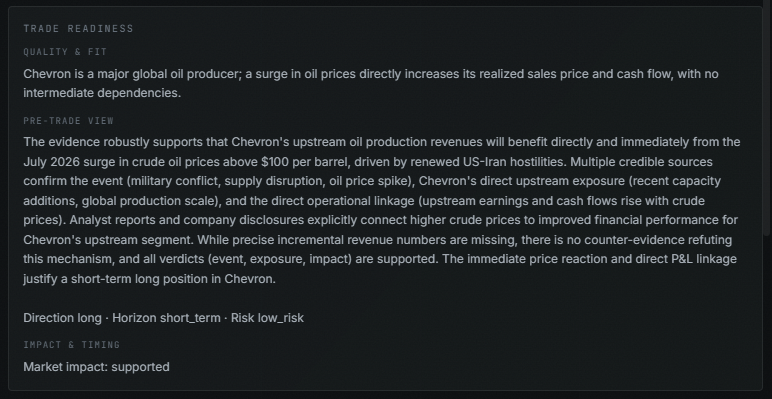
So the thesis was clean. And that is what makes this trade worth showing, because it still lost. Whatever went wrong, it wasn't the reasoning.
With the thesis in place, Tefkir took the trade. It went long Chevron, waited for the price to confirm before committing, and set its stop and targets the way it always does. From here, it was the market's move.
And the market moved the other way. The oil spike that started the whole thesis didn't hold. Almost as soon as the conflict escalated, steps toward de-escalation began, and the fear that had driven crude above 100 started to drain out of the price. Oil gave back its spike.
Chevron followed it down. This is the part worth sitting with: the thesis was right. Chevron's price did track crude, exactly as the reasoning said it would. The mechanism worked perfectly. It just worked in the wrong direction, because the thing underneath it, the high oil price, had already reversed.
- The position
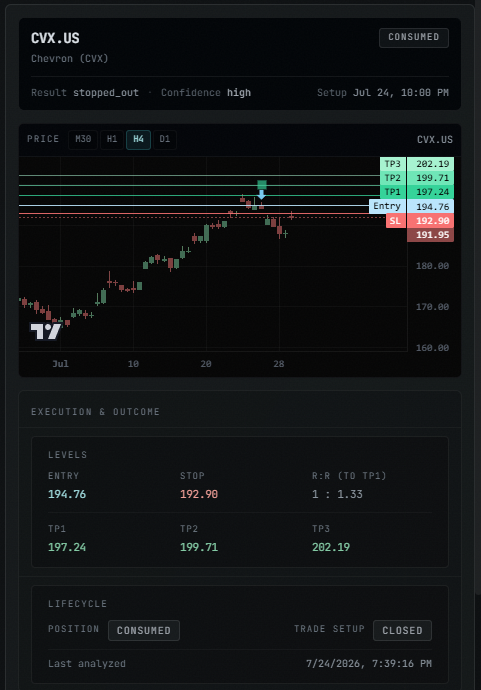
The stop did its job, and the position closed at a loss.
THE LESSON
A thesis is only as durable as the event underneath it. Tefkir reasoned correctly about what the oil spike would do to Chevron, but it treated the spike as a stable fact when it was anything but. A geopolitical panic is one of the least durable catalysts there is. It can reverse as fast as it formed, and when the catalyst goes, everything built on it goes too, no matter how sound the reasoning on top was.
That is the gap we are working on now. It is not enough to judge whether an event matters and who it touches. The system also has to weigh how long an event is likely to hold, and treat a fragile, reversible catalyst differently from a durable one. That is an active piece of what we are building.
This is also why the trade had a stop in the first place. We can be wrong, or right about the wrong thing, and either way the position has to be survivable. The reasoning failed to account for how quickly the catalyst could reverse, and the stop is what made that failure cost a defined, bounded amount instead of an open one. A good system doesn't avoid losses. It makes sure the losses it takes are ones it can afford.
That is the trade, start to finish. The thesis, the entry, the reversal, and the loss, all of it visible, because that is the point. The reasoning was sound. The catalyst wasn't durable. That distinction is the whole lesson.