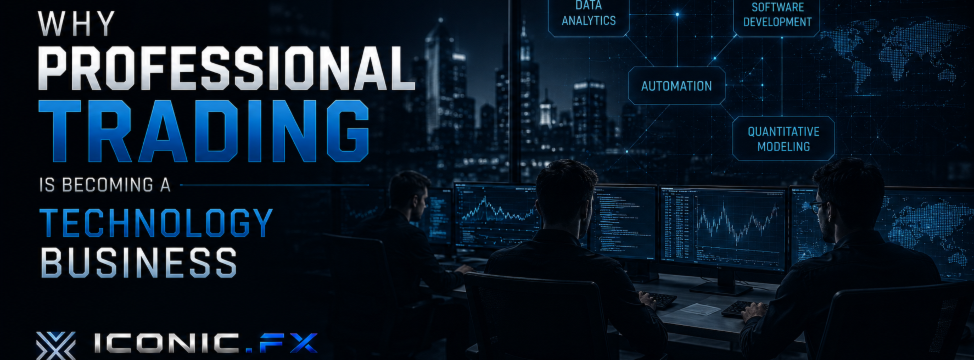
Why Professional Trading Is Becoming a Technology Business

Why Professional Trading Is Becoming a Technology Business
The world's top trading operations are increasingly hiring engineers, mathematicians and data scientists, not chart analysts. This is not a vague industry impression, it is a documented, current hiring pattern. Recent analysis of hedge fund recruitment describes the industry as laser focused on what is directly termed the quantitative mind, masters of data and technology, alongside a genuine, accelerating tech arms race pulling hiring emphasis toward foundational software engineering, high performance systems, and real time data processing, with compensation for quantitative talent carrying advanced technical degrees rising sharply as a direct consequence. Technology and software engineering roles specifically are described as especially in demand at quant driven funds, with total compensation packages reaching well into six figures and beyond. This is a long, deliberately thorough investigation into exactly why this shift is happening, what it actually means at the level of daily operations, and why the specialized, technology built trading systems this shift has produced are not a side effect of this transformation, they are its direct, natural output.
Part One: The Historical Shift From Discretionary Judgment to Quantitative Infrastructure
Professional trading was not always a technology business. For decades, the archetype of a successful trader was a discretionary decision maker, someone reading charts, interpreting news, and applying accumulated market intuition built through years of direct experience. This model produced genuine, well documented success for a long period, but it carried a structural limitation that became increasingly apparent as markets themselves grew more complex, more interconnected, and more heavily populated by automated participants, a single human's capacity to process information, however skilled, is fundamentally bounded in a way a properly engineered system's capacity is not.
The shift toward quantitative infrastructure did not happen because discretionary skill stopped mattering entirely. It happened because the specific advantages technology offers, processing dramatically more information simultaneously, applying decisions with total consistency, operating without fatigue across genuinely continuous markets, became too significant to ignore as competing operations increasingly adopted them. Once a meaningful share of any market's participants operate with this technological advantage, operations without it are not merely at a disadvantage, they are competing against opponents who can see, process, and react to more of the market than they structurally can, regardless of individual skill or experience.
Part Two: The Role of Software Engineering, Building the Infrastructure Trading Actually Runs On
Software engineering inside a modern trading operation is not a support function bolted onto the real work of trading decisions. It is frequently the actual substrate everything else depends on. Building genuinely reliable execution infrastructure, systems that correctly handle order routing, correctly manage state across a crash or a connectivity interruption, and correctly enforce risk boundaries without exception, requires the same rigorous engineering discipline that any mission critical software system demands, not the casual scripting approach that characterizes a large share of retail automation. This is precisely why current hiring data shows technology and software engineering roles commanding some of the highest compensation in the entire industry, the discipline is genuinely scarce, and genuinely difficult to substitute with any other kind of expertise.
This engineering discipline shows up directly in how a serious trading system is actually built, not merely in the strategy logic itself, but in the surrounding infrastructure, atomic state persistence protecting a system's accumulated learning from corruption during an unexpected crash, transaction filtering ensuring a system's own learning process cannot be contaminated by unrelated activity on the same account, and carefully engineered efficiency ensuring a system's internal checks run in constant time rather than degrading as complexity grows. None of this is visible in a marketing screenshot. All of it is precisely what separates infrastructure genuinely built to survive live deployment from a script that merely demonstrates well in a controlled environment.
Part Three: The Role of Data Science, Turning Raw Market Activity Into Genuine Signal
Data science inside modern trading operations addresses a problem software engineering alone cannot solve, extracting genuine, statistically meaningful signal from an overwhelming volume of raw market activity, most of which is genuine noise rather than exploitable structure. This requires the same rigorous discipline data science applies in any other domain, genuine out of sample validation, honest statistical calibration, and a disciplined skepticism toward patterns that look compelling in a specific historical sample but fail to generalize to new, unseen conditions, exactly the discipline covered in depth elsewhere in this series regarding overfitting and genuine statistical robustness.
The specific techniques modern data science brings to trading extend well beyond simple pattern recognition. Genuine causal inference, distinguishing a real, directed relationship between two markets from mere correlation that can silently break down, statistical calibration, ensuring a system's stated confidence genuinely tracks its realized accuracy rather than an arbitrary, ungrounded number, and rigorous validation methodology, walk forward testing against data a model never touched during its own development, are all data science disciplines borrowed directly from broader machine learning and applied statistics, not techniques invented specifically for trading, and their genuine, correct application is precisely what separates a data science informed trading system from one merely using data science flavored vocabulary without the underlying rigor.
Part Four: The Role of Automation, Consistency at a Scale No Human Can Match
Automation solves a genuinely different problem than either software engineering or data science alone address, ensuring that whatever genuine edge a system's underlying logic and statistical validation actually demonstrated gets applied with total, unwavering consistency, trade after trade, without the emotional deviation covered in depth elsewhere in this series. A validated strategy's true expectancy assumes perfect execution of every rule. Automation is the mechanism that actually delivers that perfect execution in practice, rather than the degraded, emotionally modified version human execution structurally tends to produce even among genuinely skilled, experienced traders.
Automation also solves a scale problem no human execution can match regardless of skill or discipline. Continuously monitoring multiple markets, applying consistent risk logic across every single position simultaneously, and reacting to genuine opportunity the instant it appears rather than whenever a human happens to be watching, are capabilities that scale automation offers structurally, independent of how skilled or disciplined any individual human operator happens to be.
Part Five: Why This Shift Is Accelerating Right Now, Not Simply Continuing a Slow Trend
Current hiring data describes this transformation using language considerably more urgent than a gradual, ongoing evolution, a genuine tech arms race, with compensation for quantitative talent carrying advanced technical degrees rising sharply as competing operations race to secure a genuinely scarce pool of people who can build and maintain this infrastructure correctly. This acceleration is not occurring in isolation. It reflects the same broader forces covered throughout this series, markets moving toward continuous, always on trading structures, an ever growing share of total volume flowing through automated participants, and genuine artificial intelligence capability maturing rapidly enough that operations without it are increasingly competing against opponents who structurally see and process more of the market than they can.
Analysis of this hiring trend explicitly frames a modern hedge fund as, at its core, an asset manager applying cutting edge technology, a genuinely striking reframing of what the institution fundamentally is. Not a collection of skilled discretionary decision makers supported by some technology, but a technology operation whose core competitive advantage increasingly lives in its data infrastructure, its statistical rigor, and its engineering discipline, with investment decisions themselves emerging from that infrastructure rather than existing independently of it.
Part Six: What This Means for the Individual Trader Who Is Not Managing Institutional Capital
Here is where this broader industry transformation becomes directly, practically relevant well beyond institutional trading floors. The specific technical disciplines driving this shift, rigorous software engineering, genuine data science, disciplined automation, are not exclusive to operations managing hundreds of millions of dollars. They are increasingly accessible in packaged, deployable form to any individual trader willing to demand the same underlying rigor from the tools they choose to deploy, rather than settling for a simple indicator script wearing sophisticated sounding marketing language.
This is precisely the gap specialized, technology built trading systems exist to close, bringing genuine software engineering discipline, genuine data science validation, and genuine automated consistency to individual traders who will never personally hire a dedicated engineering team, but who can access architecture built by people who understand exactly what institutional grade infrastructure actually requires.
Part Seven: Software Engineering Discipline, Verified Directly in Deployed Architecture
Rather than describing software engineering discipline abstractly, it is worth showing exactly what it looks like when genuinely applied to a live trading system. ICONIC BTC AI+ demonstrates this directly, atomic state persistence protecting its entire learned intelligence against corruption from a crash or power loss during a save, transaction filtering by its own magic number and symbol ensuring its learning process cannot be silently contaminated by unrelated account activity, and position management deliberately running first on every tick specifically so protective logic survives even during a news related lockout. This is not marketing language describing engineering quality. It is the actual, verifiable behavior of working code, the same standard of discipline current hiring data shows the industry increasingly willing to pay premium compensation to secure.
ICONIC GOLD AI+ extends this same engineering rigor into its own specific reliability layer, a genuine xorshift random number generator replacing a lower resolution built in alternative specifically because higher quality randomness meaningfully improves the exploration process behind genuine online learning, and a self healing recovery mechanism specifically guarding against the rare case where a platform level event fails to register correctly, ensuring the system's own understanding of its positions cannot silently drift out of sync with reality. These are not features a marketing team invents to sound impressive. They are the unglamorous, essential engineering decisions that separate a system built for genuine, unattended live survival from one that merely performs adequately during a supervised demonstration.
Part Eight: Data Science Discipline, Verified Directly in Statistical Architecture
The flagship ICONIC KYBERNETIC AI+ demonstrates genuine data science discipline applied directly to trading architecture. Its Adaptive Conformal Inference confidence gate is a real, distribution free statistical calibration technique, continuously regulating the system's own stated confidence so its realized error rate genuinely converges toward an honest target, precisely the kind of rigorous, ongoing calibration a genuine data science practice demands rather than a fixed, unverified number set once and trusted indefinitely. Its binned Transfer Entropy causal gate applies genuine causal inference methodology, measuring the actual, directed flow of information between Bitcoin and Gold rather than assuming a convenient, potentially fragile correlation between them.
ICONIC TITAN AI applies this same rigor at the level of ensemble modeling, a genuinely established data science technique, running three independent neural networks and explicitly measuring the spread, the statistical disagreement, between their individual outputs as a direct, quantifiable uncertainty signal feeding back into the system's own confidence calculation. This is not an indicator dressed up in artificial intelligence language. It is a genuine, verifiable implementation of ensemble uncertainty quantification, a technique borrowed directly from serious applied statistics and machine learning practice, exactly the kind of data science discipline current industry hiring trends show becoming increasingly central to how professional trading actually operates.
Part Nine: Automation Discipline, Verified Directly in Consistency Architecture
Both ICONIC BTC AI+ and ICONIC GOLD AI+ demonstrate genuine automation discipline through hard, structurally enforced risk boundaries applied with total consistency regardless of recent trade outcomes, ATR based position sizing that scales honestly with real, current volatility rather than a fixed assumption, and a categorical, verified rejection of grid and martingale techniques anywhere in their architecture. This consistency is precisely what the broader industry shift toward automation is actually about, ensuring genuine, validated logic gets applied identically every single time, rather than filtered through the emotional deviation covered extensively elsewhere in this series.
The flagship ICONIC KYBERNETIC AI+ extends this automation discipline to portfolio level coordination itself, a three tier drawdown framework escalating automatically through defensive posture, a full trading halt, and emergency closure, and Stochastic Tunneling capital allocation continuously re optimizing the balance between Bitcoin and Gold exposure as conditions genuinely evolve, rather than a fixed, manually adjusted split requiring constant human oversight to remain honestly calibrated.
Part Ten: Why Chart Analysis Alone No Longer Constitutes a Complete Skill Set
This is worth stating directly rather than implying softly. Reading a chart and identifying a pattern remains a genuinely useful skill, and this article is not arguing discretionary market understanding has become worthless. What has genuinely changed is that chart reading alone no longer constitutes a complete professional skill set on its own, because the operations now competing most successfully combine that market understanding with rigorous engineering, genuine statistical validation, and disciplined automated execution, capabilities a purely discretionary approach structurally cannot match at scale. A trader who understands market structure deeply but has no framework for genuine statistical validation risks mistaking a small sample coincidence for real edge. A trader who understands genuine statistics but has no engineering discipline risks building something that looks sound in testing but fails to survive live deployment. The operations winning this current hiring war are not abandoning market understanding, they are demanding it be paired with genuine technical rigor rather than standing alone.
Part Eleven: The Specific Technical Disciplines Worth Understanding, Even as a Non Technical Trader
You do not need to become a software engineer or a data scientist yourself to benefit directly from understanding what these disciplines actually protect against, and understanding them equips you to evaluate any trading system, not merely the ones covered throughout this article, with genuine sophistication rather than trusting marketing language alone.
- Genuine out of sample validation distinguishes a system that has actually been tested against data it never touched during development from one merely fitted impressively to a single historical window it will never see repeated.
- Honest statistical calibration distinguishes a system whose stated confidence genuinely tracks its realized accuracy from one offering confident sounding numbers with no underlying discipline actually supporting them.
- Atomic, crash resistant state persistence distinguishes infrastructure genuinely built to survive an unexpected interruption from a script that quietly loses its accumulated learning the moment something goes wrong.
- Hard, structurally enforced risk boundaries distinguish genuine automation discipline from a system whose risk management exists as an easily disabled suggestion rather than unbreakable law.
Every one of these four disciplines maps directly to a specific mechanism verified throughout this article, and demanding evidence of all four before trusting any trading system, regardless of vendor, is precisely the informed evaluation standard this broader industry transformation should be teaching every serious trader, not merely the institutions currently racing to hire for these exact skills.
Part Twelve: Why This Transformation Will Only Deepen, Not Reverse
Current hiring data does not describe a temporary trend likely to reverse as market conditions eventually shift. It describes a structural transformation in what a trading operation fundamentally is, reinforced by every other force covered throughout this broader series, markets moving toward continuous, always on trading structures that reward automated, technology driven participation over discretionary, session bound decision making, an ever growing share of total volume already flowing through automated participants, and genuine artificial intelligence capability continuing to mature rapidly enough that the gap between technology driven and purely discretionary operations widens further with each passing year rather than narrowing. Betting that this transformation reverses, or even simply stalls, means betting against the same structural forces every other section of this broader investigation has independently confirmed are accelerating rather than slowing.
Part Thirteen: A Concrete Comparison, What Separates a Technology Business From a Trading Hobby
It is worth making this contrast genuinely concrete rather than leaving it abstract. A trading hobby, however well intentioned, typically involves a single person applying discretionary judgment, occasionally reinforced by a handful of indicators, with no genuine engineering discipline behind execution reliability, no genuine statistical validation behind claimed edge, and no automated consistency ensuring rules actually get followed under emotional pressure. A trading technology business, at any scale, applies genuine engineering discipline to execution infrastructure, genuine statistical rigor to validating any claimed edge before deploying real capital behind it, and genuine automation to ensure validated logic actually gets applied with the consistency its own backtested expectancy assumed. The gap between these two approaches is not a matter of sophistication for its own sake. It is the direct, structural reason one approach increasingly outcompetes the other as markets themselves grow more technologically saturated.
Part Fourteen: Why Individual Traders Increasingly Need to Choose a Side of This Divide
This is the uncomfortable practical conclusion the broader hiring trend covered throughout this article points toward directly. As professional trading operations increasingly organize themselves around genuine technology, genuine data science, and genuine automation, the competitive gap between technology equipped participants and purely discretionary ones widens correspondingly, not because discretionary skill has become worthless, but because it is increasingly competing against opponents who structurally process more information, execute with more consistency, and adapt more continuously than any individual human, however skilled, can sustain indefinitely. An individual trader does not need to personally become a software engineer or a data scientist to remain competitive inside this shifting landscape. They need to deploy technology built by people who genuinely are, rather than continuing to compete purely on discretionary judgment against an increasingly technology equipped field.
Part Fifteen: The Honest Limits of This Transformation, Stated Directly
Intellectual honesty requires acknowledging what this technological transformation does not solve, even at its most sophisticated. No amount of engineering discipline, statistical rigor, or automated consistency eliminates the fundamental uncertainty inherent to trading any genuinely liquid market, a truth covered in real depth elsewhere in this series. Technology does not manufacture edge that was never genuinely there to begin with, it preserves and consistently applies whatever genuine edge actually exists, precisely why the underlying statistical validation covered in Part Eight matters as much as the engineering and automation surrounding it. And no individual system, however well engineered, replaces the need for a trader to genuinely understand what they are deploying and why, the entire purpose of this article existing at the depth it does, rather than simply asserting trust in sophisticated sounding technology without genuine comprehension underneath that trust.
Part Sixteen: How to Evaluate Whether Any Trading System Genuinely Reflects This Technological Standard
Given everything covered throughout this article, a specific, actionable evaluation framework emerges directly. Ask whether a system's engineering has been described with genuine specificity, actual mechanisms such as atomic persistence or transaction filtering, rather than vague assurances of reliability. Ask whether any claimed statistical edge comes with disclosed validation methodology, genuine out of sample testing, rather than a single impressive historical curve presented without context. Ask whether risk enforcement is described as hard, structural law incapable of being overridden, rather than a configurable setting that could quietly be disabled under pressure. And ask whether the system continues learning and adapting after deployment, or whether it represents a single, frozen calibration trusted indefinitely regardless of how much real, live evidence has since accumulated. A system built with genuine technology business discipline can answer all four of these questions with real specificity. One merely borrowing the language of this transformation without the underlying substance typically cannot.
Frequently Asked Questions
Is professional trading genuinely becoming more focused on technology than discretionary skill? Current hiring data shows trading operations increasingly recruiting for quantitative and technical roles specifically, software engineers, data scientists, and quantitative researchers, with compensation for this talent rising sharply as competing operations race to secure genuinely scarce technical expertise.
Does this mean discretionary market understanding has become worthless? No. It means discretionary understanding alone no longer constitutes a complete professional skill set on its own, since the operations competing most successfully now pair that market understanding with genuine engineering discipline, statistical validation, and automated consistency.
What specifically does software engineering contribute to a trading operation that trading knowledge alone cannot? Reliable execution infrastructure, correct state management through crashes or interruptions, and structurally enforced risk boundaries, the same rigorous engineering discipline any mission critical software system requires, which a casual scripting approach structurally cannot replicate.
What does data science actually add to trading decisions specifically? Genuine statistical rigor for distinguishing real, repeatable structure from noise, honest confidence calibration, and genuine causal inference for understanding relationships between markets, disciplines borrowed directly from broader applied statistics and machine learning practice.
Why does automation matter even when a trading strategy itself is genuinely sound? A validated strategy's true expectancy assumes perfect, consistent execution of every rule. Automation is the mechanism that actually delivers that consistency in practice, removing the emotional deviation that structurally degrades even genuinely sound strategies under human execution.
Can an individual retail trader access this same level of institutional grade technology? Increasingly yes, through specialized trading systems built with genuine software engineering discipline, genuine statistical validation, and genuine automated consistency, bringing capabilities once exclusive to well resourced institutional operations into a deployable, individually accessible form.
Why is this technological shift expected to continue rather than reverse? It is reinforced by multiple independent structural forces, markets moving toward continuous trading structures, an ever growing share of volume flowing through automated participants, and artificial intelligence capability continuing to mature, all pointing in the same accelerating direction rather than suggesting any near term reversal.
What questions should a trader ask to evaluate whether a system genuinely reflects this technology business standard? Whether its engineering is described with genuine, specific mechanisms rather than vague reassurance, whether any claimed edge discloses genuine validation methodology, whether risk enforcement is structurally unbreakable rather than an optional setting, and whether the system continues adapting after deployment rather than relying on a single, frozen calibration.
The Hedge Funds Already Made Their Choice. The Only Question Is Whether You Will Too.
The world's most resourced, most competitively motivated trading operations are not debating whether to become technology businesses. They are actively racing to hire the engineers, mathematicians, and data scientists required to complete that transformation as quickly as possible, with compensation for that specific talent climbing accordingly. This is not a trend confined to institutions managing hundreds of millions of dollars. It is a direct, practical signal about what genuinely competitive trading now requires, engineering discipline, statistical rigor, and automated consistency, capabilities now available in deployable form well beyond the institutions currently racing hardest to build them internally.
Explore systems built around exactly this institutional grade discipline, including ICONIC TITAN AI for genuine ensemble based signal intelligence, ICONIC BTC AI+ and ICONIC GOLD AI+ for engineered, asset specific execution, and the flagship ICONIC KYBERNETIC AI+ for coordinated, statistically calibrated portfolio intelligence. Explore the complete lineup, including performance based copytrading, at iconicfx.tech. The technology business transformation covered throughout this article is not coming. It is already well underway, and the only remaining question is which side of that divide you choose to trade from.
Risk Disclaimer. Trading foreign exchange, cryptocurrencies, commodities and other leveraged financial instruments carries a high level of risk and may not be suitable for all investors. The high degree of leverage can work against you as well as for you. Past performance is not indicative of future results. Automated trading systems and Expert Advisors do not guarantee profits and can produce losses. Backtests and simulated results have inherent limitations and do not represent actual trading. ICONIC.FX provides software tools only and does not provide investment advice, portfolio management or financial recommendations. You are solely responsible for your own trading decisions. Seek advice from an independent licensed financial advisor if you have any doubts.
Part Seventeen: What This Transformation Looks Like Inside a Genuinely Modern Trading Operation, Step by Step
It is worth walking through what a genuinely modern, technology first trading operation actually looks like in practice, because the abstraction becomes considerably more concrete traced through an actual workflow rather than described only conceptually. A genuine idea for a trading strategy does not go directly into live deployment based on discretionary conviction alone. It first passes through rigorous data science validation, tested against historical data, then critically validated again against genuinely unseen, out of sample data the original development process never touched, exactly the discipline separating genuine statistical evidence from an impressive but ultimately meaningless historical coincidence.
Once validated, the strategy passes to software engineering, where genuine production grade infrastructure is built around it, reliable execution logic, crash resistant state persistence, and hard, structurally enforced risk boundaries that cannot be silently overridden under pressure. Only after both of these disciplines have been genuinely satisfied does the strategy move into live, automated deployment, where its validated logic is applied with total, unwavering consistency, continuously monitored, and continuously revalidated against fresh, live evidence as genuine market conditions evolve. This is a fundamentally different workflow than a discretionary trader noticing a pattern and simply acting on it, and the difference in reliability between these two approaches compounds directly into the difference in genuine, durable results between them over time.
Part Eighteen: Why This Shift Mirrors Transformations That Have Already Happened in Other Industries
Trading is not the first industry to undergo precisely this kind of transformation, and recognizing the broader pattern makes the current shift easier to trust rather than dismiss as a narrow, domain specific fad. Manufacturing shifted decisively from craft based production toward data driven, automated precision engineering over the course of decades, not because craftsmanship became worthless, but because data driven, engineered precision consistently outcompeted it at meaningful scale. Medicine has shifted substantially toward data driven, statistically validated treatment protocols, without eliminating the genuine value of clinical judgment, but increasingly requiring that judgment be paired with genuine statistical evidence rather than standing alone. Trading is undergoing precisely the same category of transformation, discretionary skill still matters, but it increasingly wins only when paired with the same rigorous, data driven, engineered discipline that has already reshaped nearly every other complex, competitive industry before it.
Part Nineteen: The Specific Compensation Signal Worth Taking Seriously
There is a direct, unusually honest signal embedded in the current hiring data worth dwelling on specifically. Compensation is not rising uniformly across every role inside these trading operations. It is rising specifically and sharply for quantitative talent carrying advanced technical degrees and genuine software engineering capability, a market signal considerably harder to fake or exaggerate than marketing language, since real compensation reflects what sophisticated, deeply resourced organizations are actually willing to pay for, under genuine competitive pressure, rather than what sounds impressive in a recruiting brochure. When the organizations with the strongest possible incentive to identify genuine competitive advantage consistently pay premium compensation for a specific category of skill, that compensation signal is itself powerful, independent evidence about where real, durable edge in this industry has actually migrated toward.
Part Twenty: Why Outsourcing and Global Talent Distribution Reinforce Rather Than Undermine This Trend
Current analysis of this hiring transformation notes a further, related development worth understanding, expanding research and development presence globally to access broader pools of quantitative and engineering talent, alongside deepening functional outsourcing across middle office and operational functions specifically so trading operations can remain leaner and more concentrated on core, technology driven investment research. This is not a contradiction of the broader technology business thesis, it is a direct reinforcement of it. Operations are not simply hiring more people indiscriminately, they are becoming more surgically focused on securing the specific, scarce technical talent that genuinely drives competitive advantage, while streamlining or outsourcing everything else that does not directly contribute to that core technological capability. This selective, focused restructuring is precisely what an organization does when it has genuinely concluded that a specific category of capability, in this case quantitative and engineering talent, is the actual source of durable competitive edge worth protecting and concentrating resources around.
Part Twenty One: What Happens to Trading Operations That Choose Not to Make This Transition
It is worth being direct about the likely trajectory for operations that continue relying purely on discretionary judgment without adopting the technological discipline covered throughout this article. They do not necessarily fail immediately or dramatically. They face a slow, structural competitive disadvantage against increasingly technology equipped opponents, precisely the same gradual, easy to miss erosion covered in depth elsewhere in this series regarding edge decay generally. A discretionary edge that once competed effectively against a market populated primarily by other discretionary participants faces a genuinely different competitive landscape once a meaningful share of that market's participants operate with the processing capacity, consistency, and continuous adaptation technology provides. This is not a dramatic, single moment of failure. It is a compounding, gradually widening gap, precisely the kind of slow erosion that catches unprepared participants considerably more off guard than a sudden, obvious shock ever would.
Part Twenty Two: Bringing Every Layer of This Transformation Together
Step back across everything covered throughout this article and the complete picture becomes unmistakable. Professional trading is not merely adopting technology as one tool among several. It is fundamentally reorganizing itself around technology as its core operating discipline, software engineering providing the reliable infrastructure everything else depends on, data science providing the statistical rigor separating genuine edge from noise, and automation providing the consistency ensuring validated logic actually gets applied as intended rather than degraded through human deviation. Current hiring data confirms this is not a gradual, decades long drift, it is an accelerating, urgently prioritized transformation, with compensation for the specific talent driving it rising sharply as competing operations race to secure a genuinely scarce resource.
None of this eliminates the fundamental uncertainty inherent to trading any genuinely liquid market, and none of this replaces the value of a trader genuinely understanding what they are deploying rather than trusting sophisticated sounding language blindly. What it does mean, directly and practically, is that the gap between technology equipped participants and purely discretionary ones will keep widening, not narrowing, and the systems built with genuine engineering, genuine statistical rigor, and genuine automated discipline are not a premium alternative to how professional trading works. They are, increasingly, simply what professional trading has already become.
Part Twenty Three: Why the Traders Who Understand This Shift Early Gain a Genuine, Compounding Advantage
There is a specific, compounding advantage available to traders who genuinely internalize this transformation before it becomes completely obvious to everyone else, and it deserves to be stated directly rather than left implicit. Technology adoption inside any competitive domain follows a recognizable pattern, early adopters capture disproportionate advantage precisely because they are competing against a field that has not yet caught up, while late adopters find themselves catching up merely to reach parity with what has already become standard practice elsewhere. Current hiring data places this trading specific transformation somewhere in its acceleration phase, urgent, well documented, and increasingly visible, but not yet universally adopted across every corner of the retail trading population. Traders deploying genuinely engineered, statistically validated, properly automated systems today are positioned considerably closer to the early adopter side of this curve than the traders who will eventually adopt equivalent discipline only once discretionary trading has become an obviously losing proposition against an overwhelmingly technology equipped field.
Part Twenty Four: A Final, Honest Word on What Technology Cannot Replace
This article has made an extensive, thoroughly evidenced case for why technology increasingly defines professional trading, and it would be intellectually dishonest to close without acknowledging directly what that technology genuinely cannot replace. Genuine understanding of why a system behaves the way it does remains irreplaceable, a trader who deploys sophisticated technology without understanding its underlying logic is not meaningfully different from a discretionary trader following a pattern they cannot actually explain, regardless of how impressive the technology surrounding them happens to be. Genuine judgment about which specific tools to trust, and how much capital to allocate behind them, remains a human responsibility no algorithm performs on your behalf. And genuine, disciplined patience, allowing a validated system's true statistical expectancy the number of trades it actually requires to manifest, covered in exhaustive depth elsewhere in this series, remains as essential in a technology first trading operation as it ever was in a purely discretionary one. Technology changes how professional trading is executed. It has not changed, and likely never will change, the fundamental human responsibility to genuinely understand, genuinely validate, and genuinely trust only what has actually earned that trust through real, disclosed evidence.
Part Twenty Five: The Question Worth Asking Before Your Next Trading Decision
Carry this single question forward from everything covered throughout this extensive investigation. When evaluating any trading approach, your own discretionary judgment included, ask honestly whether it reflects the genuine engineering discipline, genuine statistical rigor, and genuine automated consistency that increasingly defines how the most competitively motivated, best resourced trading operations on earth have chosen to operate, according to their own hiring decisions and their own compensation structures, not according to marketing language from any single vendor, including the ones covered throughout this article. The world's top trading operations have already answered this question with their hiring budgets. The question remaining is simply whether your own approach to markets reflects that same answer, or whether it still operates according to a model an increasingly technology saturated competitive landscape is quietly, steadily leaving behind.
Part Twenty Six: Why This Reframing Changes How You Should Read Every Future Piece of Trading Marketing
Once you genuinely internalize professional trading as a technology business rather than a discretionary art form supported by some tools, a specific, permanently useful filter emerges for evaluating everything you encounter afterward. A product description leaning entirely on emotional excitement, dramatic returns, and confident sounding promises, with no genuine specificity about its underlying engineering, its validation methodology, or its risk enforcement mechanics, is speaking the language of the discretionary trading era this article has documented is already being competitively left behind. A product description willing to specify its actual engineering mechanisms, disclose its actual validation approach, and describe its risk boundaries in genuinely structural, unbreakable terms is speaking the language current hiring data confirms the most competitively serious operations on earth have already fully adopted. This filter will not make every decision obvious or effortless. It will consistently point you toward genuine substance over confident sounding language, precisely the discipline this entire extensive investigation has been building toward from its very first sentence.
Part Twenty Seven: The Complete Picture, One Final Synthesis Before You Act on Any of This
Every thread covered throughout this extensive investigation converges on the same conclusion, arrived at independently through hiring data, through structural market analysis, through cross industry comparison, and through direct examination of what genuinely engineered trading architecture actually looks like once verified in working code rather than described in marketing language. Professional trading is not adopting technology as a helpful accessory to an otherwise unchanged discretionary practice. It is being fundamentally rebuilt around technology as its core operating discipline, with the organizations possessing the strongest possible incentive to identify genuine competitive advantage, and the deepest resources to act on that identification, already voting decisively with their hiring budgets and their compensation structures.
This transformation is not distant, theoretical, or confined to institutions you will never personally interact with. It is directly, practically accessible today through specialized systems built with genuine software engineering discipline, genuine data science validation, and genuine automated consistency, exactly the three pillars this article has walked through in depth, verified directly against real, working architecture rather than asserted through confident sounding language alone. The world's top trading operations made their choice, and they made it with real capital, real hiring budgets, and real competitive urgency behind that decision. The only remaining question, for every trader reading this, is whether their own approach to markets reflects that same clear eyed, technology first conclusion, or whether it still depends on a model an increasingly saturated, increasingly technologically sophisticated competitive landscape is quietly, steadily leaving behind with every passing quarter.