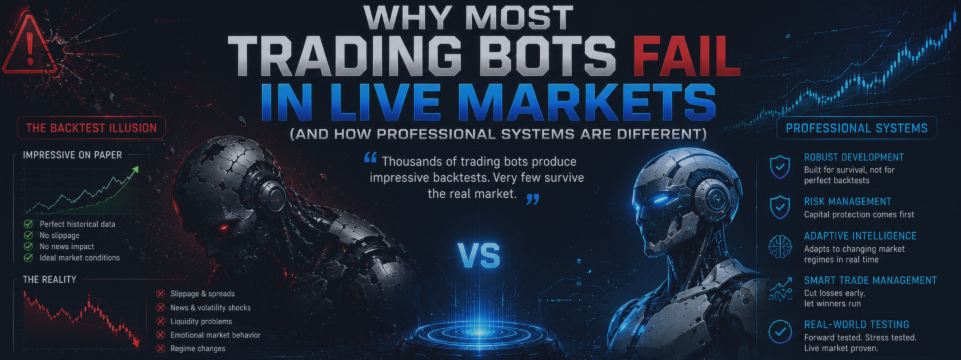

Thousands of trading bots produce impressive backtests. Very few survive the real market.
This is where the separation happens. Not inside the Strategy Tester. Not inside a perfect equity curve. Not inside a screenshot showing unrealistic historical growth. The real separation happens when the market goes live: spread, slippage, news, volatility, liquidity, execution quality, drawdown pressure and system stress.
Most trading bots do not fail because automated trading is impossible. They fail because they are built for the past, not for the future. They are optimized, but not robust. They are aggressive on entry, but weak on risk. They look powerful in a backtest, then break when real market conditions appear.
Professional systems are different. They do not only search for signals. They evaluate context. They protect capital. They adapt to market regimes. They manage trades actively. They accept that losses are part of the game — and they build defensive layers around that reality.
This article explains why most bots fail in live markets, why backtests alone are dangerous, how overfitting happens and what professional systems should bring to the table. This is especially important for highly volatile markets such as Bitcoin and Gold — exactly where systems like ICONIC BTC AI+ and ICONIC KYBERNETIC AI+ are positioned.
1. The Biggest Illusion: A Good Backtest Is Not Proof
A backtest is a tool. Not proof. Not a promise. Not a guarantee. It only shows how a strategy would have performed under specific historical conditions.
The problem starts when traders confuse a backtest with reality. In a backtest, many things are cleaner than they will ever be live. Data is complete. Candles are closed. Slippage is often simplified. Spread is often underestimated. Emotional interference is absent. Broker conditions are rarely simulated with full realism. And most importantly: in the backtest, the future is already known.
The live market is different. It is not clean. It is not polite. It is not static. It is a dynamic battlefield of liquidity, expectations, panic, algorithms, news events, stop hunting and sudden structural breaks.
A bot that only works in the laboratory is not a professional trading system. It is an optimized experiment.
2. Why Beautiful Equity Curves Can Be Dangerous
A perfect equity curve looks strong. It sells certainty. It creates trust. It triggers greed. That is why it is used so aggressively in bot marketing.
But professional traders know one thing: the more perfect a backtest looks, the more critical you should become.
Why? Because real markets are chaotic. No real system wins without friction. No robust model trades without drawdowns. No live system moves for years in an almost straight line when costs, spread, slippage and changing market conditions are treated realistically.
An overly smooth equity curve can be a warning sign. It may mean the strategy was fitted too tightly to the past. It may mean parameters were adjusted until historical data looked perfect. It may mean the bot has not learned to trade the market — it has only memorized history.
3. Overfitting: When the Bot Memorizes the Past
Overfitting is one of the main reasons trading bots fail in live markets.
Overfitting happens when a system is adjusted so strongly to historical data that it performs extremely well there, but reacts poorly to new data. The bot does not recognize real market structure. It recognizes patterns that happened to work in the past.
It is like a student who does not understand mathematics but memorizes the answers from old exams. As long as the same exam appears, he looks brilliant. As soon as new questions appear, the system collapses.
In trading, the market never gives you the exact same exam twice.
Typical Signs of Overfitting
- The bot only works on one specific symbol.
- The bot only works during one specific historical period.
- The bot requires extremely precise parameter values.
- Small parameter changes destroy performance.
- The equity curve looks unrealistically smooth.
- Spread, slippage and commissions were not simulated harshly enough.
- The bot was optimized and evaluated on the same data.
- There is no serious out-of-sample validation.
A professional system should not depend on one perfect parameter combination. It should operate inside a stable range. If a bot only works when every setting is perfectly aligned, that is not robustness. That is fragility.
4. Curve Fitting: The Illusion of Control
Curve fitting is the dangerous sibling of overfitting. It happens when parameters are adjusted again and again until the historical curve looks attractive.
A moving average is changed from 50 to 47. Then to 46. Then the RSI filter is adjusted. Then the ATR distance. Then the time filter. Then the take profit. Then the stop loss. Eventually, the backtest looks powerful.
But what was really achieved?
Not necessarily a better strategy. Often just a better fit to historical noise.
The market does not reward historical cosmetics. The market rewards systems that can operate under uncertainty.
5. Optimized Is Not the Same as Robust
Many traders confuse optimization with quality. That is a mistake.
Optimization asks: which settings would have produced the highest profit in the past?
Robustness asks: which structure remains stable when the future behaves differently from the past?
That difference is massive.
An optimized bot can look perfect historically and fail completely live. A robust bot may look less spectacular in a backtest, but it can be much more stable in live conditions because it does not depend on one perfect scenario.
Optimized Bots Think in Maximum Historical Profit
- Maximum profit factor.
- Maximum historical return.
- Minimized backtest drawdown.
- Perfect parameter combination.
- Focus on visual appeal and sales impact.
Robust Systems Think in Survival
- Stable performance across different market phases.
- Controlled drawdown.
- Realistic trading costs.
- Adaptive risk and exit logic.
- Protection against regime shifts.
- Clear limits for losing days and capital exposure.
The difference is simple: an optimized bot wants to impress. A robust system wants to survive.
6. The Live Market Is Not a Backtest With Internet Access
Many traders underestimate the difference between simulation and live execution.
In the live market, the signal is only one part of the equation. What also matters is when the order arrives, at which price it is filled, how wide the spread is, how fast liquidity changes and whether the market still has the same structure after entry as it had before entry.
A weak bot sees a signal and trades. A professional system evaluates whether that signal is actually tradable under current conditions.
The Five Live-Market Enemies of Weak Bots
- Slippage: The real execution price is worse than expected.
- Spread Expansion: Trading costs rise exactly when the market becomes unstable.
- Regime Shifts: The market shifts from trend to range, from calm to panic, from structure to chaos.
- News Shocks: News events can destroy technical setups within seconds.
- Losing Streaks: Without clear limits, the bot scales its own mistakes.
A bot that ignores these factors is not professional. It is naive automation.
7. Why the Entry Is Overrated
Retail traders search for the perfect entry. Professional systems search for controllable risk.
That is a completely different mindset.
An entry is only a hypothesis. Nothing more. The bot says: under these conditions, a move may develop. After that, the market decides. If the market confirms the hypothesis, the trade must be managed properly. If the market invalidates it, the system must react.
Many bots fail because they become stupid after the entry. They open positions but do not manage them intelligently. They have a signal, but no plan for escalation, reduction, exit, protection or pausing.
8. Risk Management Is the Core of a Trading System
A trading bot without strong risk management is like a sports car without brakes. Impressive until the first corner.
Professional risk management starts before the trade, continues during the trade and only ends when the system is neutral again.
Before the Trade
- Is the market structure clean?
- Is volatility tradable?
- Is the spread acceptable?
- Are there relevant news events?
- Does the setup match the current market regime?
During the Trade
- Is the trade developing as expected?
- Should the stop be adjusted?
- Should risk be reduced?
- Are there signs that the original idea is no longer valid?
- Should the trade be closed earlier?
After the Trade
- Was the trade structurally correct?
- Was the exit executed cleanly?
- Should the system learn from the result?
- Is the daily risk limit still intact?
- Should the system pause for the day?
This is why professional bots are not just signal machines. They are risk architectures.
9. Why Bitcoin Destroys So Many Bots
Bitcoin is not a calm market. BTC is fast, aggressive, volatile and often driven by liquidity. Moves can look technically clean and still reverse violently. Breakouts can explode or fail instantly. Spreads and slippage can reshape the outcome of a strategy during stressful periods.
A BTC bot therefore needs more than simple rules. It needs adaptive logic. It needs capital protection. It needs mechanisms for fast loss control. It needs intelligent stop and trailing structures. It needs protection against bad market phases.
ICONIC BTC AI+ is positioned exactly in that zone: a specialized MT5 Expert Advisor for Bitcoin with a focus on adaptive decision-making, capital protection, execution hardening, Smart Bail-Out, adaptive trailing stops, daily loss limits, max drawdown protection and circuit-breaker logic.
This matters because BTC does not forgive weak architecture. A fragile bot can survive for a while in quiet markets. In Bitcoin, its structure becomes visible. Fast. Brutal. Unmistakable.
10. Smart Bail-Out: Why Exiting Early Can Be Professional
Many traders believe a stop loss is enough. That is too simple.
A stop loss is the last line of defense. But professional systems can detect earlier when a trade is losing quality. If the setup no longer carries its original logic, there is no reason to wait until the full stop is reached.
Smart Bail-Out means the system attempts to identify weak trades earlier and reduce losses before they become unnecessarily large.
That is not fear. It is structural intelligence. Especially in BTC, an early exit can be the difference between a controlled loss and an unnecessary drawdown.
This is why such logic matters in systems like ICONIC BTC AI+: not every trade deserves to be held until the maximum stop.
11. Adaptive Trailing: Making Profit Is Not Enough — You Must Defend It
Many bots use fixed take-profit targets. That can work, but it is often too rigid.
The market does not move in fixed distances. Sometimes a trade continues cleanly. Sometimes it reverses just before the target. Sometimes momentum expands and offers more potential. Sometimes momentum dies earlier than expected.
Adaptive trailing aims to protect profits dynamically. The goal is not only to take profit. The goal is to give the market enough room without giving back too much open profit.
Professional systems need exactly that balance. A trailing stop that is too tight kills good trades. A trailing stop that is too wide gives too much back. Adaptive models try to align that decision more intelligently with volatility and market behavior.
12. Why Multi-Asset Systems Need a Higher Intelligence Layer
When a system trades multiple markets, it is no longer enough to look at every symbol in isolation.
BTC and Gold can both react to macro stress, liquidity flows, risk appetite and dollar dynamics. If a system ignores these relationships, it may unknowingly build duplicated risk.
A professional multi-asset system must understand portfolio risk. It must allocate budget. It must consider margin. It must control drawdown tiers. It must detect when several positions become dangerous together.
ICONIC KYBERNETIC AI+ follows an Omni-Nexus approach for BTCUSD and XAUUSD. The system combines Transfer-Entropy, Liquid State Machine, Physics-Informed Margin Axiom and Stochastic-Tunneling to structure portfolio harmonization, risk capping and budget allocation more intelligently.
That is a different level from a single bot blindly opening entries. This is about coordination. Capital flow. Portfolio risk. The question of when a market should be traded — and when exposure should be reduced.
13. Portfolio Harmonization: The Difference Between Many Bots and One System
Many traders stack bots. One BTC bot. One Gold bot. One Forex bot. One scalper. One trend follower. Each works alone. Each sees only its own signal. Each risks capital.
The problem is simple: the account sees all risks at the same time.
When several bots trade simultaneously, a portfolio is created. And a portfolio needs control. Without control, an account can become overloaded even if each individual bot appears to act correctly.
Professional systems therefore think not only in trades, but in total exposure.
ICONIC KYBERNETIC AI+ is positioned exactly in this category: not as a simple single-signal bot, but as a coordinating multi-asset system for BTCUSD and XAUUSD with a focus on portfolio harmonization, drawdown control, budget allocation and adaptive AI logic.
14. News Filters: Why Doing Nothing Can Be the Best Trade
Many weak bots trade all the time. That looks active. But it is often dangerous.
Professional systems must know when not to trade. Around major news events, technical logic can become worthless very quickly. A setup that looked clean minutes earlier can be destroyed by a single event.
A news filter is not a luxury. It is a protection mechanism. It reduces the probability of entering during uncontrollable market conditions.
This is especially important for Gold, BTC and other markets that react strongly to macro impulses, liquidity and risk appetite.
15. Regime Filters: Markets Change Their Character
A market can be trending today and ranging tomorrow. It can start calm and suddenly become explosive. It can show momentum and then shift into mean reversion.
A bot that applies the same logic all the time ignores this reality.
Professional systems need regime detection. They must distinguish whether the current environment fits the strategy. A breakout system in a tight range can bleed slowly. A mean-reversion system in a strong trend can be destroyed.
This is why hybrid regime filters and adaptive market validation matter. They help a system evaluate not only the signal, but the quality of the environment around the signal.
16. Why Capital Protection Is Not Optional
Capital is not just money. Capital is the ability to keep playing.
When capital is lost, the trader does not only lose account balance. He loses flexibility, clarity and the ability to use future opportunities.
That is why a professional bot must protect capital first. Returns come second.
Capital protection does not mean losses can be avoided. That is impossible. It means losses are limited, structured and controlled systematically.
Important Protection Mechanisms
- Daily loss limit
- Max drawdown protection
- Consecutive loss circuit breaker
- Adaptive lot size
- Margin governance
- News filter
- Regime filter
- Smart Bail-Out
- Adaptive trailing
Without these layers, a bot is not professional. It is exposed.
17. AI Is Not a Label. AI Must Have Function.
The term AI is used aggressively in trading. Many systems call themselves AI even though they are basically just simple rules under a futuristic name.
That is not enough.
AI must have a function. It must improve decisions. It must support adaptation. It must help estimate risk more intelligently. It must help evaluate patterns in context, not just detect them mechanically.
In ICONIC BTC AI+, the focus is on Bitcoin-specific adaptive decision logic, long-memory feature streams, Smart Bail-Out, adaptive SL/TP mechanisms, capital protection and execution hardening.
In ICONIC KYBERNETIC AI+, the focus moves toward coordinated multi-asset intelligence, portfolio harmonization, meta-labeling, experience replay, hybrid regime filters and risk-aware budget allocation.
These are not cosmetic terms. These are functional areas that become relevant exactly where simple bots fail live.
18. The Professional Checklist Before Going Live
Before a bot is deployed live, harder questions should be asked.
- Was the bot only optimized, or was it seriously tested for robustness?
- How does the system react to spread expansion?
- How does it handle slippage?
- Are there loss limits?
- Is there drawdown protection?
- Is there protection against losing streaks?
- Is there adaptive exit logic?
- Can the system identify poor market conditions?
- Is news risk considered?
- Can the system persist its internal state?
- Is there a clear symbol-specific logic?
- Is portfolio risk controlled?
If these questions cannot be answered, caution is required.
19. The Hardest Question: How Does This System Lose?
Most traders ask: how much can I make?
Professionals ask first: how does this system lose?
Because every system loses. The question is not whether losing phases will appear. They will. The question is whether the system can survive them in a controlled way.
Does the bot lose small or large? Can it recognize bad phases? Does it reduce risk? Does it stop after too many losses? Does it protect open profit? Does it close weak trades early? Does it understand when market conditions no longer fit?
These questions are more important than any backtest screenshot.
20. Why Aggressive Returns Without Defense Are Dangerous
Aggressive marketing sells returns. Professional architecture protects against ruin.
A bot can show high gains and still be dangerous if its loss logic is weak. High return without protection is not an advantage. It is accelerated risk.
The market only needs one bad phase to expose a fragile system.
That is why every aggressive growth logic must be supported by defensive architecture. If you want to scale capital, you must scale loss control. If you want to trade volatility, you must respect volatility. If you want to trade BTC, you must accept that this market eliminates weak systems brutally.
21. What Professional Systems Do Differently
Professional systems do not operate on hope. They operate on conditions.
They do not only ask: is there a signal?
They ask:
- Is the market environment suitable?
- Is the risk acceptable?
- Is execution reasonable?
- Is volatility tradable?
- Is the portfolio already overloaded?
- Is there news risk?
- Is the trade still valid after entry?
- Should risk be reduced?
This is the difference between automation and system architecture.
22. Why ICONIC BTC AI+ Matters for Bitcoin
Bitcoin needs specialized logic. Full stop.
BTC is too volatile, too fast and too aggressive for naive bot architecture. A BTC system must not only identify opportunities. It must defend capital. It must control losing phases. It must react flexibly to market conditions. It must manage trades actively.
ICONIC BTC AI+ is positioned for exactly that environment: a specialized MT5 Expert Advisor for Bitcoin with adaptive AI logic, Smart Bail-Out, adaptive stops, capital protection, execution hardening and protection mechanisms against critical losing phases.
If you want to automate Bitcoin trading, do not use toy logic. BTC demands systems that can handle stress.
Learn more: View ICONIC BTC AI+ on MQL5
23. Why ICONIC KYBERNETIC AI+ Matters for BTC and Gold
BTC and Gold are two markets with enormous psychological and macroeconomic relevance. Both can react to liquidity, risk appetite, uncertainty and global capital flows. If you trade both markets, isolated signals are not enough.
ICONIC KYBERNETIC AI+ follows a coordinated multi-asset approach for BTCUSD and XAUUSD. With portfolio harmonization, drawdown tiers, budget allocation, margin governance, Transfer-Entropy, Liquid State Machine, Physics-Informed Margin Axiom and Stochastic-Tunneling, it is not just about entry signals — it is about systemic risk control.
That is the point: a single bot trades a symbol. A professional system understands the account as one complete structure.
Learn more: View ICONIC KYBERNETIC AI+ on MQL5
24. Final Conclusion: The Market Separates Code From Architecture
Most trading bots fail because they are not real systems. They are rules. They are backtests. They are optimized versions of the past. They look good as long as the market behaves like it used to.
But the live market is not the past. The live market is now.
It is volatile. It is dynamic. It is brutally honest.
Professional systems are different. They accept uncertainty. They build defensive layers. They manage trades actively. They control risk. They react to regimes. They protect capital. They think not only in profit, but in survival.
If you take automated trading seriously, do not look for the bot with the most beautiful equity curve. Look for architecture. Look for risk logic. Look for systems built not only for backtests, but for the real market.
For Bitcoin: View ICONIC BTC AI+ on MQL5
For coordinated BTC and Gold architecture: View ICONIC KYBERNETIC AI+ on MQL5
Risk Disclaimer
Trading Forex, CFDs, cryptocurrencies and automated systems involves significant risk and may result in the loss of invested capital. Backtests, simulations and historical performance do not guarantee future results. This article is for informational and marketing purposes only and does not constitute financial advice, investment advice or a recommendation to trade.