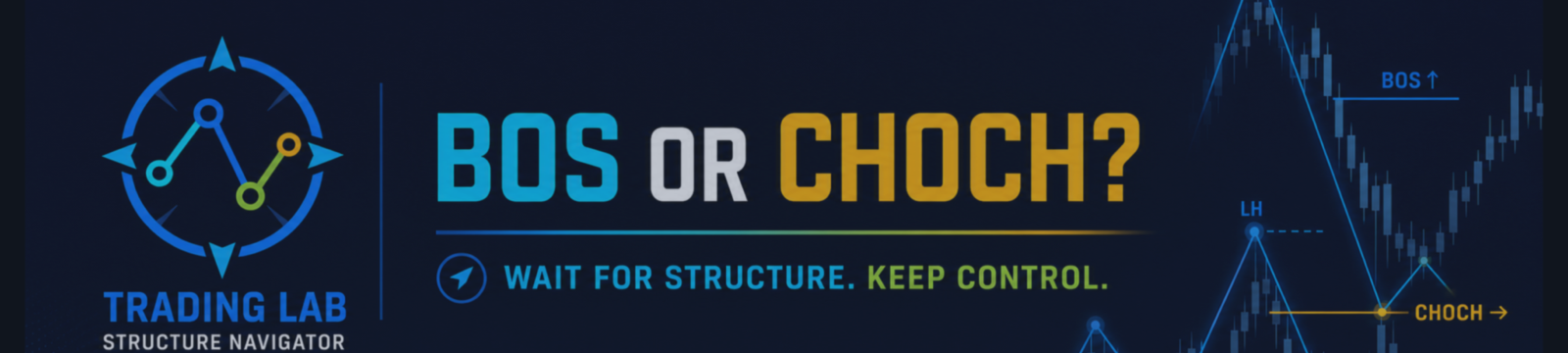

Wait for structure. Keep control.
A fast candle attracts attention, but movement alone does not provide a complete trading decision. Before reacting, a discretionary trader still needs to understand whether price is continuing an established structure, challenging it or simply creating noise.
This is where two familiar market-structure terms become useful: Break of Structure (BOS) and Change of Character (CHOCH).
They are not automatic signals. They are labels that help traders describe what price has already done.
The visual language of structure
Market structure is commonly described through four swing labels:
- HH — Higher High
- HL — Higher Low
- LH — Lower High
- LL — Lower Low
Together, these labels create a visual vocabulary. The objective is not to mark every fluctuation. It is to make important changes easier to recognize and compare across charts.
A consistent vocabulary is particularly useful for developing traders, chart review, mentoring and trading education. Two people may still disagree about an opportunity, but they can discuss the same visible structural events.
BOS: evidence of continuation
A Break of Structure generally describes price progressing beyond an important swing in the direction of the established structure.
The word important matters. Different timeframes contain different swings, and a movement that looks significant on one chart may be only a small internal fluctuation on another.
BOS therefore helps frame a continuation-oriented question:
Is the established structure still progressing?
It does not answer whether price is already extended, whether conditions are suitable for entry or how risk should be managed.
CHOCH: a reason to reassess
A Change of Character generally highlights behaviour that contradicts the previously established structure.
It is best treated as a reason to pause and reassess, not as proof that a complete reversal has begun. After a CHOCH, price may reverse, correct, consolidate or return to the previous direction.
CHOCH therefore frames a transition-oriented question:
Has market behaviour changed enough to challenge the previous interpretation?
That distinction is important. BOS can support a continuation reading. CHOCH can warn that the current reading deserves another look. Neither removes uncertainty.
The same event can tell different stories
Market structure is inseparable from timeframe context.
An upward break may look constructive on a lower timeframe while the broader chart remains bearish. A local bearish event may be only a pullback inside a larger bullish environment. When these layers disagree, the conflict itself is information.
This is why a useful manual workflow separates three perspectives:
- Big Picture — the broader environment.
- Structure — the chart used to organize swings and structural events.
- Execution — the chart used to observe the trader's manual entry process.
Alignment may produce a clearer narrative. Conflict may suggest patience. Neither condition guarantees an outcome.
The Trading Lab observation discipline
Rather than turning every label into a signal, use four simple actions:
Observe
Identify the visible structure without rushing to predict the next candle.
Frame
Place the event inside its broader timeframe and market context.
Wait
Allow price to show whether the structural area remains relevant. Avoid treating the first dramatic movement as an obligation to trade.
Decide
Make a separate manual decision about entry, invalidation and risk. A structural label is evidence for that decision, not the decision itself.
This discipline is intentionally simple:
Observe. Frame. Wait. Decide.
It encourages patience without pretending that uncertainty can be removed from the market.
What BOS and CHOCH should not become
BOS and CHOCH should not become decorative labels that justify a decision already made emotionally.
Before acting, a trader may still need to consider:
- broader directional context;
- current volatility and market activity;
- whether price is extended;
- spread and execution conditions;
- the location of invalidation;
- personal risk limits.
The exact interpretation belongs to the trader's method. The important habit is to keep observation, interpretation and execution as separate steps.
A workspace for manual observation
Trading Lab Structure Navigator was built around this philosophy for MetaTrader 5. It organizes multi-timeframe market context, visual swing structure and relevant state changes in one manual decision-support workspace.
It can help the trader observe and wait, but it never opens, modifies or closes orders. Its internal scoring, state evaluation and proposal logic remain part of the product rather than a public trading recipe.
Traders can examine the workflow through the Free Demo on the Trading Lab Structure Navigator product page.
Final thought
The purpose of market structure is not to make every chart look certain. Its purpose is to make uncertainty easier to organize.
Learn what price has confirmed. Recognize when behaviour changes. Keep the final decision in your own hands.
Wait for structure. Keep control.
Trading Lab Structure Navigator is an analytical and educational utility for manual decision support. It does not guarantee outcomes, provide automated execution or replace independent analysis and risk assessment.