
The Mathematics Behind Every Million Dollar Trader
The world's best traders do not think in profits, they think in probabilities. This is not a motivational slogan, it describes a genuinely different mathematical relationship with markets than most retail traders ever develop. This article moves past the basic expectancy explainer quickly, most of that ground has been covered thoroughly elsewhere, and spends its real depth on two areas most trading content skips entirely, the geometric mathematics of position sizing and survival, and the specific cognitive errors that distort how traders judge whether a system actually works.
Part One: Expectancy, Stated Concisely
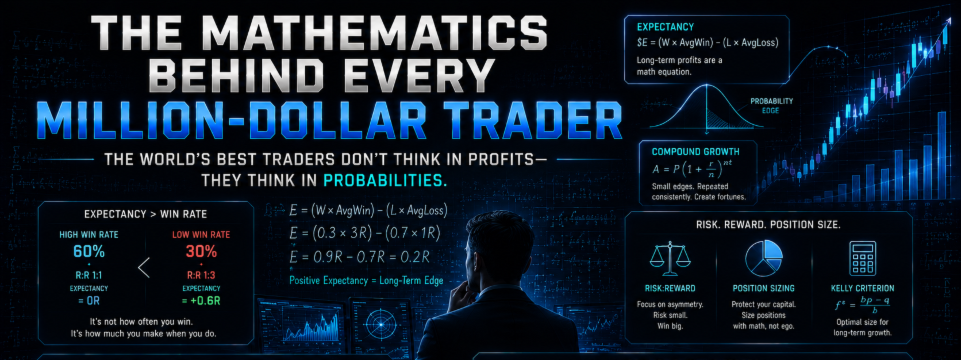
Expectancy multiplies win rate by average win, then subtracts loss rate multiplied by average loss, producing what a system genuinely earns on average per trade over a large enough sample. A system winning forty percent of the time with wins averaging three times the size of losses produces strongly positive expectancy despite losing on the majority of trades, while a system winning seventy percent of the time with losses twice the size of wins can quietly produce negative expectancy despite its impressive sounding win rate. This is the essential foundation everything else in this article builds on, and it deserves to be understood before moving further, but it is not, on its own, the deepest mathematics separating genuinely successful traders from everyone else.
Part Two: Position Sizing and the Mathematics of Survival, Not Just Profit
Here is the mathematics most traders never properly internalize. Losses and gains are not symmetric. A fifty percent drawdown requires a full one hundred percent gain simply to return to the starting point, and an eighty percent drawdown requires a four hundred percent gain, an asymmetry that makes capital preservation mathematically far more important than most traders intuitively appreciate.
The deeper, more advanced mathematics concerns how position sizing compounds over a long sequence of trades. Returns compound geometrically, not arithmetically, meaning the exact same average per trade edge can produce dramatically different long run outcomes depending entirely on position sizing discipline. A trader with genuinely positive expectancy on every individual trade can still produce negative long run geometric growth if position sizes are large enough that volatility itself erodes the compounding process, a phenomenon sometimes called volatility drag. In plain terms, betting too large, even with a real edge, can mathematically destroy the very compounding that edge was supposed to build, while betting sustainably, even at a smaller average per trade profit, allows genuine expectancy to compound cleanly over hundreds or thousands of trades. This is precisely why professional risk frameworks anchor position size to a defined, sustainable percentage of capital, allowing genuine edge to compound rather than allowing size itself to become the thing that eventually destroys the account.
Part Three: Why Low Win Rate Strategies Can Genuinely Outperform
The expectancy mathematics already explains the mechanism, but it is worth understanding why this truth resists intuition so persistently. Loss aversion, a well documented psychological bias, makes frequent small losses feel disproportionately painful compared to their actual mathematical cost, while infrequent large wins feel less emotionally satisfying than their actual mathematical contribution deserves. This emotional mismatch is precisely why so many traders gravitate instinctively toward high win rate approaches regardless of their underlying expectancy, the psychological experience of frequent small wins feels better moment to moment even when the mathematics quietly favors the opposite structure.
Part Four: The Cognitive Errors That Distort How Traders Evaluate Systems
This is where most trading education stops entirely, and it is precisely where genuine sophistication begins.
- Outcome bias. Judging a decision by its result rather than by the expectancy that genuinely justified it at the time. A single lucky win from a poor expectancy decision gets misremembered as validation, while a single unlucky loss from a genuinely sound decision gets misremembered as proof the approach is broken.
- Recency bias in system evaluation. Overweighting the last few trades when judging whether a system still works, rather than assessing performance across a statistically meaningful sample large enough to distinguish genuine signal from ordinary variance.
- Survivorship bias in strategy marketing. Only ever encountering the highlighted success stories of a strategy or trader, never the full, honest distribution of outcomes including the failures, badly distorting the perceived quality of any widely marketed approach.
- The gambler's fallacy in reverse. Believing a system is due for a win after a losing streak, or due for a correction after a winning one, when trade outcomes that are genuinely independent of each other carry no such memory regardless of how compelling the pattern feels.
- Mistaking small sample variance for genuine signal. Drawing strong conclusions from a handful of trades, when the sample size genuinely required to distinguish real skill from ordinary statistical variance is almost always considerably larger than intuition suggests.
Part Five: What This Actually Looks Like in Practice
Genuinely successful traders, and well engineered automated systems, share a common mathematical discipline, expectancy first thinking, position sizing calibrated for sustainable geometric compounding rather than maximum single trade profit, and active vigilance against the specific cognitive traps covered above rather than reacting emotionally to short term noise. The defined reward to risk structure inside ICONIC BTC AI+ and ICONIC GOLD AI+, where take profit is calculated as a deliberate multiple of stop distance, embodies exactly the expectancy first design covered in Part One, while their percentage based position sizing reflects the sustainable, survival oriented compounding discipline covered in Part Two. The regime bucket learning inside ICONIC KYBERNETIC AI+, requiring accumulated evidence before trusting any learned adjustment, functions as a structural defense against precisely the small sample variance trap covered in Part Four, refusing to overreact to a short, statistically meaningless sequence the way an emotional human trader so often does.
Frequently Asked Questions
Why does position sizing matter as much as having a real trading edge? Returns compound geometrically rather than arithmetically, meaning oversized position sizing can produce negative long run growth even with genuinely positive per trade expectancy, a phenomenon sometimes called volatility drag.
Why do humans resist the idea that low win rate strategies can be superior? Loss aversion makes frequent small losses feel disproportionately painful and infrequent large wins feel less satisfying than their actual mathematical contribution deserves, creating an emotional bias toward high win rate approaches regardless of underlying expectancy.
What is outcome bias in trading? Judging a decision by its result rather than by the expectancy that justified it at the time, causing lucky outcomes from poor decisions to be misread as validation and unlucky outcomes from sound decisions to be misread as failure.
How large a sample is actually needed to judge whether a trading system works? Considerably larger than most traders intuitively assume. Judging performance from a handful of trades routinely confuses ordinary statistical variance with genuine signal about a system's real underlying quality.
Probabilities Compound. Emotions Do Not.
The mathematics separating genuinely successful traders from everyone else was never a secret formula. It is expectancy, understood and respected, position sizing calibrated for survival and geometric compounding rather than maximum single trade excitement, and disciplined resistance to the specific cognitive traps that quietly distort how almost everyone else evaluates their own results.
Explore systems built around exactly this mathematical discipline, including ICONIC BTC AI+, ICONIC GOLD AI+ and the flagship ICONIC KYBERNETIC AI+, at iconicfx.tech.
Risk Disclaimer. Trading foreign exchange, cryptocurrencies, commodities and other leveraged financial instruments carries a high level of risk and may not be suitable for all investors. The high degree of leverage can work against you as well as for you. Past performance is not indicative of future results. Automated trading systems, indicators and Expert Advisors do not guarantee profits and can produce losses. ICONIC.FX provides software tools only and does not provide investment advice, portfolio management or financial recommendations. You are solely responsible for your own trading decisions. Seek advice from an independent licensed financial advisor if you have any doubts.