Why the Same EA Produces Different Results on Different Brokers (XAUUSD Reality)

At one point during testing, I ran into something confusing. The same EA, with identical settings, on the same symbol (XAUUSD), was producing different results across multiple accounts.
At first, I assumed something was wrong with the strategy. I checked the logic, parameters, and historical data - everything looked correct. But after repeating the tests across different environments, one thing became clear:
The difference wasn’t coming from the system. It was coming from how trades were executed.
🌟 What Actually Changes Between Brokers?
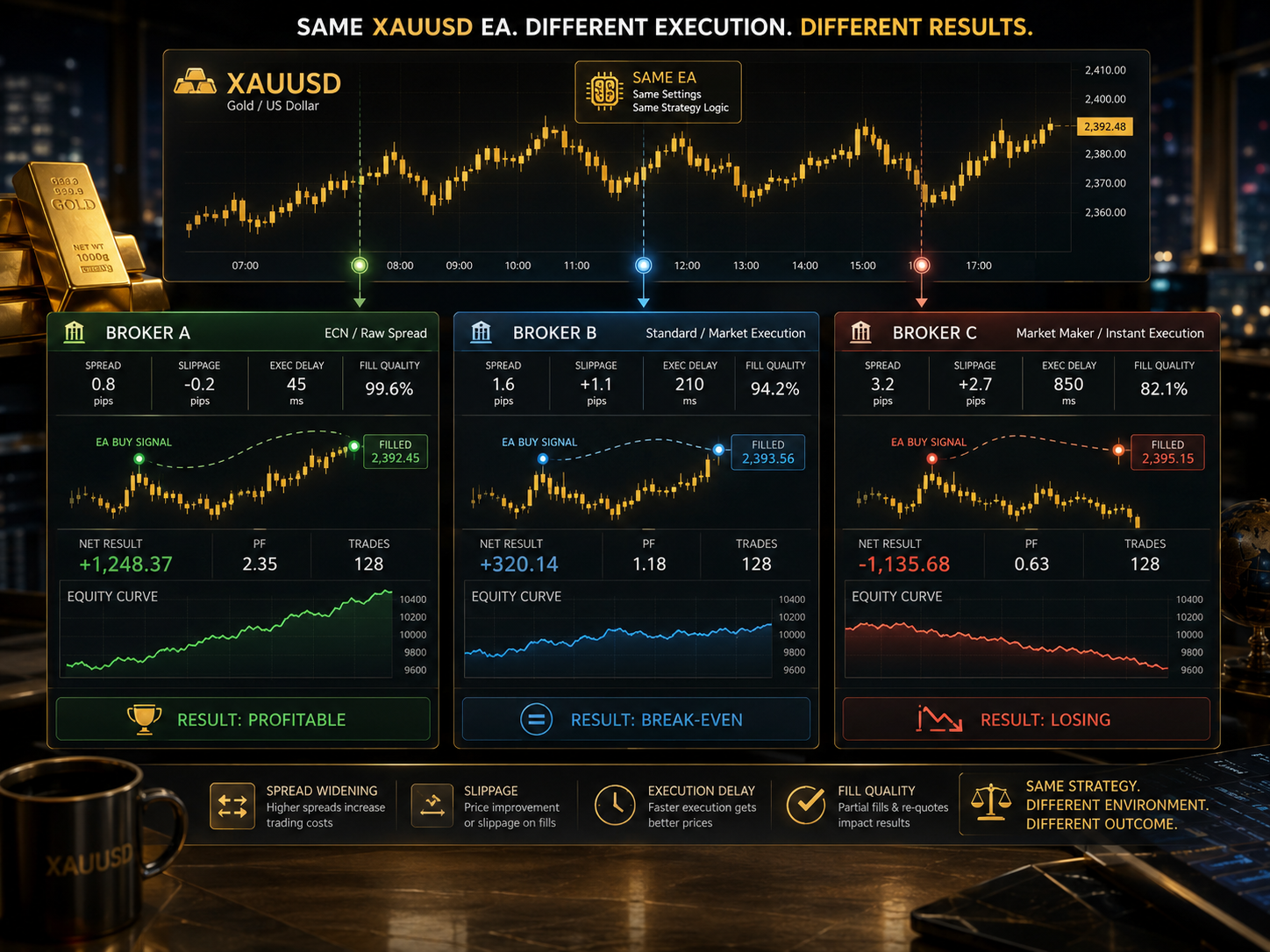
Most trading systems are built based on price data and execution assumptions. But in live trading, once an order is sent, the final result depends on factors that are not fully visible in backtesting:
✅ Spread
On XAUUSD, spread is not fixed. It can widen during rollover, news events, or low-liquidity periods - directly impacting both entries and exits. For systems with tighter profit margins, this alone can significantly change performance.
✅ Slippage
Gold moves fast, especially during active sessions and macro events. Orders are not always filled at the requested price. Even small slippage, when repeated over many trades, can shift the overall outcome of a system.
✅ Execution Speed
Some strategies rely on reacting to short-term price movements. If there is a delay between signal and execution - even by a small margin - the actual entry may no longer match the original setup.
✅ Order Fill Consistency
This is less obvious, but becomes clear over time. Two brokers can show similar quotes, but handle order execution very differently under real conditions - especially during volatility spikes.
🌟 Why This Is More Visible on XAUUSD
Gold behaves differently compared to most major currency pairs.
- Higher volatility
- Faster intraday movement
- Strong sensitivity to macro news
- Larger spread fluctuations
Because of this:
👉 Execution differences are amplified: A system that looks stable in testing may behave differently in live trading if execution conditions are not consistent.
👉 The tighter your strategy margin, the more execution quality matters.
🌟 A Practical Observation
When running the same EA configuration across different accounts, I’ve consistently observed:
- Trades closing earlier on one account due to spread expansion
- Entries slightly shifted because of execution delay
- Overall trade sequences remaining similar, but final results diverging
The strategy itself does not change. Only the trading environment does.
🌟 The Real Mistake Most Traders Make
When results don’t match expectations, most traders try to adjust the strategy. But in many cases:
👉 The issue is not in the logic
👉 It’s in the execution environment
Understanding this can save a lot of unnecessary optimization and overfitting.
🌟 Choosing a More Consistent Environment
This is not about finding a “perfect broker”. There isn’t one.
The real goal is simple:
👉 Reduce the gap between strategy design and real execution
In general, more consistent results tend to come from environments that offer:
- Relatively low and stable spreads (not just advertised)
- Fast and reliable execution
- Minimal slippage under normal conditions
- RAW / ECN-style account types
🔍 Matching Execution Environment to Strategy
Not all systems are equally sensitive to execution differences.
⚡ High-frequency/scalping systems
- Extremely sensitive to spread and execution speed
- Require tight spreads and fast execution
📊 Intraday systems
- Moderately sensitive
- Benefit from stable and consistent execution
📉 Swing systems
- Less sensitive to small execution differences
- Still benefit from overall stability
👉 The tighter the profit per trade, the more important execution becomes.
🌟 What This Means in Practice
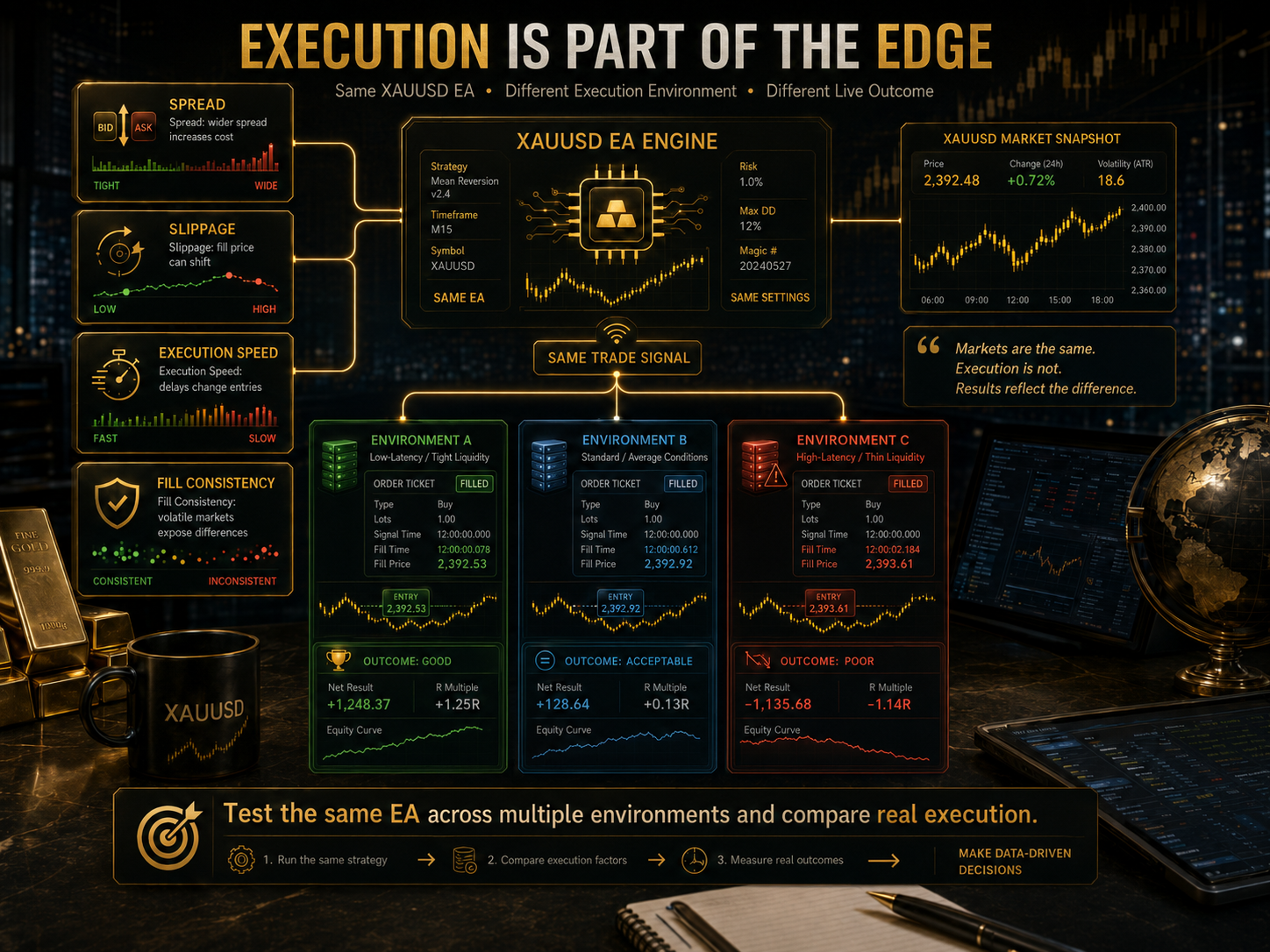
Instead of asking: “Which broker is the best?”
A better question is: “Which execution environment fits my strategy?”
Different brokers provide different execution profiles:
- Some focus on tight spreads + speed
- Some offer more stable fills
- Some are more accessible depending on region or account type
🚀 Broker Environments You Can Test (MT5)
From my own testing across multiple environments, I’ve seen clear differences in execution quality depending on the setup.
If your EA is sensitive to execution, even small differences here can impact your real results more than you expect.
If you want to see how execution affects your system in real conditions, the most practical approach is simple:
👉 Run the same EA across multiple environments and compare results
Here are some commonly used broker environments for MT5 and automated trading:
→ XM - flexible accounts, easy onboarding, multiple setups
→ IC Markets - low spread, fast execution (especially RAW accounts)
→ Tickmill - stable spreads and consistent execution under normal conditions
→ FxPro - multiple execution models depending on account type
→ AvaTrade - suitable for less latency-sensitive strategies
👉 You don’t need to guess - you can test it directly and see the difference yourself, often within just a few trading sessions.
📢 Important Notes
- The EA itself is not tied to any specific broker
- Different execution conditions will produce different results
- Strategy Tester results are typically more stable than live execution
- Differences become more noticeable during high volatility or news periods
👉 Short-term performance differences should always be interpreted carefully
🌟 Final Thoughts
If your live results don’t match what you expected from testing:
Don’t rush to change the strategy.
In many cases:
👉 The issue is not in the system
👉 It’s in how orders are executed
Backtesting assumes perfect execution. Live trading is an interaction between your strategy and the execution environment.
🔥 Final Conversion Trigger
If you’re serious about improving your results:
👉 Don’t just optimize your strategy
👉 Optimize where it runs
Because in real trading: Execution is part of the edge.
🎁 New to Gold Algo Lab?
Start with the Gold Algo Lab Tool Map - a practical guide that organizes our MT5 tools into 6 connected stages: market context, setup selection, risk planning, trade execution, position management and account protection.
→ Gold Algo Lab Tool Map: Where to Actually Start With MT5 Tools for XAUUSD
https://www.mql5.com/en/blogs/post/771930
Do not choose a tool by its name alone. Start with the part of your trading process that needs the most control, then build your workflow one layer at a time.
Gold Algo Lab builds practical, risk-first MT5 tools for serious XAUUSD traders, shaped by 8 years of developing and trading real systems to help traders identify clearer setups, manage risk with greater confidence and execute with more discipline.