The MetaTrader 5 Strategy Tester report contains more information than many traders realize.
Unfortunately, many users look only at one number:
Net profit.
If the net profit is high, they assume the Expert Advisor is good. If the equity curve looks smooth, they assume the strategy is reliable.
This is not enough.
A Strategy Tester report should be read as a risk and behavior document. It shows how the EA performed under specific historical test conditions. It does not guarantee future results, but it can help traders understand the strategy.
This article explains how to read the most important parts of a MetaTrader 5 Strategy Tester report — using a real backtest as a worked example throughout.
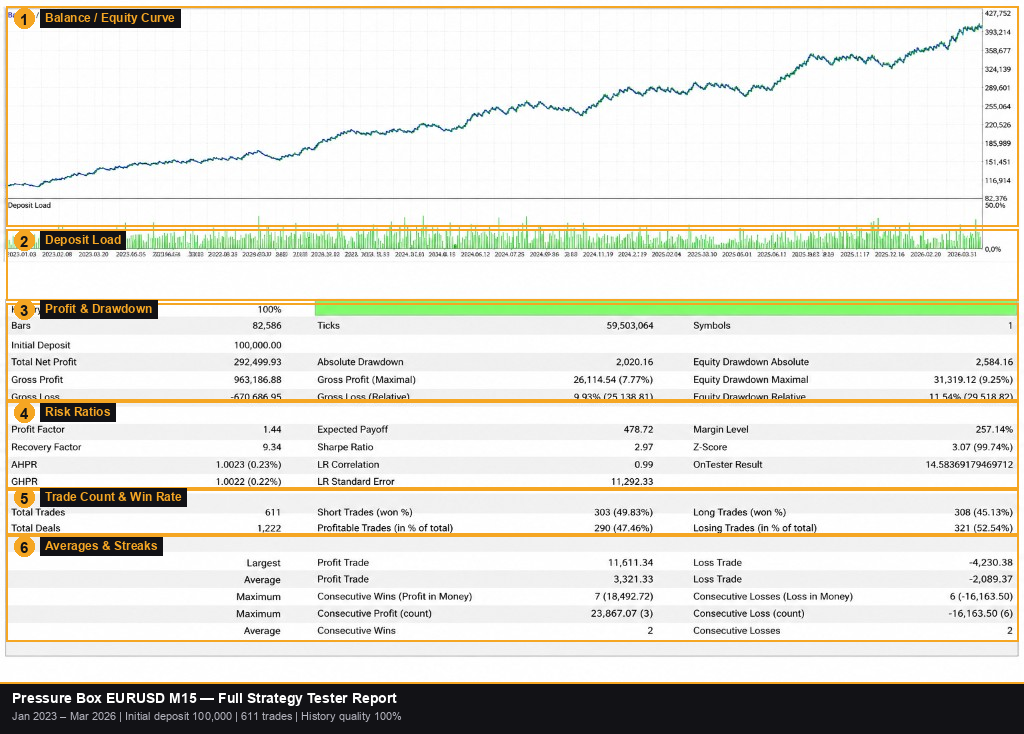
Worked example: Pressure Box EA on EURUSD M15, tested from January 2023 to March 2026, with an initial deposit of 100,000, history quality 100%, and 611 closed trades.
1. Net Profit

Net profit shows the final profit or loss after all closed trades in the test.
It is one of the most visible metrics, but it should never be viewed alone.
A high net profit may come from:
- strong strategy logic
- high risk settings
- one favorable market phase
- over-optimized parameters
- excessive lot size
- a few large trades
- unrealistic spread
- insufficient test period
A low net profit may also be misleading if the strategy has low drawdown and stable behavior.
Net profit answers only one question:
"What was the final result of this test?"
It does not answer:
"How much risk was taken to get there?"
That is why other metrics are essential.
In this report: Total Net Profit is 292,499.93 on an initial deposit of 100,000 — roughly +292% over the test period. That looks strong at first glance. But the gross loss alone was -670,686.95, meaning the strategy had to recover from substantial losing turnover to reach this result. Net profit is the headline, not the full story.
2. Gross Profit and Gross Loss

Gross profit is the total profit from all winning trades.
Gross loss is the total loss from all losing trades.
These numbers help show the balance between wins and losses.
For example, two strategies could both show net profit of 15,000:
- gross profit: 30,000 / gross loss: -15,000
- gross profit: 300,000 / gross loss: -285,000
Both tests have the same net profit, but the second system may have much higher turnover and risk.
Gross profit and gross loss help explain how the net profit was produced.
In this report: Gross Profit is 963,186.88 and Gross Loss is -670,686.95. The strategy generated nearly one million in winning trades — but also lost more than two-thirds of a million. Net profit of 292,499.93 is the difference between these two large numbers. This tells you the EA is active and turnover is high, not that every trade was a winner.
3. Profit Factor

Profit factor is calculated as gross profit divided by gross loss.
A profit factor above 1 means the strategy made more gross profit than gross loss during the test.
Example:
- gross profit: 20,000
- gross loss: 10,000
- profit factor: 2.0
Profit factor is useful, but it must be interpreted carefully.
A very high profit factor may be suspicious if:
- trade count is very low
- the test period is short
- the EA was heavily optimized
- spread assumptions are unrealistic
- the strategy uses too many filters
- there is no out-of-sample validation
Profit factor should be evaluated together with drawdown, trade count and stability.
In this report: Profit Factor is 1.44 (963,186.88 / 670,686.95). That is above 1.0 and confirms profitability — but it is moderate, not spectacular. Combined with 611 trades over three years and 100% history quality, this is a realistic figure worth taking seriously. It does not suggest a curve-fit miracle; it suggests a strategy that wins slightly more than it loses in gross terms.
4. Expected Payoff

Expected payoff shows the average result per trade.
It is calculated by dividing net profit by the number of trades.
Example:
- net profit: 10,000
- trades: 500
- expected payoff: 20 per trade
Expected payoff helps evaluate the statistical quality of a system.
However, it must be compared with trading costs.
If expected payoff is very small, spread and slippage can destroy live performance.
A strategy with a large expected payoff may be more robust to execution differences, but it still needs risk evaluation.
Expected payoff should not be viewed in isolation. It should be interpreted together with average win, average loss and trade distribution.
In this report: Expected Payoff is 478.72 per trade (292,499.93 / 611). On EURUSD M15, that is a meaningful buffer above typical spread costs — but slippage, commission and live spread widening can still reduce it. Always compare expected payoff with your broker's real execution costs before going live.
5. Absolute Drawdown

Absolute drawdown measures the decline below the initial deposit.
It shows how far the account fell below the starting balance during the test.
This metric is useful, but it is not always the most important drawdown measure.
If a strategy grows significantly and then suffers a large drawdown from a higher peak, absolute drawdown may not fully describe the risk.
That is why maximal and relative drawdown are also important.
In this report: Absolute Drawdown is 2,020.16 and Equity Drawdown Absolute is 2,584.16. The account barely dropped below the starting 100,000 at any point — a reassuring sign early in the test. But as the account grew to 300,000+, later drawdowns from higher peaks were much larger in absolute terms. Absolute drawdown alone understates the risk experienced during the later phase.
6. Maximal Drawdown
Maximal drawdown shows the largest drop from a previous equity or balance peak during the test.
This is one of the most important metrics in the report.
It answers:
"What was the worst historical decline during the test?"
A strategy with high net profit but very high maximal drawdown may be difficult to use.
Drawdown matters because it affects:
- account survival
- emotional pressure
- recovery time
- margin safety
- risk tolerance
- practical usability
Always evaluate net profit together with maximal drawdown.
A strong strategy should not be judged only by return.
It should be judged by return relative to risk.
In this report: Balance Drawdown Maximal is 26,114.54 (7.77%) and Equity Drawdown Maximal is 31,319.12 (9.25%). For a +292% return, a maximal equity drawdown under 10% is relatively controlled. Ask yourself: would you tolerate a ~31,000 drop from a peak while running this EA live? If yes, the risk profile may suit you. If not, reduce lot size before deploying.
7. Relative Drawdown
Relative drawdown expresses drawdown as a percentage.
This makes it easier to compare strategies with different deposit sizes.
For example:
- 2,000 drawdown on 10,000 account = 20%
- 2,000 drawdown on 100,000 account = 2%
Relative drawdown is often more intuitive than absolute currency values.
A trader should ask:
"Would I tolerate this drawdown in live trading?"
If the answer is no, the strategy or risk settings are not suitable.
In this report: Balance Drawdown Relative is 9.93% (25,138.81) and Equity Drawdown Relative is 11.54% (29,518.82). On a 100,000 account, an 11.54% equity drawdown means the account could have dropped by roughly 11,500 from a local peak. That is meaningful but not extreme for a multi-year trend-following style test. Relative drawdown makes this comparable to other EAs regardless of deposit size.
8. Recovery Factor

Recovery factor compares net profit to maximal drawdown.
It helps evaluate how efficiently the strategy recovered from risk.
A higher recovery factor can indicate better return relative to drawdown.
Example:
- net profit: 20,000
- maximal drawdown: 5,000
- recovery factor: 4.0
However, recovery factor should not be viewed alone.
It can be inflated by short favorable periods, aggressive risk or over-optimization.
A useful recovery factor must be supported by sufficient trade count, realistic costs and stable performance across time.
In this report: Recovery Factor is 9.34 (292,499.93 / 31,319.12). The strategy earned roughly 9 times its worst equity drawdown — a strong efficiency ratio. Supported by 611 trades and a smooth equity curve (LR Correlation 0.99), this recovery factor looks credible rather than inflated by a single lucky month.
9. Number of Trades

The number of trades is critical.
A backtest with very few trades may not provide enough information.
If an EA made 500% from 10 trades, the result may depend heavily on one or two outcomes.
A higher trade count can provide more data, but too many trades may indicate overtrading or high cost sensitivity.
The trader should ask:
- Are there enough trades to evaluate the system?
- Are trades distributed across the whole period?
- Did one period produce most trades?
- Are long and short trades balanced?
- Does trade frequency match the strategy type?
Trade count provides context for every other metric.
In this report: Total Trades is 611 over roughly three years — about 17 trades per month on M15. Total Deals is 1,222 (entry + exit per trade). Short trades: 303. Long trades: 308. The distribution is balanced and spread across the full test window visible in the equity curve. This is enough data to evaluate the system statistically — unlike a backtest with 20 trades and a lucky streak.
10. Win Rate
Win rate shows the percentage of trades that closed profitably.
A high win rate feels attractive, but it does not guarantee profitability.
A strategy can have a high win rate and still lose money if losing trades are much larger than winning trades.
A strategy can have a lower win rate and still be profitable if average winners are much larger than average losers.
Win rate must be compared with:
- average profit trade
- average loss trade
- risk-reward ratio
- expected payoff
- drawdown
Win rate alone is not enough.
In this report: Profitable Trades: 290 (47.46%). Losing Trades: 321 (52.54%). The strategy lost more trades than it won — yet it is clearly profitable. This is the most important lesson in this report: win rate below 50% does not mean a losing EA. What matters is the size of wins versus losses. Read sections 11 and 12 together with this one.
11. Average Profit Trade and Average Loss Trade

These values show the average size of winning and losing trades.
They help explain the strategy's risk-reward profile.
For example:
- win rate: 70% / average win: 30 / average loss: 100 — may still struggle
- win rate: 40% / average win: 150 / average loss: 60 — may be profitable
The relationship between average win and average loss is more important than win rate alone.
In this report: Average Profit Trade is 3,321.33 and Average Loss Trade is -2,089.37. The risk-reward ratio is approximately 1.59:1 (3,321 / 2,089). With a 47.46% win rate and this RRR, the math works: winners are large enough to cover the slightly higher number of losers. Short trades won 49.83% of the time; long trades won 45.13% — a slight directional bias toward shorts, worth noting when evaluating market conditions.
12. Largest Profit and Largest Loss
The largest winning and losing trades can reveal outlier dependency.
If one large trade creates most of the profit, the strategy may be less stable than it appears.
If one large loss creates most of the drawdown, risk controls may need improvement.
Traders should ask:
- Does the strategy depend on one huge winner?
- Is the largest loss acceptable?
- Are outliers reasonable for the strategy type?
- Would the result remain positive without the largest winner?
Outlier analysis helps prevent false confidence.
In this report: Largest Profit Trade is 11,611.34 and Largest Loss Trade is -4,230.38. The largest win is roughly 2.7 times the average win — noticeable but not extreme. Removing it would still leave net profit well above 280,000. The largest loss is about 2 times the average loss — within a reasonable range. No single outlier appears to carry the entire result.
13. Consecutive Wins and Losses

Consecutive losses are especially important.
They show the longest losing streak during the test.
A profitable strategy can still have long losing streaks.
The trader should ask:
- Can I tolerate this losing streak?
- Is risk per trade too high?
- Would this losing streak violate my account rules?
- Does the EA reduce risk after losses?
- Do losses cluster during certain market conditions?
A strategy must be survivable.
If a normal losing streak creates unacceptable drawdown, the risk setting is too high.
In this report: Maximum Consecutive Wins: 7 (+18,492.72). Maximum Consecutive Losses: 6 (-16,163.50). Average Consecutive Wins: 2. Average Consecutive Losses: 2. A 6-trade losing streak costing over 16,000 is the real-world stress test. Before going live, ask: if the EA hits 6 losses in a row tomorrow, would you keep it running — or panic and disable it? Your answer determines whether this risk setting fits your psychology.
14. Balance Curve

The balance curve shows the account balance after closed trades.
It is useful for visualizing closed performance.
A good balance curve may show:
- steady growth
- controlled drawdown
- reasonable recovery
- no sudden extreme spikes
- no long periods of deterioration
But balance alone can hide floating drawdown.
That is why the equity curve must also be reviewed.
In this report: The balance curve (blue line) shows steady upward growth from 100,000 to roughly 390,000 over three years. Drawdowns are visible as small step-backs but recovery is consistent. There are no sudden vertical spikes suggesting a single lucky trade, and no long flat periods suggesting the EA stopped working. The curve shape supports the statistical metrics — but always check equity alongside it.
15. Equity Curve
The equity curve includes floating profit and loss from open positions.
This is critical.
A strategy may have a smooth balance curve but a dangerous equity curve if it holds losing trades for a long time.
A gap between balance and equity can reveal hidden risk.
Traders should be careful with strategies where:
- equity drawdown is much larger than balance drawdown
- floating losses remain open for long periods
- positions are averaged without clear limits
- balance looks smooth but equity is unstable
The equity curve often tells the real risk story.
In this report: The equity curve (green line) tracks closely with the balance curve throughout the test. The gap between them is minimal — equity drawdown maximal (9.25%) is only slightly above balance drawdown maximal (7.77%). This suggests the EA closes trades rather than holding large floating losses. That is a healthy sign. If the green line had dipped far below blue for extended periods, hidden risk would be a concern.
16. Trade Distribution
Trade distribution shows when and how trades occurred.
Important questions include:
- Are trades spread across the full test period?
- Are profits concentrated in one month or year?
- Does the EA stop trading for long periods?
- Are losses clustered?
- Does performance depend on one market phase?
- Are long and short trades both reasonable?
A strategy with distributed performance is usually more meaningful than one that depends on a single lucky period.
Distribution matters.
In this report: The equity curve spans January 2023 to March 2026 with consistent activity throughout — no multi-month gaps. Deposit load bars appear regularly across the timeline, confirming ongoing trade activity. Profit growth is distributed across the period rather than concentrated in one spike. With 303 short and 308 long trades, both directions contributed. This distributed profile adds confidence compared to a backtest where 80% of profit came from one quarter.
17. Long vs Short Results
Some reports separate long and short trade performance.
This can reveal directional imbalance.
For example:
- long trades profitable / short trades losing — may suggest bullish-only edge
The trader can then decide whether to:
- trade only one direction
- improve filters
- adjust settings
- test other market periods
- avoid unsuitable symbols
Long/short analysis helps understand strategy behavior.
In this report: Short Trades: 303 (49.83% won). Long Trades: 308 (45.13% won). Shorts performed slightly better, but both directions are active and neither is dramatically worse. This suggests the strategy logic works in both directions on EURUSD M15, not only in trending bull markets. If short win rate had been 20%, you would want to disable short trading or investigate the short entry logic.
18. Deposit Load and Margin

Margin-related metrics can be important, especially for EAs using multiple positions.
The trader should check whether the EA uses excessive margin.
High margin usage can create risk during drawdown or volatility spikes.
Important questions include:
- How much margin is used?
- Could positions survive adverse movement?
- Does the EA open multiple trades?
- Is leverage dependency too high?
- Could a margin call occur under stress?
Performance is irrelevant if margin risk is uncontrolled.
In this report: Deposit Load bars stay well below the 25% mark throughout the test — mostly in single digits. Margin Level is 257.14%, meaning equity was typically more than 2.5 times the used margin. This is conservative. The EA is not running near a margin call threshold. Even during the maximal drawdown phase, there appears to be sufficient margin buffer. This makes the backtest result more practically usable than a strategy running at 80% deposit load.
19. Tester Graph Interpretation
The graph should be read carefully.
A good graph is not only one that rises.
Look for:
- smoothness
- drawdown depth
- recovery time
- sudden jumps
- long flat periods
- equity vs balance gaps
- acceleration caused by compounding
- performance concentration
A graph can be visually persuasive but still risky.
Do not let the curve replace analysis.
In this report: The equity curve is smooth with LR Correlation 0.99 — nearly linear growth. Drawdowns are shallow and recovery is quick. No sudden jumps or long flat periods. Compounding is visible in the later phase as the curve accelerates upward — expected when lot size scales with equity. Sharpe Ratio 2.97 confirms strong risk-adjusted returns. The graph is visually persuasive — but only meaningful because the underlying statistics (611 trades, moderate profit factor, controlled drawdown) support it.
20. Final Evaluation Checklist
When reading a Strategy Tester report, ask:
- Is net profit positive?
- Is drawdown acceptable?
- Is profit factor realistic?
- Is expected payoff meaningful?
- Is recovery factor reasonable?
- Are there enough trades?
- Is performance stable across time?
- Are losses manageable?
- Is equity behavior healthy?
- Are costs realistic?
- Is risk per trade reasonable?
- Does the result depend on one outlier?
- Does the EA match the stated strategy?
Only after these questions are answered should the report be considered useful.
Applied to this report:
| Net profit positive? | Yes — 292,499.93 |
|---|---|
| Drawdown acceptable? | Equity max 9.25% — moderate |
| Profit factor realistic? | 1.44 — credible with 611 trades |
| Expected payoff meaningful? | 478.72 — above typical spread |
| Recovery factor reasonable? | 9.34 — strong |
| Enough trades? | 611 over 3 years — yes |
| Stable across time? | Yes — distributed growth |
| Losses manageable? | Max 6 consecutive, -16,163 |
| Equity healthy? | Minimal balance/equity gap |
| Costs realistic? | Verify spread settings used |
| Outlier dependency? | Low — largest win not dominant |
| Matches strategy? | Pressure Box logic on EURUSD M15 |
21. Final Thoughts
A MetaTrader 5 Strategy Tester report is not a guarantee.
It is a diagnostic document.
It helps traders understand how an EA behaved under specific test conditions.
The most important metrics include:
- net profit
- drawdown
- profit factor
- expected payoff
- recovery factor
- trade count
- win rate
- average win and loss
- consecutive losses
- balance and equity curve
- trade distribution
The Pressure Box EURUSD M15 backtest demonstrates a key principle: a strategy with a win rate below 50% can still be robust if average winners exceed average losers, drawdown is controlled, and trade count is sufficient. The report looked impressive at first glance (+292% net profit). Reading it fully revealed the real profile — moderate profit factor, manageable drawdown, honest win rate, and conservative margin usage.
A professional trader does not judge an EA by one number.
A professional trader reads the full report.
Rules over emotions.
Statistics over opinions.
Risk control before performance.
Risk Notice
Trading foreign exchange, CFDs and other leveraged products involves significant risk and may not be suitable for every trader. Strategy Tester reports, backtests and historical simulations do not guarantee future results. Expert Advisors can produce losses, and no automated system can guarantee profits. Always test carefully and use risk settings that match your personal risk tolerance.