Directional CLM
- Индикаторы
- Версия: 4.30
- Активации: 5

Directional CLM (Composite Liquidity Metric)
Most oscillators tell you what price did. CLM tells you what price earned.
Directional CLM measures how much movement the market actually achieves per unit of friction and participation, then converts the persistence of that earned movement into a single directional conviction reading. A quiet, efficient glide that keeps earning ground builds conviction just as powerfully as a loud impulse — and a loud grind that travels nowhere, despite enormous effort, builds none. That distinction is the entire point of this pane: it separates markets that are working from markets that are merely moving.
What you see
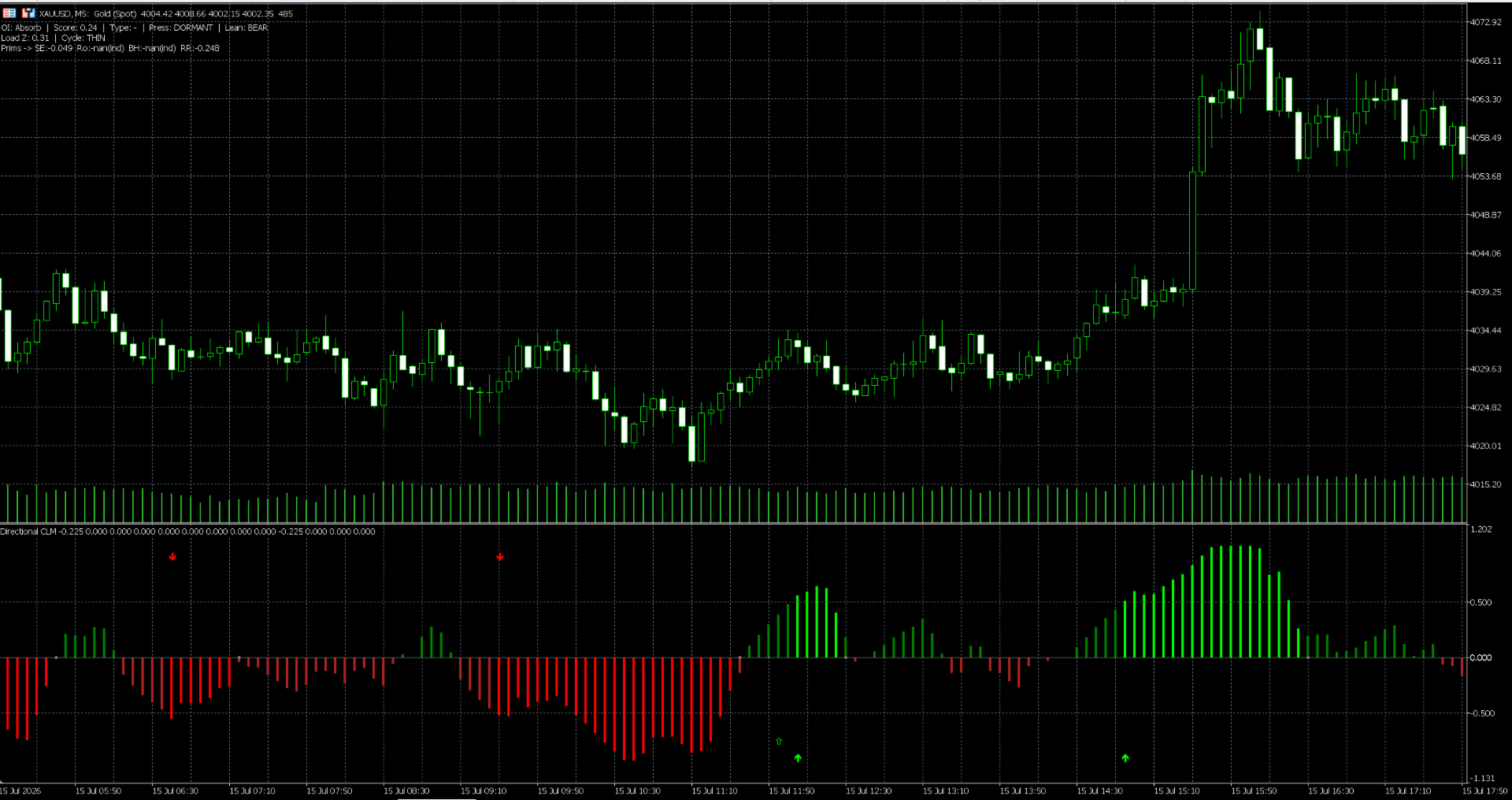
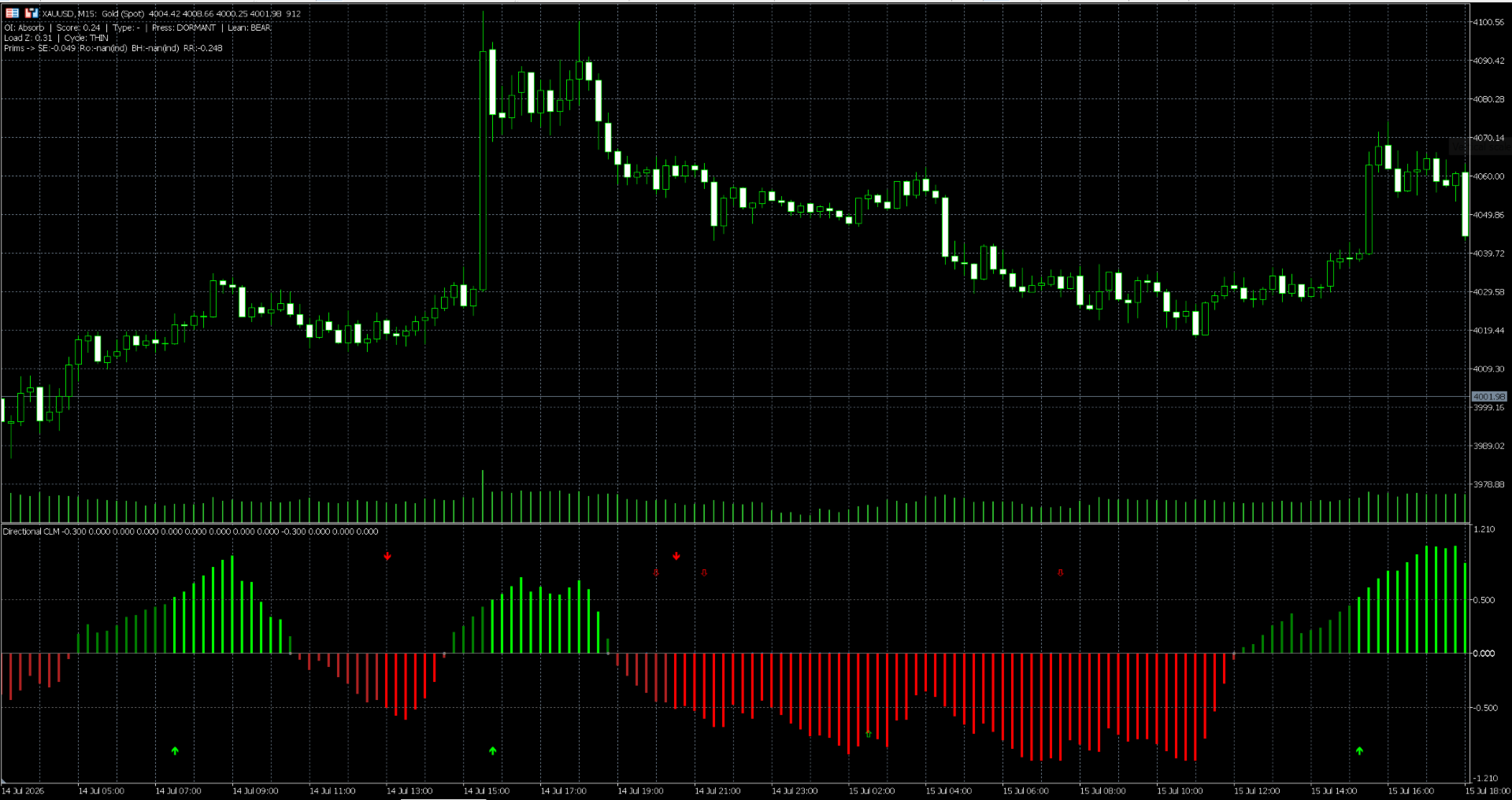
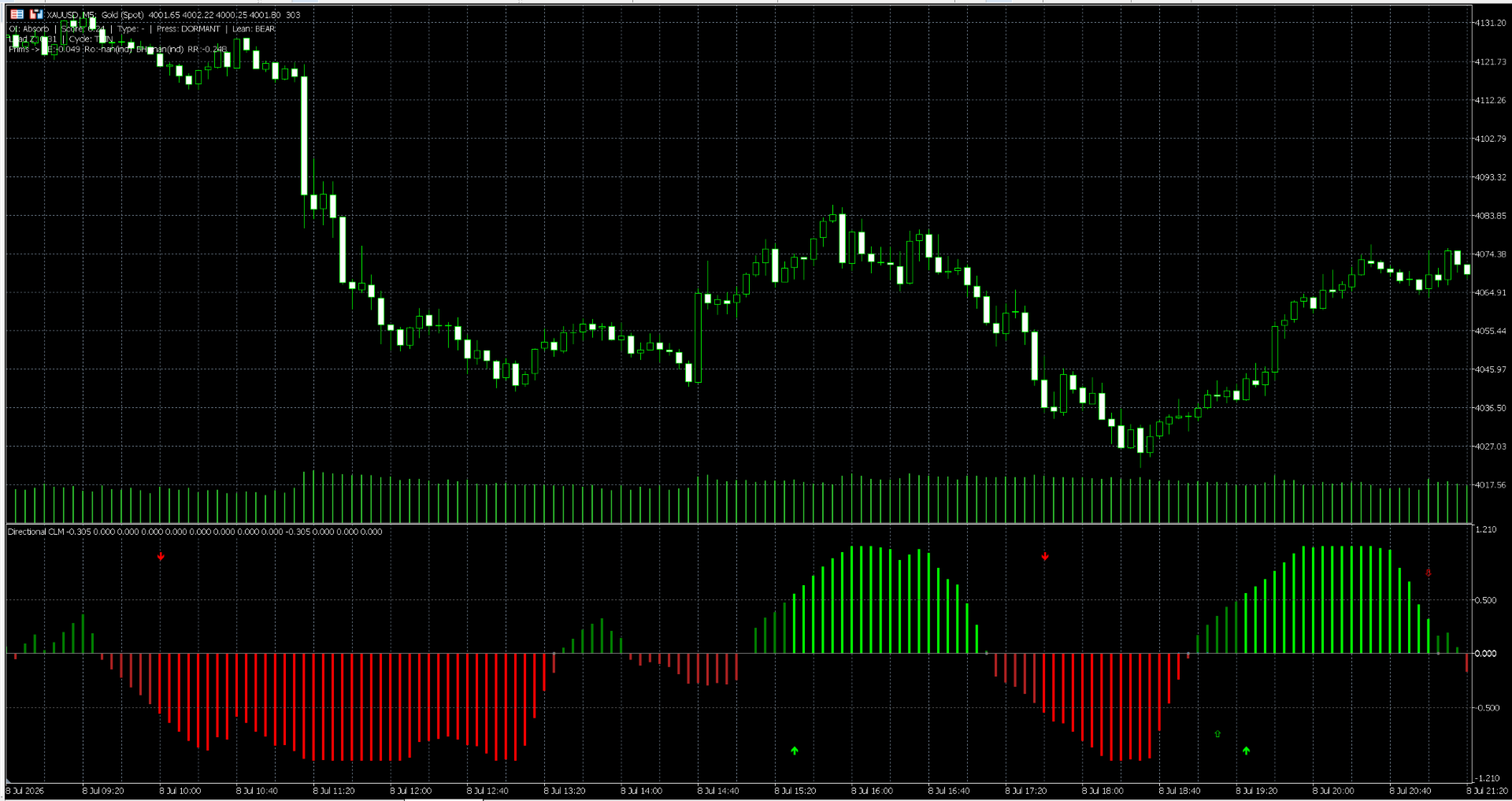
Conviction columns — the core output. They build toward +1 or −1 as evidence accumulates and decay when it stops arriving. Conviction is earned slowly and lost quickly by design: flow against the held direction erodes the reading at a penalty, so stale calls die fast.
Commit / release markers — the pane commits to LONG or SHORT only when conviction clears its commit level, and releases to NEUTRAL when it falls below its release level. The two levels are separate, so the state doesn't flicker at the boundary.
Compression dots — the pane detects when the market's friction falls unusually far below its own norm and marks the compressed stretch on the zero line.
Ignition arrows — when compression releases and the directional signal is strong enough, an ignition arrow fires in the direction of the flow. Arrows are graded: bright for high-intensity releases, dark for standard ones.
Nothing is ever hidden. Signals modulate in intensity — brightness, magnitude — but every bar always shows its reading. You are never left guessing whether the indicator is "off".
Why it behaves consistently across instruments
Every internal quantity is measured against its own recent typical amplitude, continuously. There are no fixed lookback windows in the decision path, and no percentile ranks. The practical consequence: the same visual reading means the same thing on a calm session and a violent one, and the pane does not need re-tuning every time volatility regime shifts.
Additional machinery
Quiet guard — when participation drops well below its reference norm, conviction building freezes (existing conviction ages naturally; it doesn't teleport). Thin tape can't manufacture a commitment.
Counter-move absorption — when a swing runs against the held conviction while showing absorption characteristics, conviction is eroded toward zero. It disarms; it never flips. A reversal must be earned from a neutral state.
Time-of-day adaptation (optional) — intraday, volume and friction can be compared against their typical value for that time of day, so session opens and dead hours are judged against their own norms.
Alerts
Pop-up alerts on closed bars for: commit LONG, commit SHORT, release to NEUTRAL, ignition long, ignition short, compression released.
For EA builders
The decision layer — conviction, state, compression and quiet-guard flags, plus every visible plot — is exposed as buffers for clean iCustom reading. Internal measurement series are not exported and cannot be extracted. Read closed bars (shift 1); the forming bar updates live by design. A volume source selector (tick / real) is provided — on futures with real volume, switch it.
Inputs (all behavioural — dial by feel, on a demo first)
Core Response: participation and resistance memories, efficiency and directional smoothing, effort and resistance weightings. Longer memories = steadier judgement; higher directional smoothing holds a leg's sign longer before it counts.
Scaling: how quickly the pane adapts to the instrument's current amplitude, and how aggressively the signal saturates.
Conviction: build rate, decay rate, opposing-flow penalty, commit and release levels. This group sets the personality of the pane — patient committer or fast trigger.
Absorption: swing sensitivity and the erosion rate applied when a counter-swing shows absorption.
Quiet Guard: the participation windows and the quiet threshold.
Compression & Ignition: compression strictness, minimum duration, ignition strength and grading.
Honest notes
Behaviour depends on the instrument's liquidity profile and timeframe. It was developed and refined on gold micro futures on intraday charts; other instruments work, but expect to spend time in the inputs before trusting the reading. That is normal and intended — the defaults are a starting point, not a promise.
This is a decision-support instrument, not a signal service. It tells you when the tape is earning its movement; entries, exits and risk are yours.
No performance claims are made or implied.