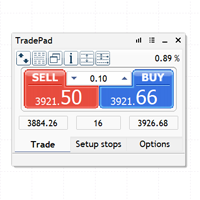
Mentaris Trade Manager
- Utilities
- Version: 3.2
- Updated: 6 October 2026
- Activations: 10

Mentaris Trade Manager
1. Trade management in one workspace
Mentaris is a MetaTrader 5 panel for managing open positions and pending orders, saving management settings, and reviewing closed trades. Set take profit (TP), stop loss (SL), profit protection, trailing and staged management rules while making trading decisions according to your own strategy. Live positions, settings and history are available within the same workspace. Mentaris does not predict market direction or create an investment strategy for you.
2. Four management modes
Beginner, Advanced, Expert and Scale In provide different management tools. In the Turkish interface these are Çırak, Kalfa, Usta and Kademeli Giriş. Their names describe functionality, not expected returns. Select the tools appropriate to each supported workflow rather than assuming that a higher mode produces better results.
3. Beginner: targets and Profit Lock
Set TP and SL amounts in the account currency and enable or disable the corresponding functions separately. Profit Lock manages a protective level on the profitable side of a position. Chart levels and panel values help you identify the rules applied to the selected trade.
You can also move the SL line to the profitable side of the entry price. Its profit-lock label does not automatically activate the separate Profit Lock function. When the separate function is disabled, the previously recorded SL is restored, subject to broker confirmation. Removing or restoring a stop is not reported as completed if the request fails.
4. Advanced: dynamic management and Scale Out
TP Step advances the profit target when its conditions are met. Trigger defines when dynamic protection starts, and Trail Gap determines the retracement allowance. Scale Out supports up to three stages with individual targets and closing volumes. Available volumes depend on the remaining position and the broker's minimum lot and lot increment rules.
5. Trail Gap as a fixed or trailing profit lock
In Advanced and Expert, when Trail Gap is enabled and Trigger is disabled, the control can operate as an independent fixed profit lock. Set its level on the chart and confirm it. This fixed level does not automatically follow every favorable price move. A newly confirmed lock observes subsequent movement; an earlier peak alone does not activate it.
With Trigger enabled, Trail Gap acts as the distance for dynamic trailing. As the favorable peak advances, the protective level advances. With unchanged settings, a price retracement alone does not loosen the trailing lock.
For example, with a USD account, an observed peak profit of 100 USD and a constant gap of 20 USD correspond to a target protective level of approximately 80 USD. At a peak of 120 USD, that becomes approximately 100 USD. This illustrates constant-gap trailing; additional dynamic rules may change the behavior. These are target levels, not guaranteed closing proceeds.
6. Expert: virtual stop, spread conditions and M1 confirmation
Expert adds a virtual SL, automatic or manual spread-limit selection and optional M1 confirmation. A virtual stop is monitored by Mentaris in the terminal; it is different from an SL accepted by the broker. M1 confirmation adds a waiting condition tied to a one-minute candle transition. Spread conditions can also delay the virtual stop. Loss can increase while waiting.
The catastrophe SL, when enabled, is a separate broker-side stop. The spread control governs the virtual-stop conditions; it is not a universal spread filter for all trading actions.
Optional Aggressive Trailing requires Trigger and Trail Gap to be enabled with positive values. In this mode, TP is a virtual target and the broker TP is removed. Normal trailing can use broker TP. Aggressive Trailing depends on terminal-side management and does not imply higher returns or lower risk.
7. Scale In: management by symbol and basket
Scale In groups relevant positions opened at different prices for basket management. Track direction, total volume and volume-weighted average entry, and define common targets. BUY and SELL sides are managed separately.
For a symbol assigned to Scale In, management follows the scale-in workflow; Beginner, Advanced and Expert are not used simultaneously for that symbol. This does not automatically assign other symbols to Scale In. The average-entry line excludes commission and swap and is not a guarantee of breakeven after all costs.
8. Basket SL as profit protection
When price and broker stop-distance rules permit, move the common SL into the profitable side of the basket's average entry: above it for BUY, below it for SELL. Drag the line and confirm with OK to request the common level for the relevant members. A subsequent return to that level is intended to trigger their stops.
This is protection at a selected SL price, not automatic Trail Gap tracking. Commission, swap, slippage and gaps can prevent a positive result after costs.
9. TP/SL changes from a phone or tablet
While desktop MT5 and Mentaris are running, a broker-accepted TP or SL change made on a basket member from a phone or tablet connected to the same account is detected. The changed level is applied at the same price to relevant members of the same symbol and direction. Changing only TP preserves SL; changing only SL preserves TP. Other symbols and the opposite direction are not included.
Mentaris runs on the desktop, not on the mobile device. Connection and trading permissions must remain active, and each update is subject to broker rules. An already accepted remote change replaces an older unconfirmed desktop draft on that basket side; it does not wait for a second desktop OK.
10. Remote update reports and stable basket prices
A remote-update summary shows how many members were updated and how many could not be updated. With MT5 notifications correctly configured and enabled, the summary can be sent as a mobile notification. Otherwise it is written to the terminal log.
Once established, common basket TP/SL levels are retained as prices while the same basket continues. A change in volume or average entry alone does not move them. The estimated monetary outcome at those prices may therefore change. Editing the target amount, level or lock state can require recalculation.
11. Partial exit by lots, money or percentage
The partial-exit window accepts a closing volume or an amount in the account currency and offers 25%, 50%, 75% and 100% shortcuts. In the normal view it applies to the selected position; in Scale In it applies to the relevant basket through the symbol summary.
Basket closing volume is allocated approximately proportionally across members, allowing for lot increments, minimum closing volumes and minimum remaining volume. Money mode builds a preview using executable lot sizes; it does not guarantee the requested cash result.
12. Exit preview and realized result
Before applying, inspect the planned volume and estimated result. The estimate includes proportional swap and supported broker commission information, or a commission estimate from historical exits when necessary. Missing commission estimates are identified.
After execution, the window shows the realized result confirmed in broker records, separately from the estimate. Changes in members or volume require reassessment. An incomplete exit is not automatically followed by additional closing orders to reach the target. Slippage and charges posted later can change the final outcome.
13. BE / SL editing and basket action scope
Enter a price or monetary value in the BE / SL window, inspect the preview and press Apply. Basket BE / SL uses total volume and weighted average entry; it applies a common SL while preserving each member's existing TP. The basket BE preview excludes fees.
Common BE and partial-exit controls are in the symbol summary. Profit/loss display filters do not reduce their basket-membership scope. In the current version, if a symbol contains both BUY and SELL scale-in members, common BE / partial exit is blocked. This is separate from remote TP/SL synchronization, which works by direction.
14. Saved symbol and lot settings
Save frequently used settings with their symbol and lot size, then view, edit or delete them. Symbol-and-volume matching identifies the applicable saved management configuration, reducing repeated setup.
15. Three distinct entry workflows
Saved entry: when a trade's symbol and volume match a saved configuration, the corresponding mode and enabled rules are used.
Direct entry: a position that does not match a saved configuration has a separate workflow. Set its mode and levels through FOCUS. Manual Scale In membership is separate from saved-setting matching; selecting Scale In follows that symbol's scale-in management rules.
Pending-order entry: pending orders have their own mode and FOCUS settings before execution. Once an order becomes an open position, controls and chart visibility adapt to its active state. These three routes retain their separate management relationships.
16. FOCUS, chart editing and confirmation
FOCUS selects the trade you want to work on. Depending on its mode, inspect TP, SL and other chart levels, drag them or enter values in the relevant fields. Adding or dragging a level first creates a draft. OK confirms and starts application; X cancels the draft. Switching focus to another trade does not confirm it. Broker acceptance is still required for the requested change.
17. Re-adding disabled features
Removing TP or another feature from the chart is not permanent. Select the trade with FOCUS and re-add a disabled feature supported by its current mode and protection state. For example, add TP again, set its level and confirm with OK, or cancel with X. Menu availability depends on the selected trade and its active features.
18. Manual level protection
Manual SL/TP protection options help prevent automatic level updates from overwriting manually assigned levels. This does not necessarily disable every automatic function. Depending on the mode, virtual stops or Scale Out may remain active and must be considered separately.
19. Live monitoring, groups and closing controls
Monitor profit, loss and net results, switch between symbols and drill down from symbol summaries to entry/profit-loss groups and individual trades. All, profit and loss filters assist inspection. Scale-in members have their own view; changing the view alone does not change a trade's management class.
Close winning trades, losing trades or trades in the relevant scope. The confirmation window shows the action scope and number of targets. Pending-order cancellation has its own confirmation and failure information when the broker does not accept it.
20. History and period reports
Filter closed trades by date range, symbol and profit/loss. Review position and closing-record counts, wins, losses, zero-result closes, net profit/loss, symbol distributions, broker-recorded commission, fees and swap, and analyses by trading hour and holding duration. Partial closes are separate records, so position counts and closing counts are distinguished.
Reports include average win/loss and the largest winning record's effect. Net results excluding that record help show dependence on a single outcome. Small data samples are identified. The information describes past activity, not future performance or an optimal trading time.
21. Scale-in plan history
Review recorded plans by direction, entry records, volume and open/closed status. Unverified record completeness is identified. Open and unverified plans are excluded from plan win-rate calculations. Trades from before monitoring are not automatically treated as verified plan history.
22. Interface languages and monetary values
The application interface supports Turkish and English. A translated Market description does not add another interface language. Monetary targets and displays use the account currency; price calculations depend on symbol contract specifications and broker data.
23. Getting started
Attach Mentaris to a chart in desktop MT5 and enable the required algorithmic-trading permissions. Check the symbol and trade settings, select a management mode and define targets and protection. Save reusable settings or configure an individual trade, monitor it in the live panel and confirm chart edits. Review closed trades in history and reports. First observe the chosen settings on a demo account with your broker.
24. Operating requirements and support
Dynamic trailing, virtual stops and other software-monitored functions require MT5 and Mentaris to remain running with an active connection and trading permissions. Closing the terminal stops virtual monitoring. Broker-accepted SL/TP orders are different from locally monitored conditions.
Execution depends on market hours, liquidity, price movement, stop distances, volume restrictions and broker rules. Gaps or slippage can make the realized result differ from displayed targets. Mentaris guarantees neither profit, a success rate nor complete loss prevention. Trading decisions, volume and management rules remain the user's responsibility. For setup and usage questions, use the MQL5 product comments or messaging system.