
Most traders size a position as if the stop were a price they will get. It is not. A stop-loss is an instruction to the broker: when the market trades at this level or worse, close me at whatever price comes next. Most of the time the next price is right next to the stop. Sometimes it is not, and that is the trade a buyer should ask about before paying for any robot.
Two ways price can reach a stop
When price moves step by step, the stop is touched and filled a little past it, by the spread and some slippage. The loss is close to what you planned.
When price jumps, there is no step to touch. Over a weekend, at a daily open, or on a news release, the first available price can already be far past the stop. The broker fills there, because that is the first price there is. The stop did exactly what it was told. The loss is no longer the one you planned.
The arithmetic
An illustration, not an account. The account is 10 000 and one trade may lose 1 percent, so 100. The stop is 40 points from the entry, so the size works out to 2.5 a point.
Step by step, the stop fills at about 40 points and the trade loses about 100. Now the market opens 80 points past the stop. The fill is 120 points from the entry, and the trade loses 120 x 2.5 = 300. Three times the plan, 3 percent of the account in one trade, with nothing broken.
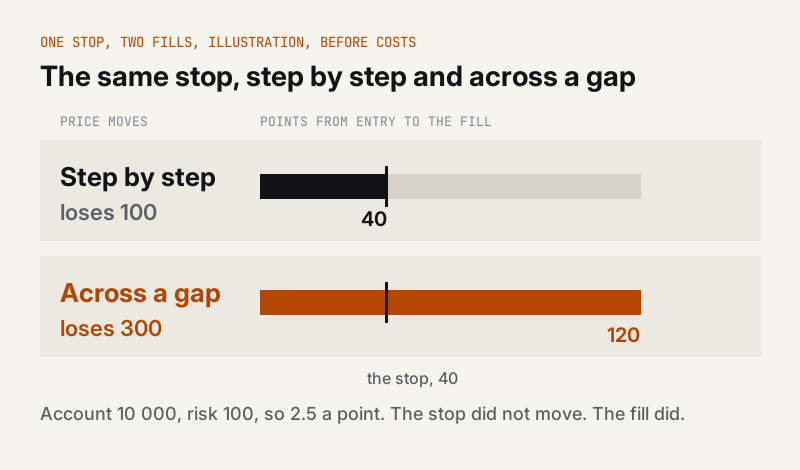
The planned risk is the worst case only when price moves one step at a time. Across a gap, the worst case is the gap.
The check before you buy
1. Does it hold positions through the daily close and over the weekend? Those are the hours when gaps happen. A robot that is flat by then has mostly removed the question. One that holds has to answer it with size.
2. How big are the gaps on the instrument it trades? Open your own platform's history and compare Friday's last price with Monday's first, for a few months. Indices, metals and crypto weekends behave very differently from a major currency pair on a quiet Tuesday.
3. Is any loss in its history bigger than its planned risk? Sort the losing trades by size. A loss well past the usual stop-out is a gap or slippage, and how often it appears tells you how often the plan was not the worst case.
4. Which worst day do you accept, the stop or the gap? If gaps of three stops happen on what it trades, the honest risk per trade on those days is three times the setting. Size so that number is one you can live with.
None of this is a reason to avoid stops. A stop is still what turns an open-ended loss into a bounded one. It is a reason to know what it bounds.
Our robots and signals, with the losing rows left in: https://www.mql5.com/en/users/aller.techno