How much to risk on one trade: decide the loss first, the size follows

The question most traders ask before a trade is how many lots to buy. It has no good answer, because a lot is an amount of money in the market, not an amount you can lose. The question that has an answer is the other one: how much do I lose if this trade is wrong?
The division
Decide in advance what share of the account one trade may lose. Look at how far away the stop is. Divide the first by the second. That is the whole method:
position size = money you accept to lose / (stop distance x value of one point for one lot)
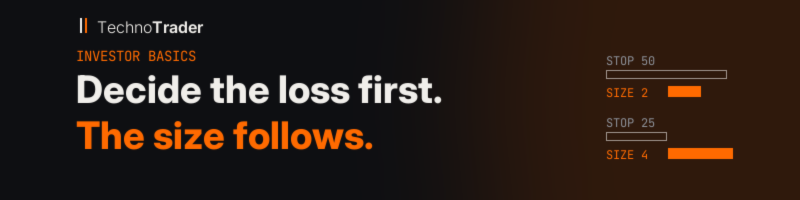
An illustration, not an account. The account is 10 000 and one trade may lose 1 percent, so 100. Say one lot moves 1 unit of money per point. With the stop 50 points away, the size is 100 / 50 = 2 lots. With the stop 25 points away, it is 100 / 25 = 4 lots.
Both trades lose exactly 100 if the stop is hit. The closer stop did not make the trade safer. It made the position twice as large at the same risk. This is why size cannot be chosen by eye: two positions that look very different can carry the same loss, and two that look the same can carry very different ones.
Why the share matters more than the entry
A losing streak is not a sign that something broke. Any rule that wins about half its trades will meet ten losses in a row sooner or later, if it trades long enough. The share you risk decides what that streak does to the account. Each loss takes the same share of what is left:
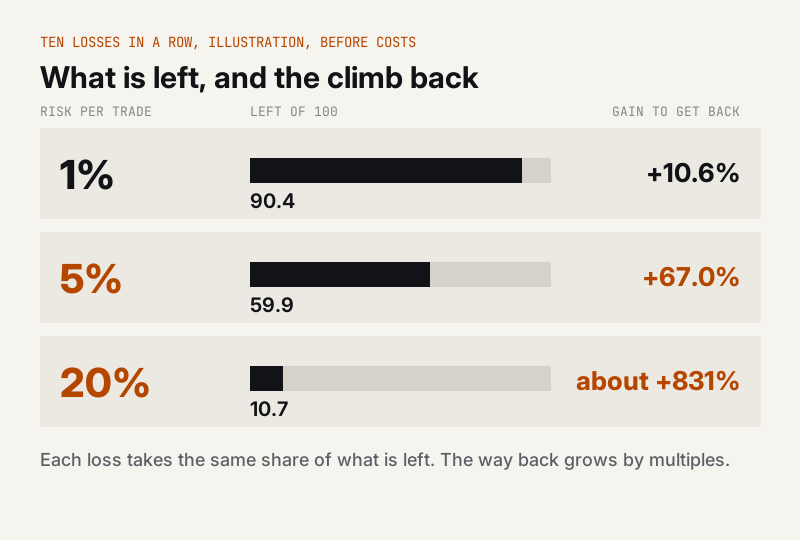
At 1 percent a trade, ten losses leave about 90.4 of every 100, and a gain of 10.6 percent puts the account back. At 5 percent, about 59.9 is left and the way back is a gain of 67 percent. At 20 percent, about 10.7 is left, and the way back is a gain of about 831 percent, which in practice means the account does not come back. The edge can be exactly the same in all three rows. Only the size changed.
The loss deepens steadily, the climb back grows by multiples. That is arithmetic, not a property of any market.
What a correct size feels like
Honestly: too small. At 1 percent, one trade does not change your day, and for the first months that feels like a waste of a good idea. It is the sign that the calculation is right. A size that feels exciting is almost always the size that will not survive the streak you will get anyway.
Traders and authors who disagree about almost everything else, entries, markets, timeframes, land on the same two rules here: a fixed share of the account per trade, and a size worked out from the stop or the market's volatility. None of them sizes by conviction.
How to check a robot or a signal for this
Three questions, before you buy or copy:
1. Does every position carry a stop from the moment it opens? If not, the loss of one trade has no ceiling, and no size can be calculated.
2. Is the risk set as a share of the account, or as a fixed lot? A fixed lot quietly changes your risk every time the balance moves.
3. On a signal page, compare the worst trade with the average loss. If the worst is many times the average, something other than a stop decided that loss.
In our robots this layer is written before the entry rule: a hard stop on every position, risk per trade as a share of the account, the size worked out from that. It is why our months are modest.
Our signals and products, with the losing rows left in: https://www.mql5.com/en/users/aller.techno