Stop loss slippage in MT5: why your stop doesn't cap your loss

Your stop loss in MT5 is a price where you ask to get out, not a promise of what you'll lose. Gaps, slippage, commission and swap all sit between the two. Here is each one, with the numbers.
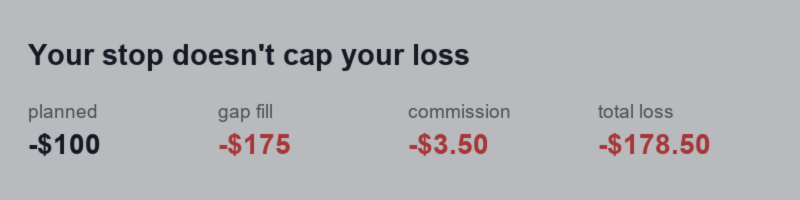
You risk $100 on a trade. You set the stop. The trade goes wrong and closes at a $178 loss. Nothing broke. You met the difference between where a stop is placed and where it is filled.
1. A stop becomes a market order
When the price touches your stop, MetaTrader 5 doesn't close the trade at the stop price. The stop turns into an order to close at the next price available. In a calm market that's the stop price or very close to it. When the market jumps, the next available price can be far away.
2. Gaps
Over a weekend or after a big announcement, price can open well past your stop with no trading in between.
Example: EURUSD, 0.50 lots, stop 20 pips away. At $5 per pip for 0.50 lots, the planned loss is $100. The market opens on Monday 35 pips beyond your entry. Your stop is filled at the first price, so the loss is 35 × $5 = $175.
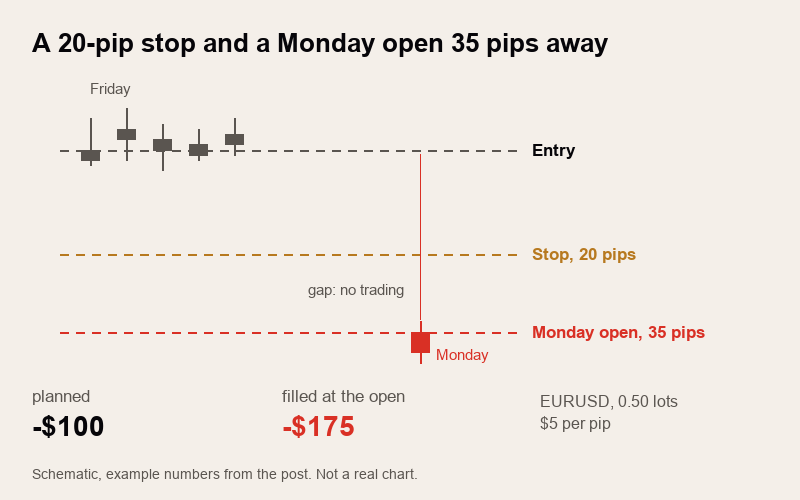
A 20-pip stop and a Monday open 35 pips away: planned $100, filled at $175
3. Slippage
Even without a gap, fast markets move faster than orders fill. At a big release the price you get can be a few pips worse than the stop. A few pips on a full lot is tens of dollars.
4. Commission
Many brokers charge commission per lot on top of the spread. At $7 per lot round turn, the 0.50 lots in the example add $3.50. It doesn't sound like much. On a strategy that risks 0.5% per trade and trades three times a day, it is a steady extra cost on every single trade.
In our example: $175 from the gap plus $3.50 commission is $178.50, against the $100 you planned.
5. Swap
Hold a position overnight and swap is added or charged. On some pairs and on gold it can be a meaningful amount that builds up every night you stay in. Your stop knows nothing about it.
6. The spread at the stop
A buy position closes at the Bid, so its stop is triggered by the Bid. A sell position closes at the Ask, so its stop is triggered by the Ask. When the spread widens, at the daily rollover or at news, the Ask jumps up and a sell stop can be hit even though the chart, which shows the Bid, never touched it.
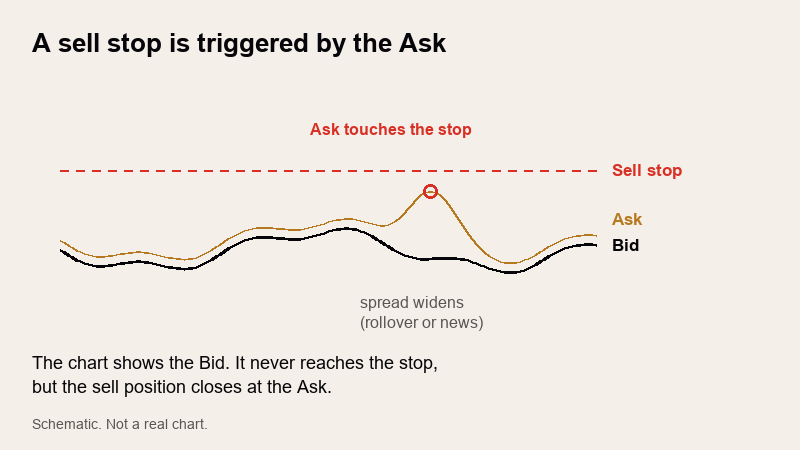
A sell stop is triggered by the Ask, so a wider spread can hit it while the Bid chart never does
What you can do about it
- Size for the risk you can live with if the stop slips, not only for the stop itself. If a 1.5x slip would hurt, the position is too big.
- Know when you hold through gaps: weekends, big releases, earnings for stocks and indices.
- Put the commission into your lot calculation, so the planned risk includes it.
- Check the symbol's swap in its specification before you hold overnight.
- Watch the spread on sells near the rollover hour.
None of this is a reason to trade without a stop. A stop that slips still gets you out. No stop leaves the loss open-ended.
How RiskDeck fits in
RiskDeck by Dojiwave shows your risk to the stop on the button before you send, for example CONFIRM BUY · $100.00, with the commission you enter. Swap and slippage come on top. The loss limits you set for the day also count from your stops, so a price gap or slippage can still take a loss past a limit. Your result in R counts swap and commission, so your numbers show what each trade really cost.