
This article is for informational and educational purposes only. It does not constitute financial advice or an investment recommendation. Trading in financial markets carries a high risk of loss.
Introduction
An Expert Advisor can be well designed and still be a bad fit for an account. The same EA that works with one lot size on a 10,000 USD account can be too risky on 2,000 USD, or impossible to run correctly on 300 USD. Choosing the risk and the capital is part of evaluating an EA, and the backtest contains most of the information needed to do it.
This is the second article in a series on evaluating an Expert Advisor. It is divided into three sections. The first shows how to move from the backtest drawdown to a lot size for your account. The second covers the minimum capital an EA needs and what changes when several EAs run together. The third gives a checklist to decide whether an EA fits your account.
1. From the backtest to your lot size
The drawdown scales with the lot
With a fixed lot, the result of every trade is proportional to its size: half the lot means half the profit and half the drawdown in money. This makes it possible to translate the backtest to any account:
Your drawdown (money) ≈ Backtest drawdown (money) × (Your lot ÷ Backtest lot)
If the EA sizes positions as a percentage of the balance, the logic is similar: testing with 2% risk and getting a 30% drawdown suggests roughly 15% with 1%. The relationship is not exact because of compounding, so it is worth running the test again with the risk you plan to use.
The backtest drawdown is not the worst case
The maximum drawdown in a backtest comes from one specific sequence of trades. With the same trades in a different order, the drawdown could have been very different. A simple way to see this is to reshuffle the trades many times and measure the drawdown each time.
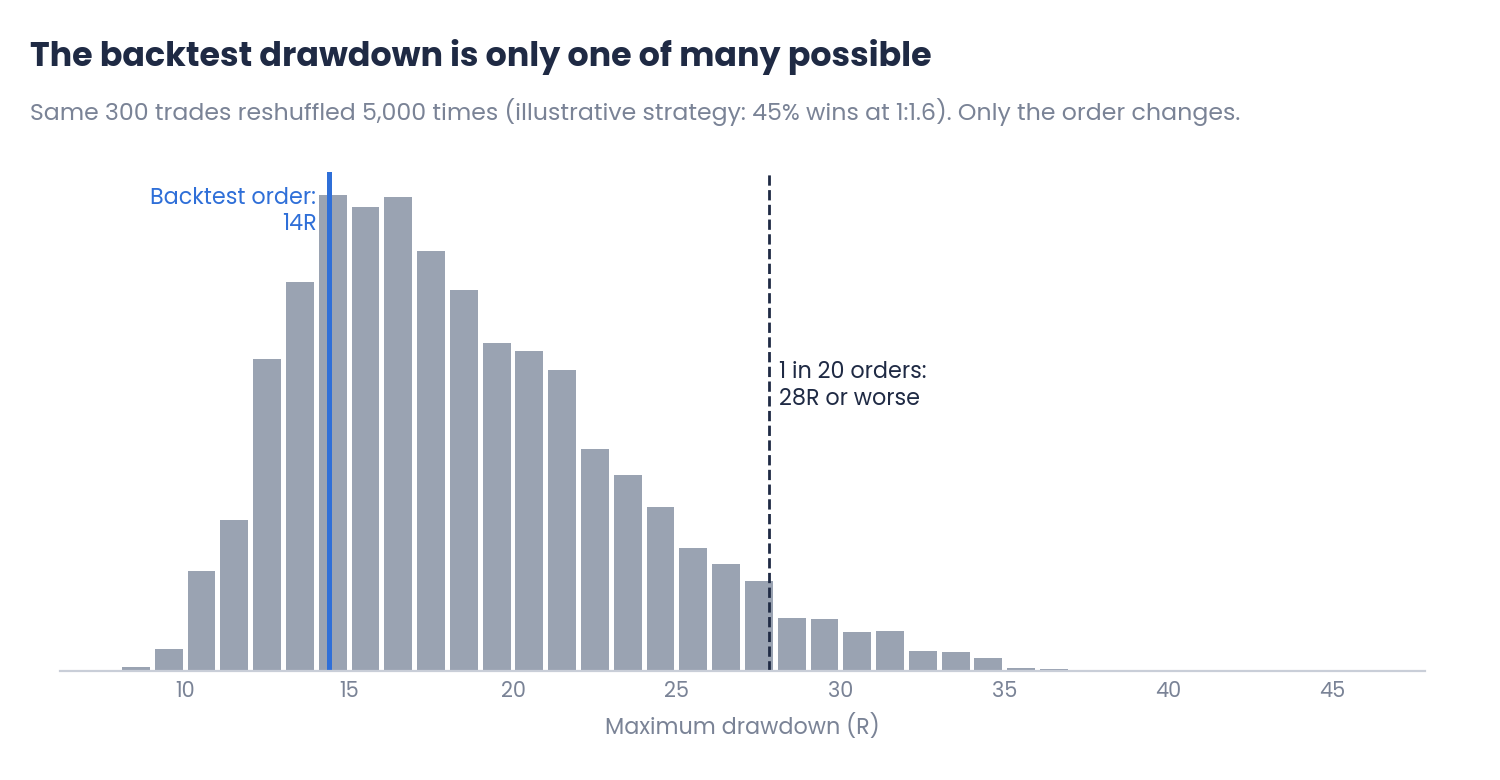
Figure 1. Maximum drawdown of the same trades in 5,000 different orders (illustrative)
In this example, the backtest showed a maximum drawdown of 14R. Half of the reshuffled sequences were worse than 17.6R, and one in twenty reached 28R or more, about twice the backtest figure. Nothing in the strategy changed; only the order of the trades. In live trading, the order is not known in advance, and the period is usually longer than the backtest, which also makes deeper drawdowns more likely.
For this reason, a common and prudent practice is to plan for a drawdown of 1.5 to 2 times the backtest maximum. (Indicative range; reshuffling assumes that trades are independent, which is not always true.)
Step-by-step example: choosing the lot
Suppose a backtest with a fixed lot of 0.10 shows a maximum equity drawdown of 1,800 USD. Your account has 5,000 USD, and you decide that you do not want to risk a drawdown larger than 20% of it.
| Step | Calculation | Result |
|---|---|---|
| 1. Backtest drawdown | With 0.10 lots | 1,800 USD |
| 2. Planning margin | 1,800 × 2 | 3,600 USD per 0.10 lots |
| 3. Maximum drawdown you accept | 20% of 5,000 | 1,000 USD |
| 4. Lot size | 0.10 × 1,000 ÷ 3,600 | 0.028 → 0.02 lots |
| 5. Drawdown like the backtest | 1,800 × 0.02 ÷ 0.10 | 360 USD (7.2%) |
| 6. Drawdown with the planning margin | 3,600 × 0.02 ÷ 0.10 | 720 USD (14.4%) |
Illustrative values. The lot is always rounded down so as not to exceed the planned risk.
The lot is set by the drawdown you are willing to accept. The profit you would like to make plays no part in the calculation. The same reasoning applies to losing streaks, as explained in the article on drawdown and recovery.
2. Minimum capital and several EAs
The minimum lot sets a floor
Every symbol has a minimum lot and a lot step, shown in its specification. On small accounts, the minimum lot can represent much more risk than planned.
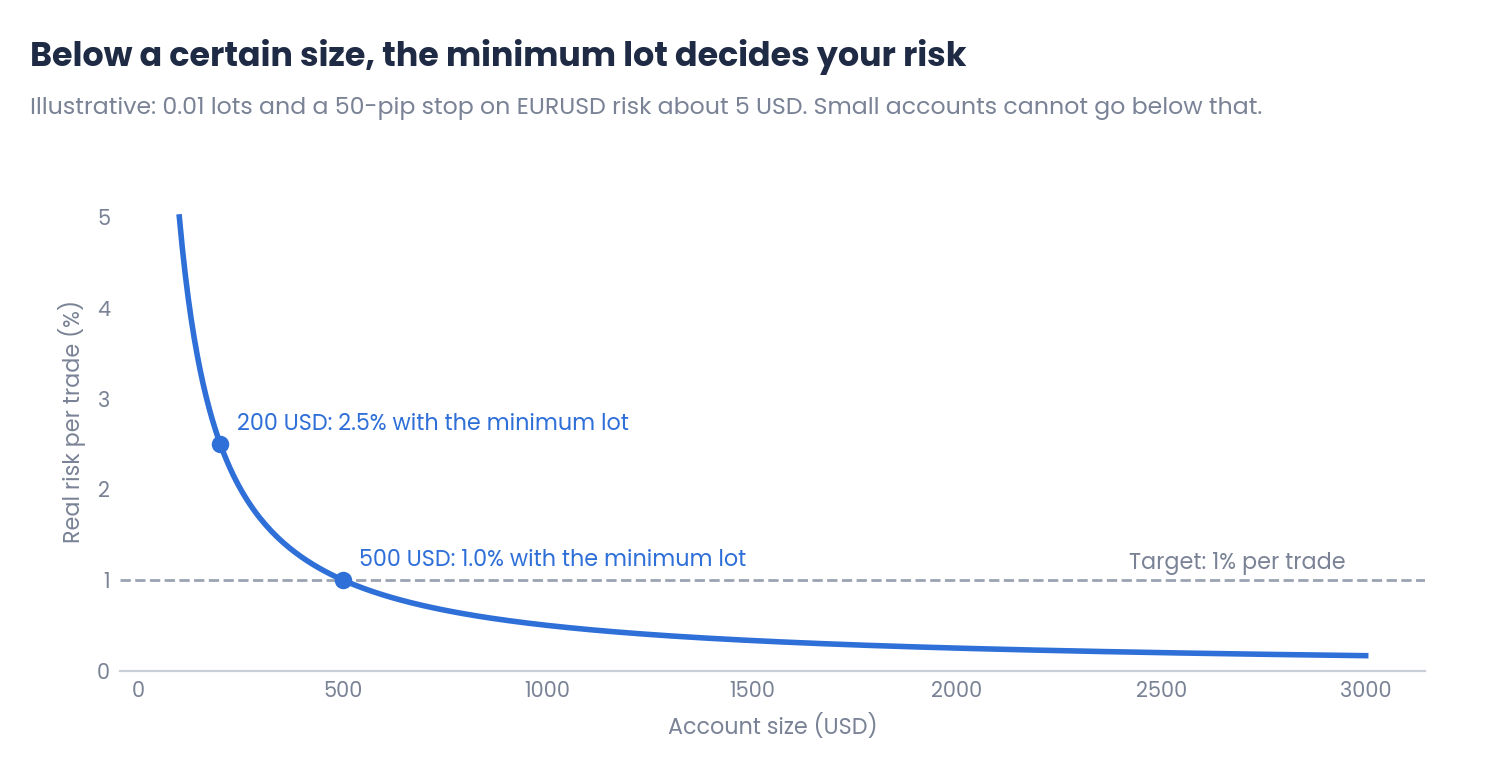
Figure 2. Real risk per trade with the minimum lot, by account size (illustrative)
If a trade with the minimum lot risks about 5 USD, a 500 USD account is already at 1% per trade, and a 200 USD account at 2.5%, with no way to go lower. When the lot calculated in the previous example comes out below the minimum, the account is too small for that EA with that risk. Rounding up to the minimum lot means accepting more risk than planned.
Margin with every position open
The drawdown is not the only limit. An EA that opens several positions at the same time, or several EAs on the same account, need enough free margin for all of them in the worst moment. If the margin level reaches the broker's stop out level, positions are closed automatically, usually at the worst price. Check the maximum number of simultaneous positions in the backtest and the margin they would require on your account.
Several EAs: less is more
Running several EAs can reduce the drawdown of the account, but only if they do not lose at the same time. Two EAs that trade the same symbol, or similar logic on related symbols, tend to have their losing periods together.
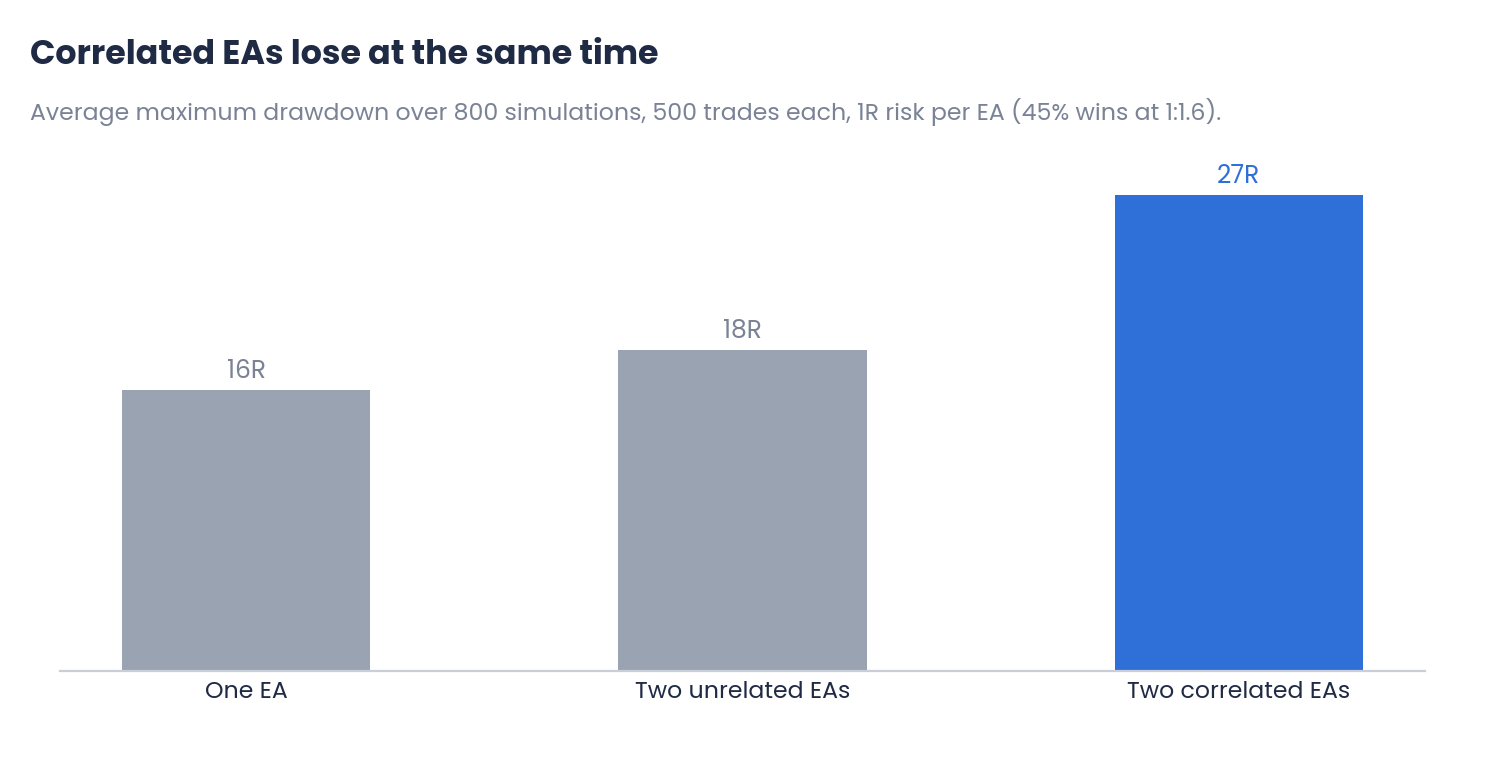
Figure 3. Average maximum drawdown of one EA and of two EAs combined (simulated)
With two unrelated EAs, the combined drawdown is only slightly larger than that of one EA, even though the account carries twice the risk. With two correlated EAs, it is much larger. Adding EAs that behave in the same way is closer to doubling the lot of one EA than to diversifying. A few EAs that you understand well, with different logic, usually give a better result than many similar ones.
3. Is the EA right for your account?
A checklist before deciding
| Question | If the answer is no |
|---|---|
| 1. Is the drawdown with the planning margin acceptable in money? | Reduce the lot or the risk per trade |
| 2. Is the calculated lot equal to or above the minimum lot? | The account is too small for this EA and this risk |
| 3. Is there enough margin with all positions open? | Reduce the lot or the number of EAs |
| 4. Could you tolerate the longest losing streak? | You will probably switch it off at the worst moment |
| 5. Is the capital money you can afford to lose? | Do not run the EA on a live account |
| 6. Do the other EAs on the account trade differently? | Their drawdowns may add up: reduce the risk or the number of EAs |
The answers depend on your own situation. When in doubt, start with the minimum lot and increase it only after a period of live results.
Common mistakes
- Choosing the lot from the profit you want. The lot should come from the drawdown you can accept.
- Treating the backtest drawdown as the maximum. It is one possible sequence; plan for a larger one.
- Rounding up to the minimum lot without noticing. On small accounts, the real risk can be several times the planned one.
- Forgetting the margin. A drawdown that the account could survive can still trigger a stop out if margin runs out first.
- Adding similar EAs to diversify. If they lose at the same time, the account risk grows instead of shrinking.
Conclusions
- From the backtest to your lot size: with a fixed lot, the drawdown in money scales with the lot. The backtest drawdown is only one possible sequence, so plan for about 1.5 to 2 times its value and calculate the lot from the drawdown you accept.
- Minimum capital and several EAs: the minimum lot sets a floor on the risk of small accounts, and the margin must cover every position open at the same time. Correlated EAs add up their drawdowns; a few well-understood EAs with different logic are better than many similar ones.
- Whether the EA fits your account: check the drawdown in money, the minimum lot, the margin, the losing streaks and the capital at risk before going live.
The right risk for an EA is the one that lets you keep running it through its worst periods. The next article in this series covers what to check before moving an EA to a live account. Test any EA with your own data on demo or in the Strategy Tester, and combine it with disciplined risk management.
References
- Van K. Tharp, Trade Your Way to Financial Freedom, 2nd edition, 2006.
- MQL5 Reference: symbol properties (SYMBOL_VOLUME_MIN, SYMBOL_VOLUME_STEP) and account properties (ACCOUNT_MARGIN_SO_SO).
Disclaimer
This content is for informational and educational purposes only. It does not constitute financial advice or a recommendation to buy or sell any instrument or product. Past drawdowns and simulations are not a forecast. The charts and examples are illustrative, and every strategy, account and broker is different. Trading forex, CFDs and other leveraged products carries a high risk of loss. Every trading decision, and its outcome, is the sole responsibility of the reader. The author accepts no liability for any loss arising from the use of this information.