One month of rent cannot prove a robot's edge. Here is what it can show

Renting a robot for a month feels like the honest way to test it. You pay a little, you watch it trade, and at the end you know. Half of that is true. A month will tell you a lot, just not the thing most people rent it to find out. Here is the arithmetic on one of our own products, Bitcoin Interval, and what we would check instead.
How many trades are in a month
Bitcoin Interval takes about sixty trades a year, so about five a month. In the listing's Strategy Tester window, on the default package, 397 trades, 47.1% closed in profit. Fewer than half win, by design.
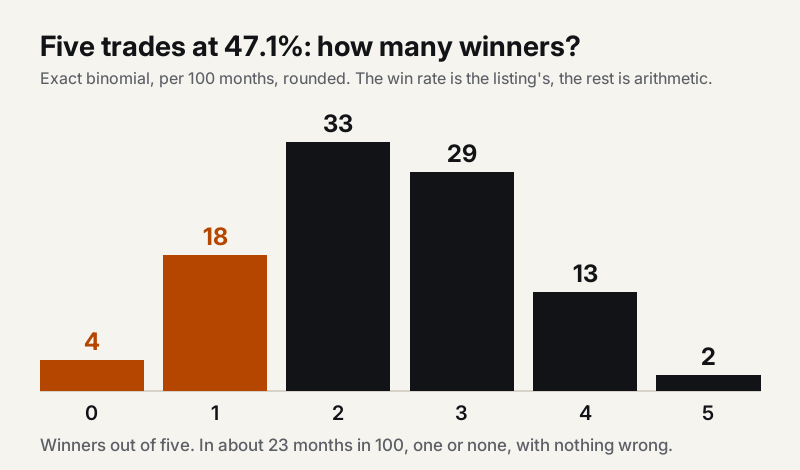
Take that 47.1% at face value and ask what five trades look like. In about 23 months in 100 you would see one winner or none. Nothing would be wrong. That is simply what five draws at 47.1% do.
A green month says less than it feels like
Now the part that matters. Suppose the tested numbers hold exactly. A profit factor of 1.50 with 47.1% winners means the average win is about 1.68 times the average loss. Our own arithmetic on two listing figures, not a figure from the listing. On that shape, a five-trade month ends green about 77 times in 100.
Now take a rule with no edge at all: the same win rate, a profit factor of 1.00. Its month ends green about 45 times in 100.
So one green month is what you would often see from a real edge and also, nearly every second time, from nothing. It moves the odds a little. It does not settle anything. Three months of rent is about fifteen trades and the two rules sit at 79 and 41 in 100. A full year of about sixty trades gets you to 93 against 47, and you could still be fooled.
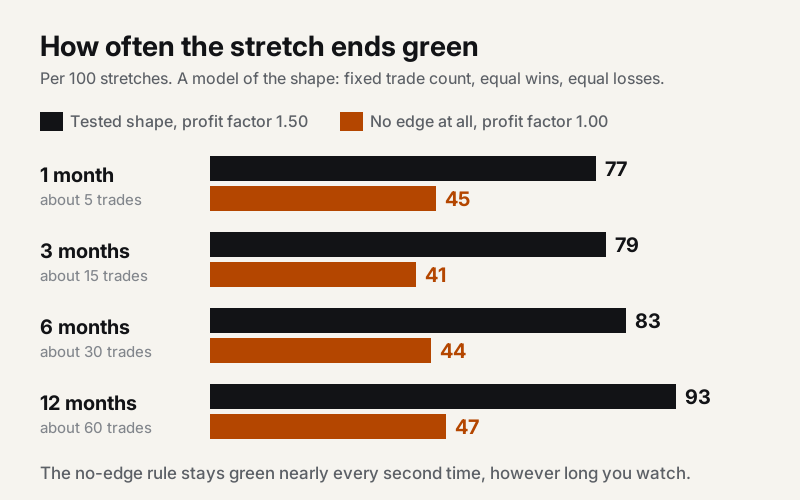
The same arithmetic runs the other way. A red first month is ordinary for the rule that works: about 23 in 100. Stopping a rental because the first month was red tells you about the month.
The model is deliberately simple: a fixed count of independent trades, every win the same size, every loss the same size. Real trades cluster and real months vary. Read it as the shape of the problem, not as a forecast.
What a rental can actually show
A month on your own account answers questions no backtest can, and they are worth paying for.
Does it run on your broker? The EA looks for Bitcoin against the dollar. If it cannot find it, it starts, warns on the panel and does not trade. Better to learn that in the first hour.
Does the stop go out with the trade? It should, on every position, verified on every pass. Look at each trade as it opens. A rental makes that easy to confirm with your own eyes.
Does your account size change the risk? The minimum position is 0.01 BTC. On a small account at current prices the size rounds up to that minimum, so real risk per trade exceeds the setting. The EA takes the trade anyway and reports it. Read what it reports.
Does your live month match your own test? This is the strongest check and the one that takes the most work. At the end of the month, run the same dates in the Strategy Tester on your own broker's data, then compare trade by trade: the same entries, the same exits, how far the prices and the results differ. Stops here are set from volatility, so a wider spread changes which setups clear the cost gate, and this comparison is where you would see that. A match tells you the tested numbers describe what is running on your account. It still does not tell you the future.
One thing about the calendar. The year-end pause is on by default, so a rental across the holidays holds even fewer trades than five a month.
How we would spend the money
First, the free demo. It costs nothing and it runs the same rules on your own broker's data, as far back as your broker's history goes. On the four other brokers we measured, the profit factor ran 1.44 to 1.51 and the return landed 12 to 34 percent below our reference feed, so your number will differ. If it falls apart here, you have saved the rent.
Then rent, for the plumbing. 30 USD for a month, or 69 USD for three if you would rather have about fifteen trades to compare. Do the four checks above. Decide from them, not from the balance.
Then judge the edge over years, not weeks. Every calendar year in the window is positive, and one of the thin ones, 2025, returned +9.0% at a profit factor of 1.17. That is a backtest, on prices that have already happened. Rent cannot add to it inside a month. Only time can, and that is the honest reason a record is worth more the longer it runs.
The purchase is 199 USD, and the same page carries the demo, the rent and the full measured record with its thin years. The test that should decide it is the one you run on your own data.
Bitcoin Interval on MQL5: https://www.mql5.com/en/market/product/193069