PropStockDip setup guide: one chart for 500 stocks, sized for your account

Who it is for: traders who trade single US stocks as CFDs. PropStockDip is a small add-on with a small return that changes a lot from year to year, not a main strategy.
After this guide PropStockDip runs on one chart of your MetaTrader 5, has found your broker's US share CFDs, and you know what the panel and the journal say on a trading day. Time needed: about fifteen minutes, plus one strategy tester run if you want to see the trades first.
| You get | PropStockDip scanning the S&P 500 list on one chart, with a checked server clock, enough daily history and a position size that fits your account. |
| Time | About fifteen minutes, plus one strategy tester run. |
| You need | MetaTrader 5, PropStockDip, a broker with US share CFDs, an account that allows holding over the weekend, and a terminal or VPS that runs before the US close on every trading day. |
What you need
- PropStockDip installed (after purchase it appears under Market in the Navigator).
- US share CFDs at your broker. Names differ: AAPL.US, AAPL, #AAPL, AAPL.NAS and others. PropStockDip finds the common patterns itself.
- Algo Trading switched on and a terminal that runs shortly before 16:00 New York on every trading day. That is about 22:00 in Central Europe most of the year. A VPS is the simple answer.
- An account that allows holding positions over the weekend. About two thirds of the trades run over a weekend.
Step 1: one chart for the whole list
Open any chart, the symbol and timeframe do not matter, and attach PropStockDip. It reads the daily history of every stock itself and sends orders with the stock's own symbol. One chart is enough; a second copy on another chart would trade the same list twice, so do not do that.
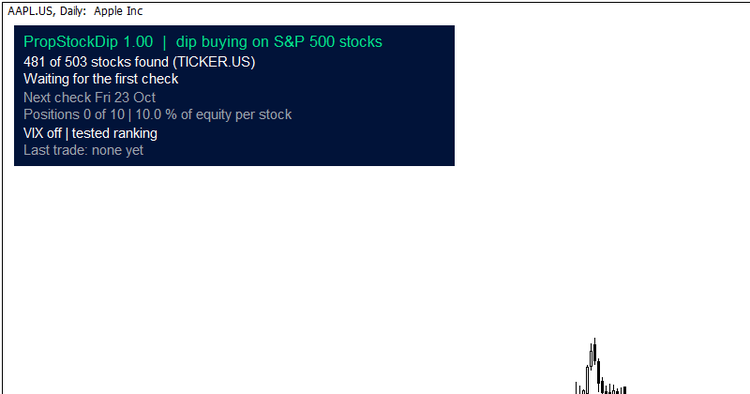
The panel: stocks found at the broker, the last daily check with signals, buys and sells, the next check in your local time, positions and the optional controls.
Step 2: check that your stocks were found
When PropStockDip starts, it writes one line to the Experts journal, for example:
PropStockDip 1.00: 481 of 503 stocks found (TICKER.US), server clock GMT+2/+3 with US DST, ...
The first number is what counts. If it says none were found, your broker uses a naming PropStockDip does not guess. Open Market Watch, look up how one US share is written (for example AAPL.NYSE or US.AAPL ) and enter the part before and after the ticker in Share CFD symbol prefix and Share CFD symbol suffix. Brokers that split US shares by exchange (.NAS and .NYSE) are found automatically when both patterns exist.
Some of the 503 tickers are missing at every broker; that is normal. The list is the S&P 500 of August 2026.
Step 3: the server clock
PropStockDip needs to know how your broker's server time relates to New York, because it checks shortly before the US close. Most MT5 brokers run GMT+2 in winter and GMT+3 in summer with the US daylight saving dates, which is the default. In live trading PropStockDip compares the setting with your computer's clock and switches to the model that fits, with a line in the journal. You only need Fixed server GMT offset for an unusual server.
Step 4: how many positions and how large
Two inputs decide the risk: Maximum open positions (default 10) and Position value per stock (default 10 % of equity). The default is fully invested without leverage when all slots are used. There is no stop loss, because the tested rule has none, so the size is your risk control.
- In my research the default portfolio had drawdowns of up to about 31 %. If your account has a loss limit, size for that: with a 10 % overall limit a third of the default or less, for example 10 positions of 3 %.
- On a sell off many stocks signal on the same day and the slots fill quickly. Ten positions are then mostly one bet on a rebound.
- Margin, minimum volume and the volume step are checked before every order. Positions below your broker's minimum are skipped with a journal line.
Step 5: what happens on a trading day
A few minutes before 16:00 New York PropStockDip checks every stock of the list once. First it sells the positions whose exit is due, then it buys new signals into the free slots, in the tested order. A stock whose spread is wider than A stock waits while its spread is wider is tried again until shortly before the close. Nothing happens during the rest of the day.
After a restart nothing is opened twice: the state comes from the open positions and the deal history.
Step 6: try it in the strategy tester first
- Choose one of the stocks as the test symbol, for example your broker's Apple CFD. On any other symbol the tester runs a demo schedule (one trade every weekday) that only shows the order handling.
- Use Own ticker list for 10 to 30 stocks. The full list of 500 stocks makes the tester download a lot of history and runs slowly.
- Model 1 minute OHLC is enough. Start about a year before the period you want to see, the rule needs a year of daily history.
- Check the margin and the deposit: share CFDs often need 20 % margin.
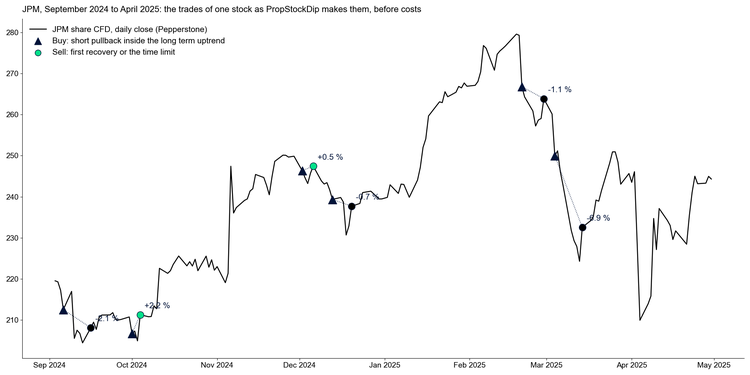
One stock of the list on Pepperstone data: buy after a short pullback in an uptrend, sell at the first recovery. Losers happen too.
The optional controls
Two groups of inputs are off by default: the VIX control (buy only, or buy larger, while your broker's VIX symbol is above a level) and the volatility preference (rank by 60 day volatility, or skip calm stocks). In my data the rule did better in both cases, but I found that only after the holdout, on the same data. That makes it a hypothesis, not a tested result. I wrote down a forward test for both on a demo account before it starts and will report the result. If you switch them on, you trade a variant that is not validated. Note that the VIX symbol of many brokers follows VIX futures and reads a little higher than the spot index.
The inputs that matter
| Maximum open positions | Default 10. Fewer positions mean larger swings per stock. |
| Position value per stock | Default 10 % of equity. Your main risk control. |
| Share CFD symbol prefix / suffix | Only if your stocks are not found automatically. |
| Own ticker list | Comma separated, for the tester or a smaller list. |
| Magic number | Change it only if another EA uses the same number. |
Typical journal lines
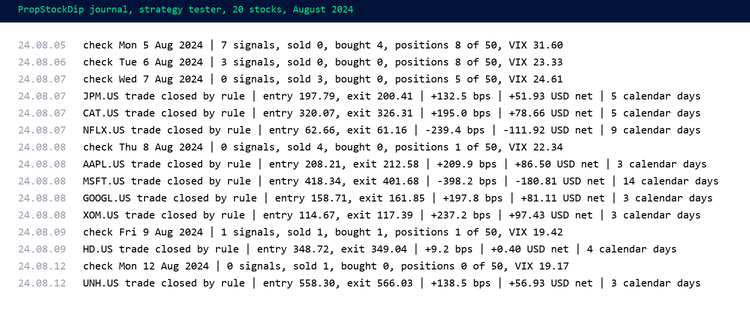
Every buy and sell with its reason, the result in basis points and in money after commission and swap.
Get it: PropStockDip on the Market · the research behind it: dip buying on S&P 500 stocks, the study
Questions: the Comments tab of the product or a message. If PropStockDip does something you do not expect, please contact me before you rate it.
More guides: my blog · All my tools: all my products
Past results do not guarantee future results. Test on a demo account first.