3,225 requests since 2012: what traders ask us to build, and where the simple ones fail

We went back over our own request forms since 2012 and sorted them into 33 needs. After removing copies and anything under 50 characters of description, that left 3,225 requests from 2,102 traders. Here is what the sample shows, what it cannot show, and the one place where the "simple" job keeps going wrong, our own work included.
Who is in the sample
Everyone in it came to us seeking custom work. That tells you what people want a programmer for, not what they would buy as a ready-made tool. The recent years are thin: in 2023-26 only about a quarter of the folders carry usable text, 193 of 760, because more requests now arrive as an attachment or by email. AI agents sorted the requests, and a human review of 20 agreed with the sorting on 16. To check whether a shift was ours or the market's, we used a second sample of 1,557 public jobs from MQL5 Freelance, sorted the same way. We count them; we do not quote them.
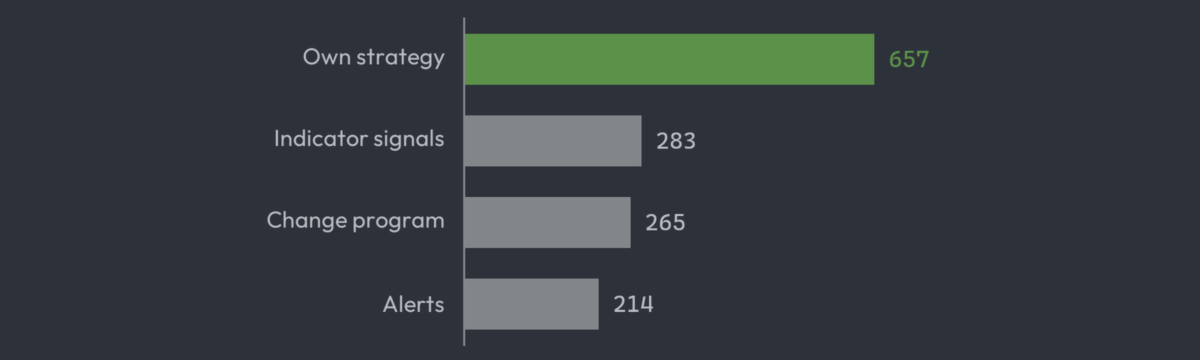
The four most requested needs
By distinct traders in our sample:
- automate my own strategy: 657
- automate the signals of an indicator I already use: 283
- extend or change a program I already have: 265
- alert me when a setup forms: 214
The two largest have not moved. 23% of all requests arrived in 2020-26; for "automate my own strategy" it is 26%, and for "automate an indicator's signals" 24%, at or just above that baseline. In the Freelance sample, "automate my own strategy" holds its share too: 21.3% of all jobs, 23.1% of those posted in 2023-26.
The parts are standard, the combination is not
The most requested components are the usual building blocks: initial stop and target (418 traders), the trader's own or a third-party indicator as trigger or filter (383), trailing stop (260), exit or reversal on the opposite signal (243), trading-hours control (226), an alert in the terminal (209). In our sample, 74% of the indicator requests and 76% of the alert requests could be built from standard components only. What differs from one trader to the next is the specific combination: a higher-timeframe trend filter, two indicators that must agree, an exit on the opposite arrow.
When does a signal count?
The request that sounds easiest, "trade the arrow" or "alert me when it appears", carries the hardest question in the job. On the closed bar or on the bar still forming? When the program is attached to a chart that already shows an arrow? After a terminal restart? When a candle's body is a fraction of a point? In our sample, 181 traders stated a requirement on signal timing or repainting, and 197 had only the compiled file of the program they started from.
The last of those questions is the one that caught us. In 2022 we built an MT4 alert indicator that watches three copies of a free third-party candle indicator, set long, medium and short, and alerts when all three candles show the same colour at a bar close. To decide a candle's colour, the code rounded the open and the close to the symbol's digits with NormalizeDouble and then compared them. A body smaller than one point can round to two equal prices, so that candle counted as neither colour, and any line-up involving it raised no alert. No error, no log line.
The two ways of deciding the colour look like this in MQL4:
The trader never reported it. We found it in September 2026, going back over our own past deliveries. The tell was in our own baseline run: close alerts outnumbered open alerts, 93 to 72, although the rule pairs them. On EURUSD M5, over one week (21 to 29 July 2026, every tick, the trader's own settings), the delivered build gave 165 alerts and the unrounded rule 253; the old build missed 88. Those figures belong to that symbol, timeframe and week, and the miss rate falls on higher timeframes, where small bodies are rarer. The fix, version 1.1, compares the values as read; we told the trader and delivered it free on 23 September 2026.
When the platform moves under you
A value that never arrives reads as a signal that never came. After the terminal updated itself to build 1491, an MT4 EA of ours that reads a compiled Supertrend indicator through iCustom could get a broken indicator copy returning an empty value in both buffers, and in some starts received no events at all. Because the EA treats a candle with no indicator value as "no direction", neither fault produced a wrong trade or a log line; the pre-delivery demo simply produced no trade. The update shipped with a switch that reads the indicator again under another form of its name, with one warning line, plus a restart check in the delivery note. To be clear, the cause is measured on one development install, not documented.
The one shift both samples agree on
Alert requests show a modest decline in both samples: 18% of the alert requests in ours arrived in 2020-26, against 23% of all requests; in Freelance, alerts were 4.4% of the 1,557 jobs (69 jobs) and 3.5% of those posted in 2023-26. Grid and martingale requests looked like they were rising in our sample (32% against the 23% baseline) while they fell in Freelance, from 3.2% to 2.6%, so we do not report that rise.
Four questions before you send a request
- When does a signal count: closed bar or forming bar, and does that differ by timeframe?
- What happens on attach and on restart, if an arrow is already on the chart?
- Which indicator file exactly: its name, source or compiled only, and where the signal lives (a buffer, an arrow object, a colour change)?
- How do the conditions combine: all, any, or a set number out of several, and on which timeframes?
These are not strategy, which is why strategy descriptions leave them out. They decide whether the program does what you meant.