
Product link:
https://www.mql5.com/en/ market/product/191385
Sooner or later, a profitable copy-trading account reaches the point where the trader wants to withdraw some money. The strategy has generated profits, the account balance has grown, and taking money out seems like the natural next step.
However, a withdrawal or deposit can affect drawdown calculations if the account's balance changes but the drawdown baseline remains unchanged. Depending on the protection settings and calculation method, this can cause the displayed drawdown to become misleading or a protection threshold to be reached earlier or later than expected.
This is an important operational consideration for traders using COPYLATOR – MT5 Trade Copier. The solution is to understand how the drawdown baseline works, plan withdrawals carefully, and verify the protection settings after any material change in account capital.
What a Withdrawal Does to the Account
Consider a receiver account that started with $10,000 and has grown to $12,000 after several profitable months. Suppose total drawdown protection uses an initial balance of $10,000 and a 20% drawdown limit.
If the trader withdraws $2,000, the account balance returns to $10,000. If there are no open positions and equity equals balance, the account is back at its original baseline. Under a simple fixed-baseline calculation, the measured drawdown is zero.
Now consider a different sequence:
- Initial balance: $10,000.
- Account balance after trading profits: $12,000.
- Trading losses reduce the balance to $11,000.
- The trader withdraws $2,000, leaving $9,000.
If the baseline remains $10,000, the account now appears to be 10% below that baseline, assuming equity equals balance. But the account's decline from $12,000 before the trading loss and withdrawal combines two different events: a $1,000 trading loss and a $2,000 withdrawal.
The displayed drawdown therefore cannot be interpreted as trading loss alone. If the account subsequently loses another $1,000 and equity falls to $8,000, it is 20% below the original $10,000 baseline. A 20% fixed-baseline threshold could then be reached even though part of the decline came from the withdrawal rather than trading.
The key point: A withdrawal changes account capital, but it does not necessarily change the drawdown baseline. The trader must account for that difference when interpreting the protection readings.
Understanding the Apparent False Trigger
A drawdown protection trigger following a withdrawal is not automatically a malfunction. The protection may be applying its configured calculation correctly, while the trader's capital-management plan has changed.
For example, if the baseline is $10,000 and current equity is $8,000, the account is 20% below that baseline under a simple fixed-baseline calculation.
From the protection's perspective, the numerical threshold has been reached. From the trader's perspective, however, some of the reduction may have resulted from withdrawing funds rather than losing them in the market.
This distinction matters because the trader may have intended the drawdown limit to measure trading losses, but the calculation may instead reflect the account's change in equity relative to its stored baseline.
The appropriate response is to review the baseline, the account's transaction history, the drawdown calculation method, and the protection status before assuming that the system has malfunctioned.
The Same Problem with Deposits
Deposits can create the opposite distortion.
Suppose an account has a $10,000 baseline and equity falls to $8,500. Under a simple fixed-baseline calculation, the account is 15% below its baseline.
If the trader deposits $2,000 and equity rises to $10,500, the account is now above the original baseline. The calculated drawdown may appear to have disappeared, even though the deposit has not recovered the money lost through trading.
A deposit increases available capital, but it does not necessarily demonstrate that the strategy has recovered or that its recent performance has improved.
For this reason, deposits should be recorded separately from trading profits when reviewing performance. Otherwise, the trader may mistake an increase in account capital for a recovery generated by the strategy.
Using the Manual Reset Correctly
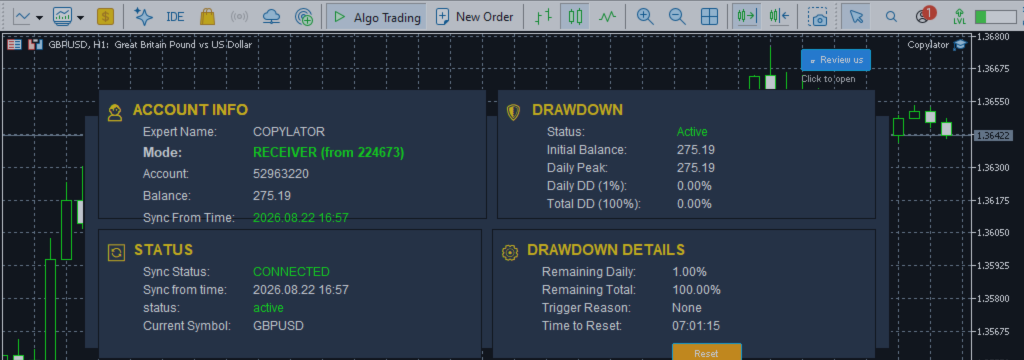
COPYLATOR provides a manual Reset button in the Drawdown Details panel on the Receiver side. According to the configured drawdown functionality, this reset clears the daily and total drawdown states and updates the initial balance baseline to the account's current balance.
This feature can be useful after a withdrawal or deposit, but it should not be treated as a routine button to press whenever a drawdown block occurs.
A manual reset changes the reference used for subsequent drawdown calculations. Depending on the account's condition, it may also clear an existing protection state. Resetting without reviewing the account can therefore change the practical risk limits.
For example, after a withdrawal, a reset may establish a new baseline that reflects the account's reduced capital. Future drawdown calculations will then be measured relative to that new reference, subject to the product's calculation method and settings.
Important: A manual reset is not a recovery of trading losses. It changes the drawdown reference point. It should only be used when the trader deliberately intends to establish a new reference and understands the effect on the account's risk limits.
When Should You Reset?
Consider reviewing the baseline after any material deposit or withdrawal that changes the capital allocated to the strategy.
Before resetting, follow a deliberate procedure:
- Review open positions. If possible, perform the reset when no positions are open. If positions remain open, floating profit or loss can make the relationship between balance and equity important.
- Confirm the transaction. Verify that the broker has fully processed the withdrawal or deposit and that the account balance reflects it.
- Record the current account figures. Note the balance, equity, existing baseline, and current drawdown readings.
- Review the risk policy. Decide whether a new baseline is appropriate and what drawdown limits should apply after the capital change.
- Perform the manual reset if appropriate. Use the Reset button in the Receiver's Drawdown Details panel.
- Verify the result. Check the displayed baseline and drawdown readings, and confirm that the protection state matches the intended configuration.
There is no universal 5% or 10% threshold at which every account must be reset. The appropriate policy depends on how the trader defines drawdown, the account's rules, and the intended relationship between trading risk and account capital.
The Timing Trap
Timing matters when changing the baseline.
If the trader resets the baseline before the broker processes a withdrawal, the reset may use the pre-withdrawal balance. When the withdrawal is subsequently applied, the account's balance falls relative to that newly stored baseline, and the drawdown reading may change immediately.
The same issue can arise with a deposit that has been requested but has not yet been credited.
Whenever practical, wait until the transaction is confirmed and the account figures have settled before deciding whether to reset. Processing times vary by broker and payment method, so verify the actual account balance rather than relying on an assumed waiting period.
If positions remain open, also check equity and floating profit or loss before establishing a new baseline. Balance and equity are not interchangeable.
The Capital Planning Approach
One way to simplify withdrawals is to establish a capital policy in advance.
For example, a trader may decide to maintain a $10,000 account allocation and withdraw profits above that amount. If the account grows to $12,000 and the trader withdraws $2,000, the remaining balance returns to $10,000.
If the baseline is also $10,000, the withdrawal leaves the account at its original reference point, assuming there are no open positions or other equity adjustments.
This approach can be straightforward for traders who want to maintain a relatively stable account size and withdraw profits periodically.
However, it does not eliminate the need to monitor drawdown. If the account has already experienced trading losses, or if there are open positions with floating losses, the amount that can be withdrawn without changing the intended risk profile may be lower than the difference between balance and baseline.
A fixed-baseline approach also needs a clear policy for profits, losses, and future deposits. The trader should not assume that any amount above the original balance is automatically safe to withdraw.
The Scaling Approach
Another approach is to adjust the drawdown reference when the account's allocated capital changes.
For example, a trader may want the baseline to reflect a smaller account allocation after a withdrawal. In that case, the trader must decide what the new baseline should be and how the drawdown limit will apply to the remaining capital.
There is no single proportional adjustment that is correct for every withdrawal policy. The result depends on whether the trader wants to preserve the original monetary risk allowance, preserve the same percentage limit, or establish a new risk budget based on the remaining capital.
These objectives are different. A simple manual reset to the current balance establishes a new reference at that balance; it does not automatically preserve the previous drawdown percentage or the previous monetary risk allowance.
Before changing the baseline, calculate the intended risk limit in both percentage and monetary terms. Then verify that the product's available settings can implement that policy. Do not assume that COPYLATOR automatically scales the baseline proportionally to each withdrawal or deposit.
The Impact on Daily Drawdown
Withdrawals and deposits can also complicate daily drawdown monitoring, depending on how the daily reference and equity changes are calculated.
If a withdrawal reduces the account's equity during the day, a calculation that compares current equity with a daily reference may register a change that is not caused by a trading loss. Conversely, a deposit may increase equity and make the displayed drawdown appear smaller.
The precise effect depends on the product's daily drawdown calculation and how the balance transaction is reflected in the account. A withdrawal should not be assumed to clear a daily block automatically, and a deposit should not be assumed to restore the account's underlying trading performance.
After a material capital change, check both daily and total drawdown readings. Treat them as risk-control measurements whose interpretation depends on the configured references, rather than as a complete record of trading performance.
The Interaction with Automatic Daily Reset
COPYLATOR's automatic daily reset and its manual drawdown reset serve different purposes.
The automatic daily reset uses the configured ResetHour and ResetMinute , based on broker server time, to reset the daily drawdown cycle. It does not update the initialBalance baseline used for total drawdown.
As a result, an automatic daily reset should not be treated as a correction for a withdrawal or deposit that has made the total drawdown baseline inappropriate.
A trader may see the daily drawdown status reset while the total drawdown reference remains unchanged. That is expected behavior when the daily reset does not modify the initial balance.
After a capital change, review the daily and total protection settings separately and make sure each reflects the intended risk policy.
The Audit Procedure
After a withdrawal or deposit, use a simple audit to confirm that the account's figures make sense.
- Record the current account balance and equity.
- Record the baseline currently shown in the drawdown panel.
- Review the withdrawal or deposit in the broker's transaction history.
- Calculate the drawdown using the product's applicable calculation method and compare it with the displayed reading.
- Confirm that any manual reset completed and that the baseline reflects the intended reference.
- Check the daily and total drawdown states independently.
- Verify that the protection settings and trading status match the written risk policy before resuming normal copying.
For a simple fixed-baseline calculation, when equity is below the baseline, the percentage drawdown is commonly expressed as:
Drawdown (%) = (Baseline - Equity) / Baseline × 100
This formula is a simplified illustration. The actual comparison should use the drawdown calculation implemented by the product and the applicable settings. If the displayed value differs from your manual calculation, investigate the calculation method, current equity, transaction timing, and stored baseline before assuming an error.
Write a Withdrawal Policy
A written policy helps prevent inconsistent decisions about when to withdraw, how much to withdraw, and whether the baseline should change.
For example, a policy could specify that withdrawals are reviewed monthly, are made only after the broker confirms that the transaction can be processed, and are calculated from profits above a defined capital reference. It could also require the trader to review open positions and verify the drawdown baseline after each material capital change.
The policy should define:
- How frequently withdrawals are considered.
- How the withdrawable amount is calculated.
- Whether the account must maintain a minimum operating capital.
- When the baseline is reviewed or reset.
- How open positions and floating losses are treated.
- Which checks must be completed before copying resumes.
The purpose is not to prescribe a universal withdrawal schedule. It is to make the relationship between capital management and drawdown protection predictable.
Should You Avoid Withdrawals?
Leaving profits in the account can avoid some administrative changes to the baseline, but it is not automatically the safest choice.
Retained profits remain exposed to trading risk. An account that has grown substantially may give back some of those gains during a future drawdown, depending on the strategy and protection settings.
Withdrawals, on the other hand, reduce the capital remaining in the account and may require a review of the baseline and risk limits.
The appropriate choice depends on the trader's financial needs, account rules, strategy, and risk objectives. A planned withdrawal schedule can help balance access to profits with consistent risk management, provided the baseline is reviewed whenever necessary.
Summary
Withdrawals and deposits change account capital without necessarily changing the drawdown baseline. This can cause the displayed drawdown to differ from the trader's intended measure of trading losses, potentially affecting when protection thresholds are reached.
To manage this risk:
- Understand how the daily and total drawdown calculations work.
- Confirm that withdrawals and deposits have been processed before reviewing the baseline.
- Consider the effect of open positions and floating profit or loss.
- Use the manual reset only when a new baseline is appropriate and the consequences are understood.
- Do not confuse a baseline reset or capital deposit with recovery from trading losses.
- Verify the dashboard readings and protection settings before resuming normal copying.
- Maintain a written policy for withdrawals, deposits, and baseline changes.
A withdrawal should be a planned capital-management decision, not an unexpected change to the account's risk calculations. By understanding the relationship between balance, equity, and the drawdown baseline, COPYLATOR users can manage withdrawals more deliberately and keep their protection settings aligned with their intended risk limits.
Product link:
https://www.mql5.com/en/ market/product/191385