
Whenever I analyze a market, I try to identify the direction of price movement first. There is no need to start with dozens of indicators, complicated chart drawings, or attempts to predict every price swing. Sometimes, one simple question is enough: where is the market moving right now?
I share my experience with trading algorithms and market analysis on my MQL5 profile. Visit my profile and add me as a friend — let’s explore trading together!
What Is a Trend?
A trend is a direction of price movement that persists over a certain part of the chart. Traders generally distinguish between three market conditions:
-
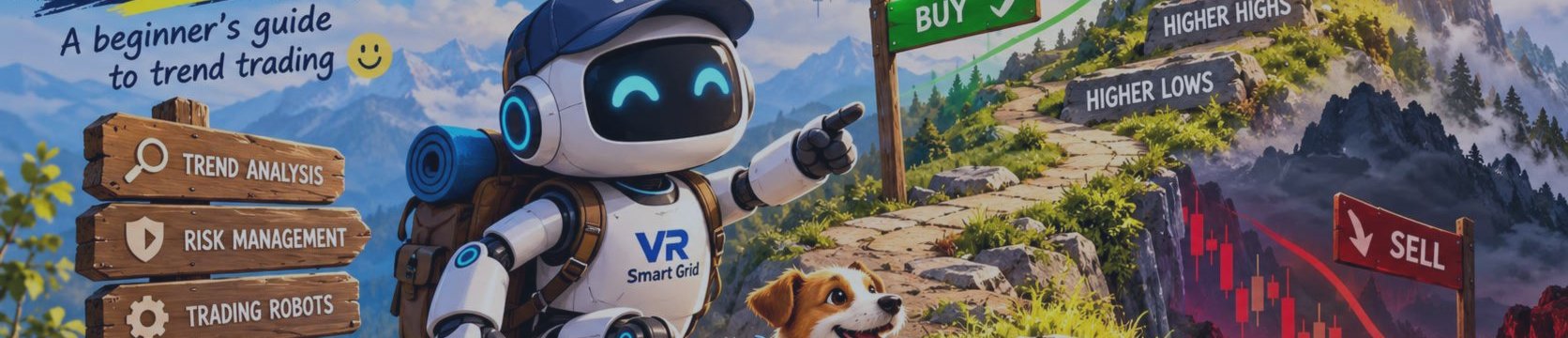
Uptrend: price forms higher highs and higher lows.
-
Downtrend: price gradually forms lower highs and lower lows.
-
Sideways market: price moves within a range without a clear direction.
Imagine climbing a mountain trail. You may take a few steps down, but your overall direction is still upward. Markets behave in a similar way: even during an uptrend, prices can temporarily decline.
That is why I do not judge a trend by looking at a single candle. The sequence of price movements and the overall market structure are much more useful.

How Can You Identify a Trend?
I recommend starting with three straightforward methods.
1. Analyze Highs and Lows
This is one of the clearest ways to assess market direction.
If new highs are above previous highs and lows continue to rise, the market may be in an uptrend.
If both highs and lows keep moving lower, the market shows signs of a downtrend.
Avoid drawing conclusions from just two random candles. A clear market structure provides a stronger basis for a trading decision.
2. Use a Moving Average
A Moving Average (MA) smooths price fluctuations and can help reveal the broader direction.
An upward-sloping average may support the idea of an uptrend, while a downward-sloping average may indicate a downtrend. However, the indicator is based on past prices, so it can lag behind the market.
I treat indicators as supporting tools, not as magical buttons that say “Buy.” If such a button existed, many trading robot developers would need a new job!
3. Analyze Multiple Timeframes
For example, the market may be moving upward on H4 while experiencing a correction on M15.
If you look only at the lower timeframe, you might mistake a temporary decline for the beginning of a full downtrend.
I recommend checking the broader picture on a higher timeframe before looking for potential entries on a lower one.
Remember that a higher timeframe does not provide a perfect forecast either. It simply helps you understand the broader context of price movement.
Why Can Trend Trading Be Useful?
The basic idea is simple: instead of trying to predict every reversal, I look for opportunities where price movement already has a recognizable direction.
During an uptrend, traders may look for buying opportunities after a pullback. During a downtrend, they may consider selling after a temporary recovery.
However, a trend does not guarantee profits. Price can reverse, break a level, or enter a sideways range. Stop-loss placement, position sizing, and risk limits remain essential parts of any strategy.
It is also important to distinguish a correction from a potential reversal. This is not always obvious in real time, so trading decisions should follow predefined rules rather than the desire to enter a trade at any cost.
Can Trend Trading Be Automated?
Yes — and this is where trading robot development becomes particularly interesting.
In MetaTrader, an algorithm can be designed to analyze price direction, check entry conditions, and manage open positions. The rules must be clearly defined: what confirms the trend, when a trade can be opened, where a loss should be limited, and under what conditions a position should be closed.
In my projects, I explore different approaches to algorithmic trade management. For example, VR Smart Grid is designed for automated management of position series. However, position management should not be confused with guaranteed trend-following performance. A robot’s behavior and risk depend on its specific logic, settings, and market conditions.
Every trading algorithm should be tested on historical data and then evaluated on a demo account. A good-looking backtest does not guarantee the same results in live trading.
Automation helps execute predefined rules consistently, but it does not eliminate market risk or turn an unprofitable strategy into a profitable one.
Common Mistakes Beginners Should Avoid
Here are several mistakes I encourage beginners to watch out for:
-
Trying to catch every market reversal.
-
Entering a trade solely because an indicator crossed a particular level.
-
Ignoring the higher timeframe.
-
Having no exit plan.
-
Increasing position size after a loss in an attempt to recover quickly.
-
Assuming that every trend must continue.
-
Using too many indicators without understanding their purpose.
The assumption that a trend must continue can be particularly costly. A trend describes an observed market direction; it does not promise future profits.
My Recommendations for Beginner Traders
If you are just learning trend trading, I recommend following a structured approach:
-
Start with a clean chart. Learn to identify highs, lows, and the overall price direction before adding multiple indicators.
-
Choose one instrument and a few timeframes. This makes it easier to compare market behavior and recognize recurring patterns.
-
Define your entry rules in advance. Write down the conditions that must be met before opening a trade.
-
Plan your exit. Decide where to place the stop-loss and under what conditions to take profit.
-
Test your strategy on historical data. Evaluate not only winning trades but also drawdowns, losing streaks, and performance in sideways markets.
-
Avoid increasing risk to chase quick profits. Build a consistent and repeatable trading process first.
-
Keep a trading journal. Record entry reasons, outcomes, and mistakes. This helps you improve your strategy based on evidence rather than impressions.
Before every trade, ask yourself: what is the market direction on the higher timeframe, where is the point that invalidates my trading idea, and how much could I lose if the market moves against me?
If you cannot answer these questions clearly, skipping the trade may be the better decision. The market will still be there tomorrow — your capital, however, can shrink after a series of impulsive decisions.
Study charts, test your ideas, and develop your own trading rules. If you are interested in trading automation, you can find more information about my projects and development work on my MQL5 profile.
Tags: trend trading, the trend is your friend, uptrend, downtrend, market analysis, technical analysis, moving average, MetaTrader 5, MetaTrader trading, trading robots, automated trading, algorithmic trading, VR Smart Grid, price action, trading for beginners, trend-following strategy