
0
29
This is the third post in my series on the seven trading sins behind my blown accounts. The first two were Wrath, the revenge trade, and Lust, meddling with an EA. If I had to pick the two sins that cost me the most, it would be Wrath and this one.
What it looked like?
A trade went against me. Price got close to my stop. And I was sure, completely sure, that it was about to turn.
So I moved the stop further away, to give it room. Some trades never got a stop at all, because I would "watch it".
And sometimes price did come back. That is the dangerous part. Every time it works, it feels like proof that you were right, and the next time you move the stop a little further.
Why it costs so much?
Your stop is your risk. Moving it is not a small adjustment, it is a new trade with a bigger bet. If you planned 1% with a 20-pip stop and move it to 40 pips at the same size, you are now risking 2% on a trade that is already going the wrong way.
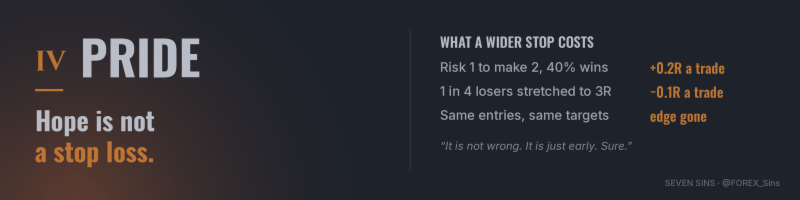
It also breaks the maths your strategy depends on. Take a strategy that risks 1 to make 2 and wins 40% of the time. It makes about +0.2R per trade. Now say that one in four of the losing trades gets "a bit more room" and ends up losing 3R instead of 1R. The result: 0.4 × 2 − 0.45 × 1 − 0.15 × 3 = −0.1R per trade. Same entries, same targets, and a winning strategy is now a losing one.
No stop at all is the same problem without a ceiling. Most of the time nothing happens. The one time it does is the one you remember.
What helps
1. Place the stop before, or the moment, you enter. If you cannot say where you are wrong, you do not have a trade yet.
2. Size the trade from the stop, not the stop from the size. Decide the risk first, then work out the lot size.
3. A stop only moves one way: towards profit. Break-even or trailing is fine. Further away is not.
4. If you really believe the idea is still good after you are stopped out, take it again later as a new trade with a new stop. That is a decision. Moving the stop is a hope.
How Seven Sins handles it
Pride is one of the seven rules Seven Sins watches. It reacts in three cases: a trade still has no stop loss after a grace period you set (60 seconds by default), a stop is removed, or a stop is moved further away. Moving a stop closer, to break-even or to trail a winner, never counts.
When it happens, a card appears on your charts with what you did, for example "Stop loss moved 20.2 pips further away.", the old and new stop, and a one-liner such as "Hope is not a stop loss." Your clean-day streak goes back to zero.
It doesn't stop you moving the stop, and it never changes your trade. It just makes sure you know you did it.

Your turn
Have you ever moved a stop further away and been glad you did? And the time it didn't come back: how much did it cost? Tell me in the comments.
Seven Sins is free on the MQL5 Market:
Two-minute setup guide: https://www.mql5.com/en/blogs/post/777187
Earlier in the series: Wrath https://www.mql5.com/en/blogs/post/777337 · Lust https://www.mql5.com/en/blogs/post/777716
Trading involves risk. Seven Sins does not trade and does not promise any change in results; it reminds you of the rules you set yourself.