Beyond Price Action: How Modern Econophysics Validates the iVISTscalp5 Temporal Framework

Beyond Price Action: How Modern Econophysics Validates the iVISTscalp5 Temporal Framework
It is important to emphasize that our methodology grew from empirical market testing rather than abstract theory. Our team developed the foundational timing calculation algorithms back in 2018, successfully mapping out future liquidity injections across financial instruments up to a week in advance. By 2021, these empirical findings were formalized into the advanced indicator known today as iVISTscalp5.

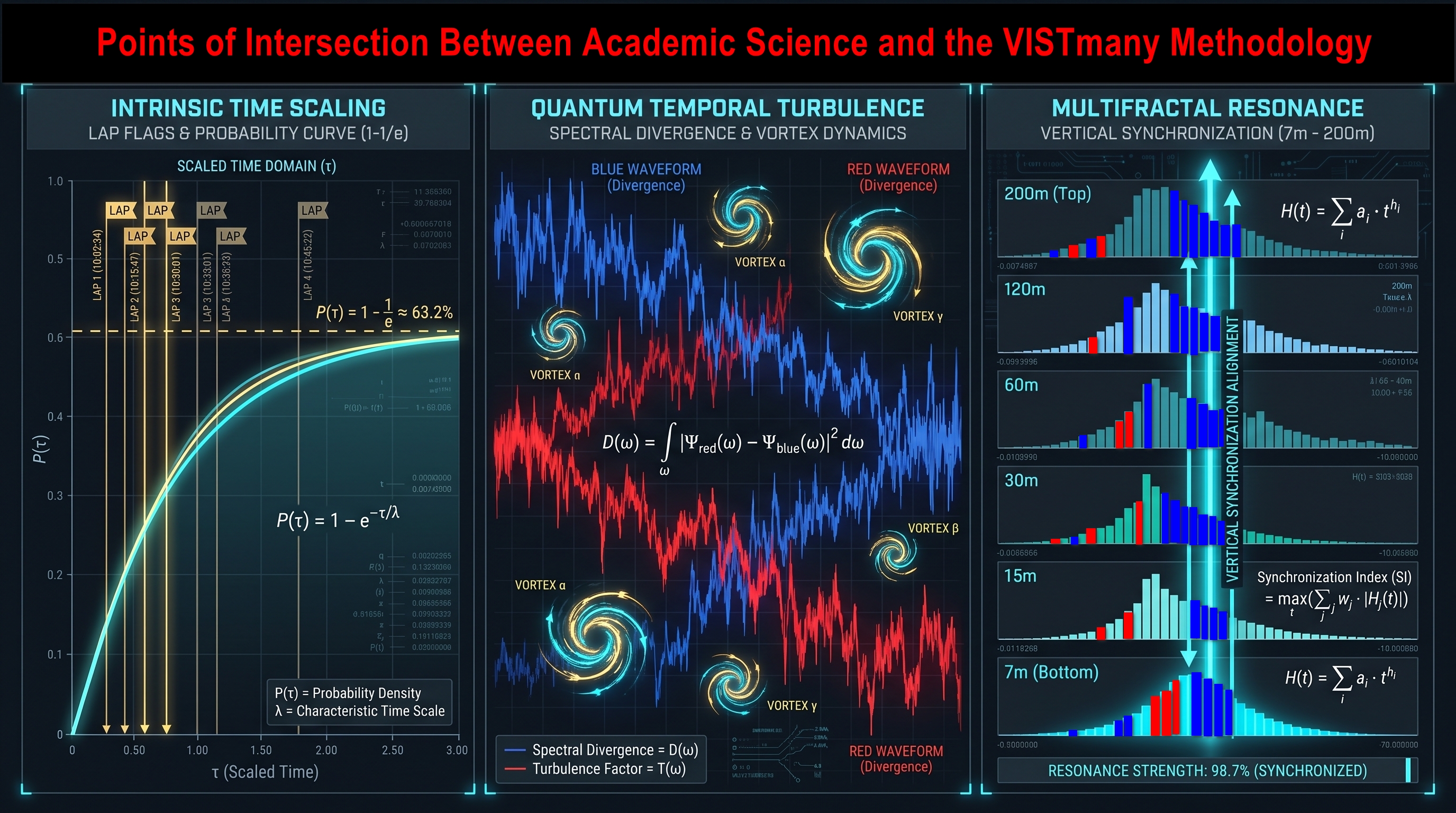
- The Academic View: The Theory of Intrinsic Time (Cornell University, 2024) argues that market time doesn't tick uniformly. Instead, it advances in discrete, event-driven steps, governed by scaling laws tied to specific structural activation thresholds.
- The iVISTscalp5 Application: We visualize this exact phenomenon through "Horizontal Spectra." The indicator tracks the accumulation of signal density (LAP) within specific temporal zones. While academia primarily applies these models retrospectively to historical data, iVISTscalp5 utilizes horizontal density predictively to forecast the precise moments of impending liquidity bursts.

- The Academic View: Can market cycle renewals be mathematically quantified? Research such as How $1-1/e$ Defines Scaling in Intrinsic Time (Thomas Houweling, 2025) models market microstructure as an exponential process, proving that market rhythms exhibit remarkable mathematical stability.
- The iVISTscalp5 Application: Our data since 2018 corroborates that market cycles follow structured patterns rather than pure chaos. Using the Time Language VISTmany (TLV) framework, our algorithm calculates the statistical probability of price reverting to a timing's origin (Start Price) and hitting predefined Target levels. It is highly encouraging to see our practical probabilistic models validated by modern academic research.
- The Academic View: What occurs when differing time-scale vectors clash? A 2024 MDPI study, Quantum Temporal Winds: Turbulence in Financial Markets, utilizes hydrodynamic principles to explain market chaos, defining it as turbulent vortices created by conflicting energy flows.
- The iVISTscalp5 Application: In our ecosystem, this is known as "Spectral Divergence." If short-term micro-timings (e.g., 7–15 min) generate a BUY signal while macro-timings (60 min) dictate SELL, a structural anomaly occurs. Visually, this translates to erratic price action with deep, unpredictable wicks. iVISTscalp5 automatically flags these desynchronized zones as high-risk environments, allowing traders to filter them out of their algorithms.
- The Academic View: Conversely, what creates a smooth, directional market impulse? Research into Multifractal Time Series (2025) highlights that the synchronization of different time scales (multi-scaling) triggers massive volatility clustering and robust trends. ( https://arxiv.org/abs/2507.23414 )
- The iVISTscalp5 Application: We define this mechanism as the "Law of Temporal Resonance" (or Vertical Synchronization). When the calculated schedules of multiple timeframes converge at a single, exact moment, resonance is achieved. Cycle conflict is eliminated, drastically increasing the probability of a clean, unidirectional price surge.
- Time (LAP): The exact activation point for market liquidity.
- Vector: The highly probable direction of the resulting impulse (BUY/SELL).
- Average Range: The expected amplitude and target zones of the movement.
For our team, time is not just a background scale; it is the primary actionable coordinate. We are committed to refining our tools to make the analysis of Temporal Space an intuitive standard for modern traders.
*******************************************
Official resources• VISTmany website: https://vistmany.com/vistlab
• iVISTscalp5 on the MQL5 Market: https://www.mql5.com/en/market/product/70310
• Official VISTmany YouTube channel: https://www.youtube.com/@vistmany557
© VISTmany Research Journal
Exploring the architecture of Temporal Space in financial markets.
The VISTmany research archive includes more than 900 publicly documented trading examples based on timing forecasts published in advance.
These examples provide a practical record for studying how forecasted temporal structures correspond to subsequent market behavior.
YouTube - VISTmany Scientific Research