Compounding Is Not Martingale: The Same Strategy, Two Very Different Numbers

Compounding Is Not Martingale: The Same Strategy, Two Very Different Numbers
"Your backtest made $64,000 from a $1,000 account. That has to be martingale."
I get this message a lot, so let me answer it properly — with numbers, not promises. The short version: compounding and martingale are two completely different things, and there is a simple test that tells them apart in ten seconds. Here it is.
Two words people mix up
🔸 Martingale increases lot size after a loss. Lose, double down; lose again, double again — chasing a single winner to erase the whole streak. Risk grows precisely when the system is already hurting. One bad run ends the account.
🔸 Compounding increases lot size as the balance grows. Win over time, the account gets bigger, and each position is sized to that bigger balance. Risk grows only after the profit is already booked. Losing trades never make the next lot larger.
Both make the equity curve steeper. That is the only thing they have in common — and it is why people confuse them. But under the hood they are opposites: one adds risk after losses, the other adds size after wins.
The ten-second test: watch the Profit Factor
Here is the trick nobody tells you. Run the exact same strategy twice over the exact same period — once with a fixed lot (no compounding at all), once with compounding — and compare the Profit Factor.
If it is real compounding, the Profit Factor barely moves. If it is martingale in disguise, it swings wildly, because the risk structure itself is changing.
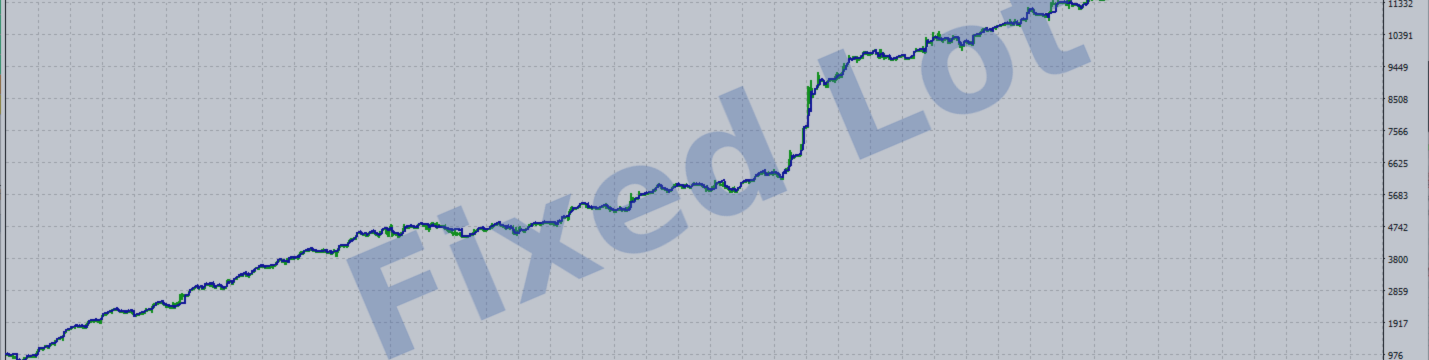
Here is GoldDragon over the identical 21-month period, 2,542 trades, 99% tick quality:
| Mode | Deposit | Net Profit | Max Equity DD | Profit Factor | Recovery |
|---|---|---|---|---|---|
| Fixed lot (no compounding) | $1,000 | $14,410 | 5.34% | 2.00 | 25.64 |
| Safe (5x compounding) | $1,000 | $64,068 | 6.94% | 1.96 | 22.82 |
Look at the two columns on the right. Net profit jumps from $14,410 to $64,068 — more than four times as much. But the Profit Factor moves from 2.00 to 1.96. Essentially unchanged.
That is the fingerprint of honest compounding. The strategy is winning and losing in the exact same proportion in both runs — the profit-to-loss ratio is identical. The bigger dollar figure comes purely from the balance growing over 21 months, so later trades are sized to a larger account. Nothing about the risk logic changed. If this were martingale, that 2.00 would not survive contact with compounding — it would balloon or collapse.
Where does the extra profit come from, then?
Simple arithmetic. In the fixed-lot run, a trade in month 20 uses the same lot as a trade in month 1 — the $1,000 starting size. In the compounding run, by month 20 the balance has grown, so the same percentage risk translates into a larger lot. Same trades, same win rate, same stop distances — just applied to a bigger number.
The strategy did not get more aggressive. The account got bigger. That is the entire difference.
Why I show you the fixed-lot row at all
Most sellers only show you the compounded number, because it is the big, exciting one. I show both — and I put the fixed-lot row first in every product table — because the fixed-lot run is the honest X-ray of the strategy. Strip away compounding and you see the raw engine: Profit Factor 2.00, recovery factor 25.64, 5.34% maximum drawdown, $14,410 over 21 months. That is what you are actually buying. The compounding is just a sizing method on top of it.
And because the drawdown scales cleanly with the position multiplier — 5.3% fixed → 6.9% (Safe) → 10.3% (Standard) → 14.9% (Aggressive) — you can pick the grade that matches your risk appetite without changing a single line of the strategy.
The bottom line
Compounding grows your lots after wins. Martingale grows them after losses. GoldDragon does the first and never the second — every position carries a fixed stop loss, no lot is ever increased to recover a loser, and the Profit Factor stays put whether you compound or not. That is the whole point of showing you both rows.
Don't take my word for it. Download the free demo, run it in fixed-lot mode and compounding mode, and compare the Profit Factor yourself. Then watch it live:
🛡️ Live signal (every trade published automatically): GoldDragon Safe Live
📖 Related reading: Why My Profit Factor Is Only 2.0 — And How to Spot a Martingale EA
Get GoldDragon
All three grades share 100% identical entry and exit logic. Same trades, same direction — only the position-size cap differs.
✅ Start here (5x): GoldDragon Safe — conservative grade, recommended for a $1,000 account.
⚖️ Balanced (10x): GoldDragon Standard — for $2,000+.
🚀 Maximum growth (20x): GoldDragon Aggressive — for experienced users who accept larger drawdowns.
🎁 Bonus: buy Standard or Aggressive, share your live results (minimum 10 trading days), and receive the Safe grade free — it runs on the same account. Details by private message after purchase.
Risk disclosure: past performance does not guarantee future results. Trading XAUUSD and CFDs carries financial risk. Always test on a demo account first and start with conservative position sizing.