
Grid Trading: Why Mean Reversion and Risk Diversification Matter

Grid Trading: Why Mean Reversion and Risk Diversification Matter
Some traders consider them one of the most interesting ways to exploit the statistical behaviour of financial markets. Others associate them almost exclusively with excessive exposure, martingale systems and potentially dangerous drawdowns.
Both views can make sense — depending on how the grid is designed.
The important question is therefore not simply:
"Is grid trading good or bad?"
A more useful question is:
"Under which market conditions does a grid have a statistical rationale, and how can its risks be controlled?"
SQUID GRID AI is a sophisticated grid-based system capitalizing on mean reversion opportunities across 6 uncorrelated assets, optimizing portfolio weight to maximize profits while managing risk with AI-driven market monitoring.
[ Live Signal ] - [ Dedicated group | Version MT5 - MT4 ]
📌 1. The statistical idea behind a grid
Many grid strategies are based on mean reversion: prices frequently move away from a reference level and subsequently retrace toward it.
A grid can progressively build positions as price moves away from this reference, improving the average entry price and allowing the basket to benefit from a subsequent retracement.
But mean reversion is a statistical tendency, not a guarantee.
A prolonged directional move can create significant floating losses. This is why the real question is not simply whether a grid can profit from mean reversion, but what happens when mean reversion temporarily disappears.
📌 2. Why diversify a grid across several assets?
A grid concentrated on one instrument is heavily dependent on that market behaving as expected.
Using several instruments with different characteristics can distribute this exposure and reduce dependence on a single market.
This is one of the principles behind SquidGRID AI, which operates across six instruments:
- XAUUSD
- EURUSD
- EURJPY
- GBPNZD
- AUDCAD
- USDCAD
The objective is not to eliminate risk, but to avoid having the entire strategy depend on the behaviour of one market.
SquidGRID also uses exposure limits, correlation monitoring, market-condition analysis and position protection. Importantly, it does not use martingale.
📌 3. Profit withdrawal is part of risk management
There is another aspect of grid trading that deserves more attention: what you do with the profits once they have been generated.
Instead of allowing all accumulated profits to remain permanently exposed to future market movements, a trader can define withdrawal thresholds.
For example:
- Allow the account to grow.
- When a predefined threshold is reached, review the position.
- Withdraw part of the accumulated profit.
- Continue trading with a controlled capital base.
A 20% growth threshold can therefore be used as a simple operational rule.
SquidGRID includes an integrated withdrawal warning to remind the user when the configured profit threshold has been reached.
This does not remove trading risk, but it can help prevent accumulated profits from remaining unnecessarily exposed to future market risk.
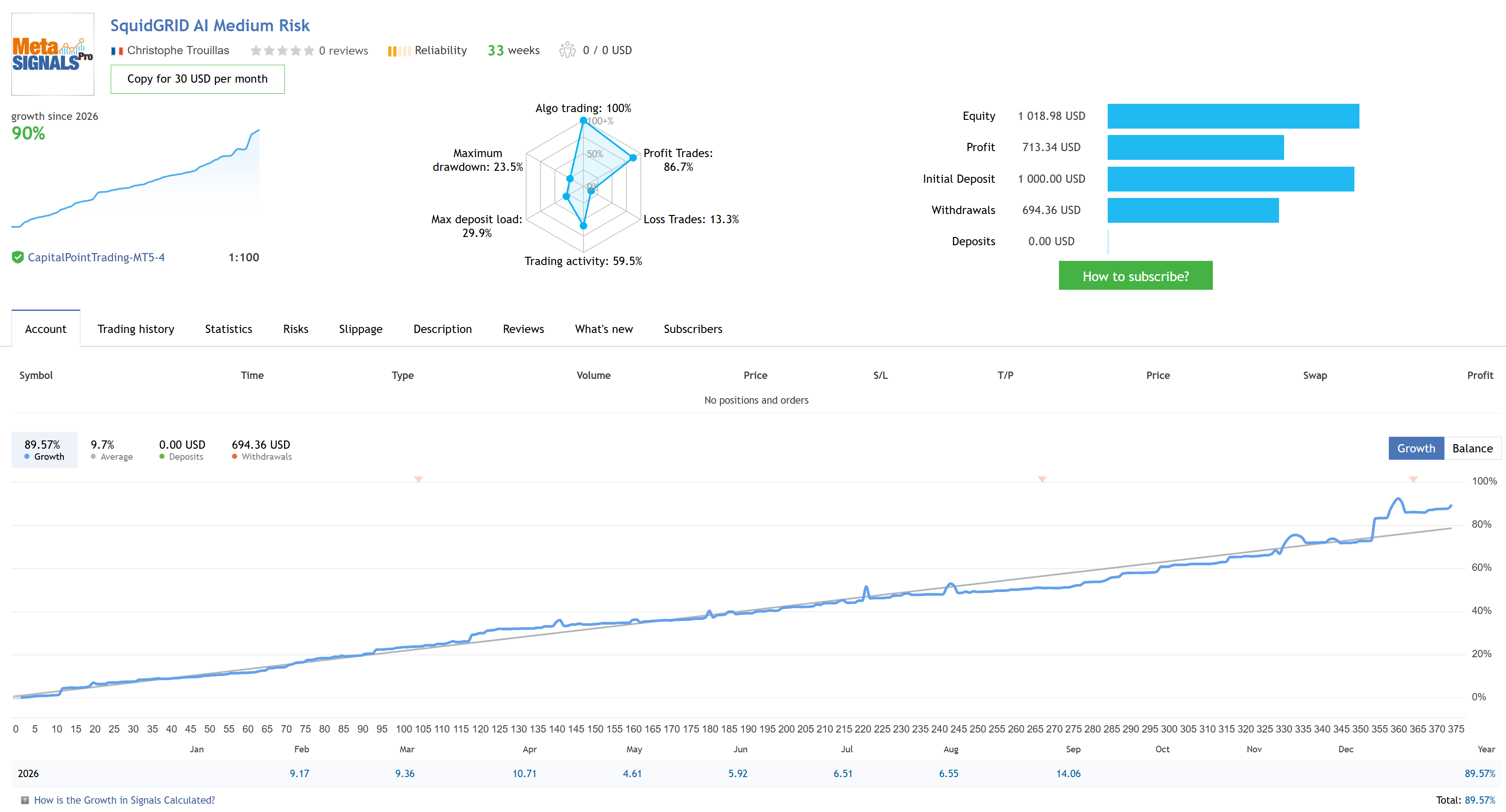
// SquidGRID - RESULTS UPDATE //
✅ 3rd withdrawal
🔹 70% of capital protected
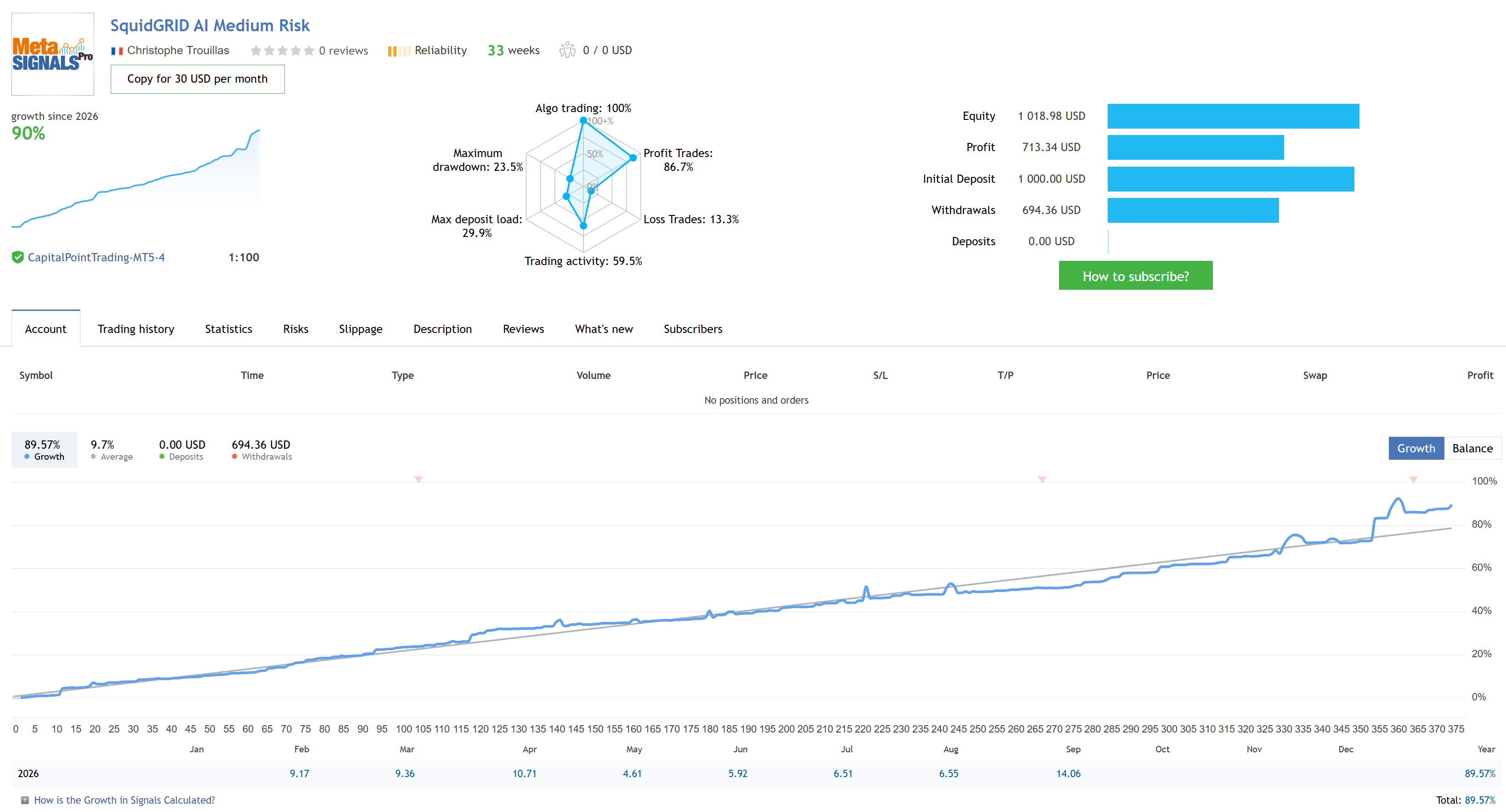
🔹 Return > 80% in less than 6 months
4. The real test is the live market
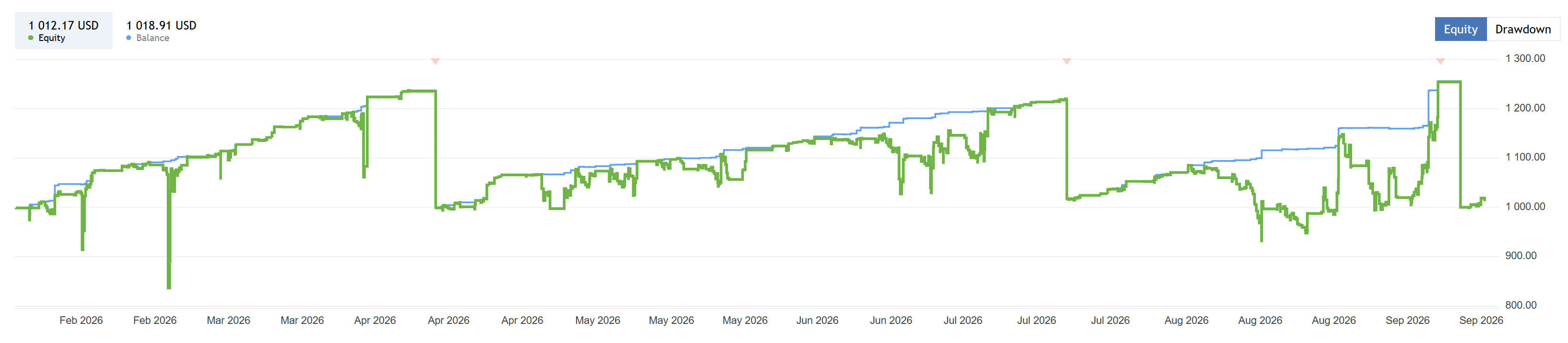
SquidGRID's live track record is currently approaching an interesting milestone: +100% growth.
Backtests can help us understand how a strategy behaved historically, but live trading provides another layer of information: changing volatility, correlations, market regimes and execution conditions.
The important question is not whether such a result can be guaranteed. It cannot.
The interesting question is how a multi-asset grid behaves as real market conditions evolve.
Past performance does not guarantee future results. Grid strategies can experience substantial drawdowns, particularly during prolonged directional markets.
SQUID GRID AI is a sophisticated grid-based system capitalizing on mean reversion opportunities across 6 uncorrelated assets, optimizing portfolio weight to maximize profits while managing risk with AI-driven market monitoring.
[ Live Signal ] - [ Dedicated group | Version MT5 - MT4 ]
Conclusion
- What statistical behaviour is being exploited?
- What happens when that behaviour disappears?
- How is exposure diversified?
- What limits the grid?
- How are accumulated profits managed?
When evaluating a grid strategy, I believe it is more useful to look beyond the headline return and ask:
These questions are relevant for anyone considering automated grid trading.
🔹 At MetaSignalsPro, we commit to deliver high quality Experts Advisors
Trading is a long and beautiful journey but with a lot of traps. Trade safe.📍 Verified Live Signals: we will provide third-party signal, on Myfxbook or Mql5 Live Signals where clients can see performance and equity curves with transparency.
📍 Verified Backtests: we check that the Live signals are aligned with the backtests in order to keep their metrics reliable for monitoring.
📍 Walk-Forward Tests: we will demonstrate how our EA performs not only on historical data but in future market conditions.
📍 Full Transparency: we will be transparent about potential weaknesses, such as periods of underperformance, drawdowns, or specific market conditions that can cause losses.
📍 Include Real Costs: our backtests account for slippage, spreads, commissions, and other real-world trading costs.
MetaSignalsPro Team
Trading easier, faster and safer
---------------------------
📚 Continue Your Learning
Setting new standards of Ethics and Robustness in algo trading
A Modern Framework for Risk Diversification in Automated Trading
How to evaluate an algo before you buy it
How to identify unauthorized seller scam sites
How to become profitable in Manual Trading: a step-by-step guide
💪 Join Our Community
💪 Join our MQL5 Public Group
💪 Join our MQL5 Public Group on algos: