XAUUSD M5 Market Review — September 3–4: A Stop, a Strong Move, and the Structure Filter
6 September 2026, 14:23

0
107
In my original 17-trade XAUUSD M5 test, I defined one fixed TrendCue workflow and applied it to every valid setup from August 3 to 19:
[Can TrendCue Smart Trend Pass a Prop Firm Test?](https://www.mql5.com/en/blogs/post/774592)
Since that test ended, I have continued reviewing the market with the same setup and publishing the analysis as new setups appeared.
The posts below are recent examples from that ongoing review:
[August 28–September 1 Market Review](https://www.mql5.com/en/blogs/post/775216)
[September 2 Follow-Up](https://www.mql5.com/en/blogs/post/775229)
This post continues the same process with September 3 and 4.
The setup remains:
- A defined session entry window
- TrendCue Structure as the hard directional filter
- A confirmed TrendCue signal for timing
- Adaptive SuperTrend as the initial risk reference
- Guardian for position management
The key rule is simple: a signal by itself is not a valid trade.
A BUY signal requires bullish Structure. A SELL signal requires bearish Structure. If Signal and Structure disagree, there is no setup.
[TrendCue Smart Trend for MetaTrader 5](https://www.mql5.com/en/market/product/174993)
## September 3 — One Stop, Then a Strong Bullish Move
September 3 produced two valid long setups during the defined entry window.
The first setup was correctly aligned: Structure was bullish and a confirmed BUY signal provided the timing.
The setup was valid, but price moved against it and reached the stop.
That result stays in the review. Alignment defines whether a setup qualifies; it does not guarantee that the trade will work.
Later, another confirmed BUY signal appeared while Structure was still bullish.
This second setup was also valid under exactly the same rules.
This time Gold developed into a strong directional move. Price advanced through each of the five marked target levels — TP1 to TP5 — and then continued higher beyond the displayed target ladder.
The important point is not that the second setup recovered the first loss.
The first valid setup failed, but that did not change the rules for the next one. The second setup still had to qualify independently under the same Structure and Signal conditions.
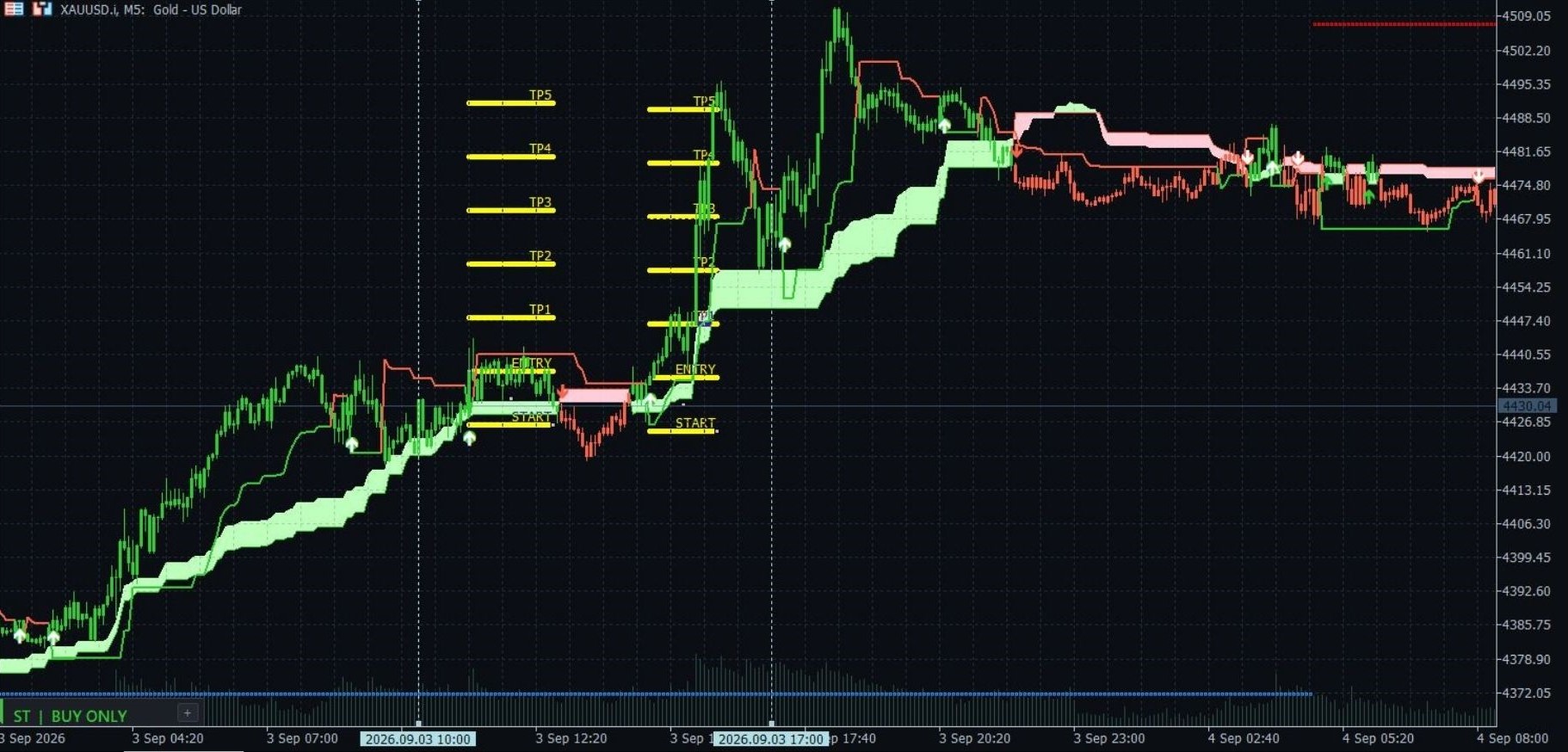
*September 3, XAUUSD M5 — the first valid long reaches the stop; the later aligned BUY setup develops into a strong move through all five marked target levels.*
## September 4 — Signals Without a Valid Setup
September 4 is a useful example of why TrendCue Structure is part of the workflow.
TrendCue printed timing signals during the session, but neither qualified as a valid trade.
At the BUY signal, TrendCue Structure was bearish.
The signal pointed higher while Structure pointed lower, so the BUY signal was ignored.
Later, a SELL signal appeared while TrendCue Structure was bullish.
Again, Signal and Structure were not aligned, so the SELL signal was ignored.
The chart annotations show Signal and Structure separately because they serve different purposes.
Signal provides the timing.
Structure defines the direction the workflow allows me to trade.
A signal becomes a valid setup only when both are aligned at the time of the decision.
An arrow on the chart by itself is not enough.
It is also important not to judge those decisions by what price did afterward.
The rule is applied before the outcome is known.
Bearish Structure plus a BUY signal means no trade.
Bullish Structure plus a SELL signal also means no trade.
That is the purpose of the Structure filter: not to make every signal correct, but to define which signals qualify for action.
Sometimes the correct decision is simply to stay out.
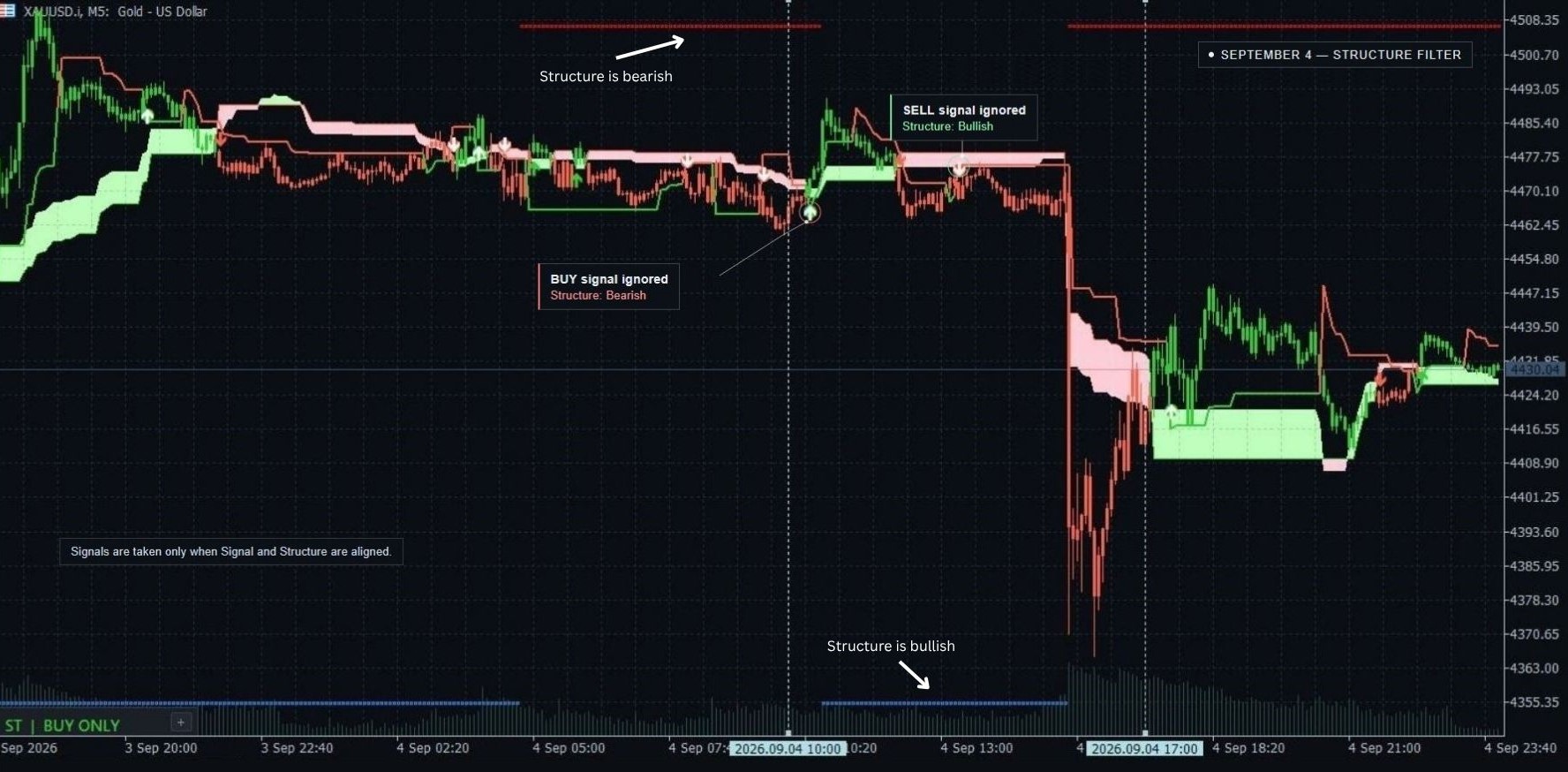
*September 4, XAUUSD M5 — the BUY signal is rejected under bearish Structure, and the later SELL signal is rejected under bullish Structure. Neither signal qualifies as a trade.*
## The Lesson from Both Sessions
September 3 shows what can happen when valid setups are taken under the rules: one can fail, and the next can still develop into a strong move.
September 4 shows the other side of the same workflow: sometimes the correct decision is not to trade because Signal and Structure disagree.
The purpose of these market reviews is to show how the same TrendCue workflow behaves under different market conditions, not to document every signal across every symbol.
TrendCue also produces setups on other markets and timeframes, and anyone who wants to explore them can use the demo directly in MT5:
[TrendCue Smart Trend for MetaTrader 5](https://www.mql5.com/en/market/product/174993)
The best way to evaluate the workflow is to replay different periods yourself and watch how Structure, Signal, risk and trade management develop candle by candle.
Trading involves risk. Historical results and chart examples do not guarantee future performance.