Quality Over Quantity: Why More Trading Setups Don’t Mean More Opportunity

One of the easiest traps in technical trading is believing that more opportunities must lead to better results.
A trader opens the chart and immediately begins searching.
There is an imbalance.
There is another one.
A candle pattern appears.
Price reaches a previous high.
An indicator changes direction.
Something is almost always happening.
The temptation is to turn every technical observation into a potential trade.
But there is an important distinction:
A setup existing on the chart does not automatically mean the setup is worth trading.
Learning to reject mediocre opportunities can be just as important as learning to recognize good ones.
The Market Produces Signals Constantly
Modern trading platforms can display enormous amounts of information.
Indicators update.
Patterns form.
Levels are touched.
Fair Value Gaps appear.
Momentum changes.
Previous highs and lows are tested.
If your only requirement is finding something technically interesting, you can probably find it almost continuously.
That creates a dangerous illusion of opportunity.
The chart is active, therefore the trader feels they should also be active.
But activity and opportunity are not the same thing.
Sometimes the market is providing a clear, structured environment.
Sometimes it is producing noise.
The trader's job is not simply to identify signals.
It is to decide which information actually deserves attention.
A Fair Value Gap Is Not Automatically a Trade
This principle is especially important when trading Fair Value Gaps.
An FVG can tell us that price moved through an area with meaningful imbalance.
That can make the area worth observing.
But Fair Value Gaps can appear in many different environments.
One may form during clean directional expansion.
Another may appear inside chaotic consolidation.
One may exist near meaningful market structure.
Another may sit in the middle of nowhere.
One may receive a convincing response.
Another may be traded through without hesitation.
The visual pattern may be similar.
The quality of the surrounding opportunity can be completely different.
This is why identifying an FVG should begin the analysis rather than end it.
Frequency Can Become Addictive
There is a psychological reason traders often prefer strategies that produce many signals.
Waiting is uncomfortable.
Taking action feels productive.
If the market has not produced a trade for some time, traders can begin lowering their standards without realizing it.
A setup that would have been rejected earlier suddenly looks acceptable.
Then another.
Soon the trading plan has changed from:
“Take the right setup.”
to:
“Find something to trade.”
That transition can be extremely damaging.
Professional selectivity often feels boring.
That is not necessarily a weakness.
Opportunity Should Be Earned
Instead of assuming every signal is an opportunity, consider reversing the logic.
Make the market prove that the setup deserves your attention.
An imbalance appears?
Interesting.
What is the surrounding structure?
Price approaches a previous extreme?
Interesting.
How does the market respond?
Momentum increases?
Interesting.
Where is that acceleration occurring?
The word interesting is useful because it prevents observations from immediately becoming trades.
Each piece of information earns the right to move the setup further through your decision process.
Structure Can Separate Quality From Noise
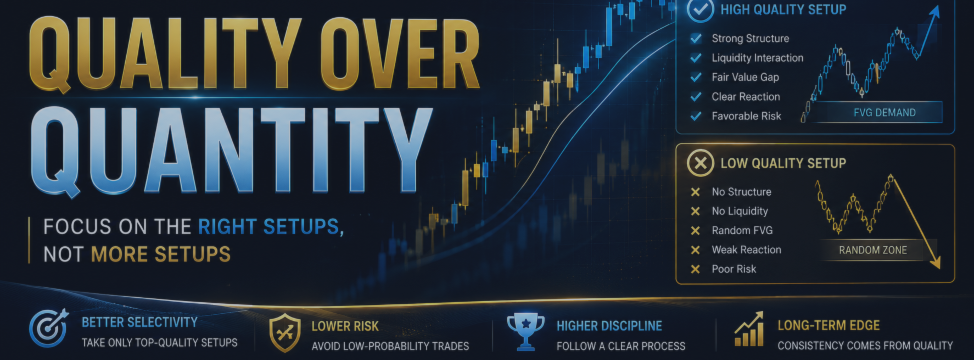
Imagine two bullish Fair Value Gaps.
The first forms inside a market repeatedly moving back and forth through the same price area.
There is little directional progression and price frequently crosses previous levels.
The second appears during a market displaying much cleaner directional structure.
The rectangles themselves may look similar.
The environment does not.
This demonstrates why setup quality cannot be determined from one technical feature alone.
Market structure provides context.
Without context, traders can end up treating every appearance of a pattern as though it carries equal meaning.
It does not.
Location Matters More Than Frequency
Suppose your strategy identifies ten potential setups during a session.
Eight occur in mediocre locations.
Two occur in areas where several meaningful market factors are present.
The objective should not automatically be to trade all ten.
The fact that a setup appears frequently does not make each occurrence valuable.
In many areas of trading, location improves interpretation.
Where did the setup form?
What happened before it?
What important price areas are nearby?
Has price already travelled significantly?
Is the market currently clean or erratic?
These questions help determine whether the technical pattern is occurring somewhere meaningful.
Liquidity Can Improve Context
Previous highs and lows can provide another layer of information because they often represent visible areas of market interest.
But liquidity should not become another automatic signal.
The useful question is not simply:
“Was liquidity taken?”
Instead ask:
“What happened after price interacted with that liquidity?”
Did price reject the area?
Did it accept beyond it?
Did the interaction align with broader structure?
Did it produce meaningful displacement?
The event becomes more useful when interpreted as part of the market sequence.
Reaction Quality Matters
A setup can look excellent before price reaches it.
Then the actual reaction can tell a completely different story.
Suppose price enters an area you were watching.
You expected decisive rejection.
Instead, price drifts through it.
There is little response.
The expected directional participation never appears.
At that point, the setup has provided new information:
The market is not behaving as expected.
A selective trader should be willing to reduce confidence or abandon the idea.
A trader focused on frequency may take the trade anyway simply because the original setup existed.
This is a critical difference.
A Setup Can Lose Quality
Trade quality is not frozen at the moment a pattern forms.
Conditions change.
A strong initial setup can deteriorate.
Price can become extended.
Structure can change.
The expected reaction can fail.
The market can move into consolidation.
New information can invalidate the reason you were interested in the setup.
This means quality should be evaluated continuously until the trade is actually taken.
Do not become emotionally attached to an opportunity simply because you identified it first.
Missing a Trade Is Not a Loss
This is one of the hardest ideas for active traders to accept.
You identify an area.
Price approaches it.
The market moves quickly without providing the conditions you wanted.
The move then continues exactly in the direction you expected.
It is tempting to think:
“I missed profit.”
But you did not lose money.
You followed your process.
A trade that moved without satisfying your requirements was simply a move you did not participate in.
There will always be another market movement.
Chasing an opportunity because you regret missing the previous one can create a much more expensive problem.
More Trades Create More Decisions
Every trade creates additional decisions.
Where do you enter?
Where is invalidation?
How much risk is appropriate?
Should you hold?
Should you exit?
Has the setup changed?
The more positions a trader takes, the more execution decisions they must make.
If those additional trades are high quality, that may be justified.
If they exist only because the trader wants greater activity, they create additional opportunities for mistakes.
Frequency therefore has a hidden cost:
decision load.
Selective trading can reduce that load and allow greater attention to the opportunities that genuinely matter.
Quality Does Not Mean Perfection
There is an important distinction here.
Waiting for quality does not mean waiting for a perfect setup.
Perfect trades do not exist.
Every trade contains uncertainty.
If traders demand absolute confirmation, they may never participate.
Quality means the setup satisfies the important conditions defined by your trading process.
It does not mean the trade cannot lose.
A high-quality setup can fail.
A low-quality setup can win.
Individual outcomes do not automatically prove whether the decision process was good.
This is why traders should judge execution over a meaningful series of decisions rather than from one result.
Do Not Judge Quality by the Outcome
Suppose you ignore your trading rules and enter a poor setup.
The trade wins.
Was it suddenly a good decision?
Not necessarily.
Now suppose you follow your process perfectly, take a well-defined setup, manage risk appropriately and the trade loses.
Was the analysis automatically bad?
Again, not necessarily.
Markets contain uncertainty.
Good trading decisions can produce losses.
Bad trading decisions can occasionally produce profits.
If traders judge quality only from the final result, they can accidentally train themselves to repeat poor behaviour.
Evaluate the process separately from the outcome.
Define What Makes a Setup Worth Taking
A selective trading approach requires clear standards.
You should be able to explain why one setup deserves participation while another does not.
The criteria will vary between strategies, but the thinking process might include questions such as:
Is the market environment appropriate?
Does the structure support the idea?
Is the setup located somewhere meaningful?
Has relevant liquidity interacted with price?
Does the imbalance make sense in context?
Is current price behaviour supporting the thesis?
Can invalidation be defined logically?
Is the risk reasonable from the available entry?
Notice that none of these questions asks:
“How many trades have I taken today?”
That should not determine whether the next setup is good.
Beware of Daily Trade Quotas
Some traders decide in advance that they need a certain number of trades each day.
This can create a subtle conflict.
What happens if the market does not provide enough high-quality setups?
The trader now has two choices.
Accept fewer trades.
Or lower the standards.
If the objective is meeting a trade quota, standards often lose.
Markets do not owe traders a fixed number of opportunities every day.
Some sessions may provide several excellent conditions.
Others may provide almost nothing suitable for a particular strategy.
A trading process should adapt to the market rather than forcing the market to satisfy an activity target.
Selectivity Can Improve Review Quality
Fewer, better-defined trades are also easier to review.
If every small technical event becomes a position, the trading journal fills with noise.
It becomes difficult to determine which setups actually matter.
A more selective process creates cleaner data.
You can examine:
- what conditions were present,
- what the market did afterward,
- why the setup was accepted,
- why similar setups were rejected,
- and whether your selection criteria are actually useful.
This makes refinement more meaningful.
Where LiquidityLabs FVG PRO Fits
This philosophy is directly relevant to LiquidityLabs FVG PRO for MetaTrader 5.
The purpose of identifying imbalance is not to encourage traders to take every Fair Value Gap that appears.
An FVG should be understood within its surrounding market context.
LiquidityLabs FVG PRO is designed to organize relevant imbalance and developing setup information visually so traders can focus on the setups that deserve attention rather than simply accumulating rectangles across the chart.
Its proprietary timeframe architecture, thresholds, formulas, filters and exact confirmation logic are intentionally not disclosed.
The broader educational principle is much simpler:
Finding more FVGs is easy. Deciding which ones matter is the real work.
A Simple Quality-First Framework
Before acting on a setup, try moving it through five stages.
Stage 1: Identification
Something technically interesting has appeared.
Do not trade yet.
Stage 2: Context
Determine whether the surrounding market supports the idea.
Stage 3: Location
Ask whether the setup exists somewhere meaningful.
Stage 4: Behaviour
Observe how price actually responds.
Stage 5: Risk
Decide whether the trade can be executed with logical invalidation and acceptable risk.
If the setup fails an important stage, reject it.
There is no requirement to replace it immediately.
The Goal Is Not Fewer Trades
It is worth clarifying that selective trading does not mean deliberately minimizing the number of trades.
The objective is not:
Trade less.
The objective is:
Do not manufacture trades that do not meet your standards.
If the market produces several high-quality setups, there may be several valid opportunities.
If it produces none, the correct number may be zero.
Quality determines frequency.
Frequency should not determine quality.
Final Thoughts
Trading platforms make it easy to find signals.
The difficult skill is deciding which signals deserve action.
An FVG can appear without creating a good trade.
Liquidity can be taken without producing a reversal.
Momentum can increase at a poor location.
A pattern can form inside meaningless noise.
Technical observations become useful when they exist within a coherent market context.
Do not measure the quality of a trading day by how many positions you opened.
Measure the quality of your decisions.
Did you understand the market environment?
Did you wait for meaningful location?
Did price behave as expected?
Was risk logical?
Did you reject setups that did not deserve your capital?
Those questions matter far more than the trade count.
Your job is not to trade everything the market shows you. Your job is to recognize when the market has shown you enough.
LiquidityLabs FVG PRO for MetaTrader 5:
https://www.mql5.com/en/market/product/189564
Trading-risk disclaimer: Trading Forex, CFDs, cryptocurrencies and other leveraged instruments involves substantial risk and may not be suitable for every trader. Fair Value Gaps, price-action analysis, technical indicators and setup-selection methods cannot guarantee future market behaviour or profitable results. Always evaluate trades independently and use appropriate risk management.