A Winning Trade Can Be a Bad Trade: Why Process Matters More Than One Outcome

A trader ignores the plan, enters late, risks too much and gets lucky.
The trade wins.
Another trader waits patiently, follows a well-defined setup, manages risk correctly and takes a loss.
Which trader made the better decision?
If we judge only by the money made or lost on those two trades, the answer appears obvious.
The first trader won.
The second trader lost.
But trading cannot be evaluated that simply.
A profitable outcome does not automatically prove that the decision was good.
And a losing outcome does not automatically prove that the decision was bad.
Understanding this distinction is fundamental to developing a repeatable trading process.
Markets Operate Under Uncertainty
When you enter a trade, you do not know exactly what will happen next.
You have information.
You have observations.
You may have market structure, liquidity, imbalance, momentum and other evidence supporting an idea.
But you do not have certainty.
That means every trading decision is made under uncertainty.
The best a trader can do is make a reasonable decision using the information available at the time and control the amount of risk attached to that decision.
The final outcome is determined afterward.
This distinction matters enormously.
Good Decisions Can Lose
Suppose a trader identifies a meaningful structural area.
Price approaches it.
A relevant imbalance exists nearby.
The market begins behaving in a way that supports the trader's thesis.
Risk is defined.
Position size is appropriate.
The trade is taken according to plan.
Then unexpected selling enters and the setup fails.
Was the trade automatically a mistake?
No.
The market simply produced an outcome that was possible from the beginning.
The trader's responsibility was never to guarantee the result.
The responsibility was to make a disciplined decision and manage the uncertainty surrounding it.
Bad Decisions Can Win
Now consider the opposite situation.
A trader sees price accelerating upward.
There is no planned setup.
Fear of missing out takes over.
The trader buys after a large move, uses excessive size and has no clear invalidation.
Price continues higher.
The trader makes money.
Was that automatically excellent trading?
Again, no.
The outcome rewarded poor behaviour.
This is particularly dangerous because profitable mistakes can teach traders the wrong lesson.
The trader may think:
“That worked. I should do it again.”
Eventually the same behaviour can produce a very different outcome.
The Market Does Not Grade Your Process
Markets do not reward discipline on every trade.
They also do not punish poor discipline immediately.
That is what makes trading psychologically difficult.
If every bad decision lost money instantly and every good decision made money instantly, learning to trade would be much easier.
Instead, outcomes contain randomness and uncertainty.
A poor trade can win.
A strong setup can fail.
Therefore individual outcomes are unreliable teachers.
Patterns of decisions over time are far more useful.
Separate Decision Quality From Trade Outcome
A useful trading journal should evaluate at least two separate things.
Outcome: What happened?
Process: Did I execute the trade according to my plan?
These should not be combined into one judgment.
A trade could be:
Good process + winning outcome
Ideal.
Good process + losing outcome
Acceptable. Losses are part of trading.
Bad process + winning outcome
Dangerous because poor behaviour was rewarded.
Bad process + losing outcome
The clearest indication that something needs correction.
This simple framework can dramatically improve trade review.
Do Not Rewrite History After the Trade
Once the outcome is known, the chart suddenly looks obvious.
A winning trade makes the original setup appear stronger than it actually looked beforehand.
A losing trade makes every warning sign seem obvious in hindsight.
This is called hindsight bias.
The trader begins judging the decision using information that was not available when the decision was made.
That is unfair analysis.
To evaluate a trade properly, try to reconstruct what you actually knew at entry.
What structure was visible?
What was price doing?
What risks were identifiable?
What evidence supported the thesis?
What would have invalidated it?
Then evaluate the decision from that perspective.
Screenshots Before Entry Can Be Valuable
One practical way to reduce hindsight bias is to capture the chart before entering.
Record why the setup exists.
Record what you expect.
Record what would invalidate the idea.
Then review the same chart after the trade.
This creates a much more honest comparison.
You can see whether the original reasoning was sound rather than unconsciously rewriting the story based on the result.
Fair Value Gaps Are Observations, Not Guarantees
This principle is especially important when working with Fair Value Gaps.
An FVG can identify an area where price previously moved with imbalance.
That information can contribute to a trading thesis.
It does not guarantee that price will react in a specific way when it returns.
A trader can identify a legitimate FVG, evaluate the surrounding structure, observe a reasonable response and still take a loss.
That does not automatically make FVG analysis useless.
Likewise, randomly trading every visible FVG and getting one profitable result does not validate the process.
The setup needs to be evaluated across repeated decisions.
One Trade Proves Very Little
Humans naturally place too much importance on recent experiences.
One excellent winner can create excessive confidence.
One frustrating loss can make a trader abandon an otherwise reasonable process.
Neither response is particularly useful.
Trading methods should be evaluated across meaningful samples, not isolated outcomes.
The question is not:
“Did this trade win?”
The more useful question is:
“Does this decision process produce acceptable results across many properly executed opportunities?”
That requires patience and record keeping.
Process Creates Repeatability
An outcome cannot be repeated.
It already happened.
A process can.
You cannot control whether the next trade wins.
You can control whether you:
wait for your setup,
evaluate structure,
understand location,
define invalidation,
size the position appropriately,
avoid chasing,
and follow your execution plan.
These behaviours are repeatable.
That is why professional development should focus heavily on them.
Control What Can Actually Be Controlled
Trading contains both controllable and uncontrollable variables.
You cannot control:
- the next candle,
- unexpected market orders,
- sudden volatility,
- whether price reaches your target,
- or whether the next valid setup wins.
You can control:
- which setups you take,
- how much you risk,
- where you enter,
- whether you chase,
- whether you follow invalidation,
- whether you trade during conditions you do not understand,
- and whether you follow your own rules.
Energy should be concentrated on the second group.
A Trading Plan Is a Decision Framework
A trading plan should not simply contain entry signals.
It should define how decisions are made.
For example:
What market environment is appropriate?
What structure should be present?
What makes a location interesting?
What behaviour supports the setup?
What invalidates it?
How will risk be controlled?
What conditions make the trade unacceptable?
This transforms trading from spontaneous prediction into a repeatable decision process.
Do Not Change the Rules After Every Loss
Suppose a properly executed setup loses.
The trader immediately adds another filter.
The next loss produces another rule.
Eventually the strategy contains so many conditions that it barely resembles the original method.
This is dangerous.
A single loss does not prove a rule is missing.
Losses are expected in any uncertain environment.
Changes should be based on meaningful evidence across repeated observations, not emotional reactions to individual trades.
Do Not Increase Risk After Every Win
Winning streaks create the opposite problem.
A trader executes several successful trades.
Confidence increases.
Position size begins increasing.
Rules become less important.
The trader starts believing recent outcomes demonstrate exceptional predictive ability.
But the underlying uncertainty of the market has not disappeared.
A strong process should survive both winning and losing periods without dramatic emotional changes in execution.
Review Mistakes Separately From Losses
Not every loss is a mistake.
Not every mistake creates a loss.
This distinction should appear clearly in a trading journal.
Examples of actual process mistakes might include:
entering without the required setup,
chasing after price has moved,
ignoring predefined invalidation,
using inappropriate position size,
trading during conditions outside the plan,
or interfering emotionally with management.
These behaviours deserve correction regardless of whether the trade made money.
Grade the Execution
Consider giving each trade a process grade.
For example:
A: Followed the plan completely.
B: Minor execution deviation that did not materially alter the setup.
C: Significant deviation from the process.
D: Impulsive or unjustified trade.
Then compare those grades across many trades.
The objective is not simply to maximize winning trades.
The objective is to maximize high-quality execution.
If the underlying trading approach is sound, consistent execution gives it the opportunity to demonstrate its actual characteristics.
Probability Requires Repetition
A probabilistic trading approach only becomes meaningful through repetition.
Imagine a hypothetical strategy where the trader has identified a genuine statistical edge.
That does not mean every trade wins.
Results can still arrive in unpredictable sequences.
Wins can cluster.
Losses can cluster.
The trader does not know the sequence in advance.
Therefore the process must be robust enough to survive individual outcomes.
This is another reason risk management and consistency are inseparable from strategy.
Where LiquidityLabs FVG PRO Fits
This philosophy is relevant to LiquidityLabs FVG PRO for MetaTrader 5.
The purpose of organizing FVG and developing setup information is not to imply that any indicator can know the outcome of the next trade with certainty.
Technical tools are most useful when they support a structured decision process.
LiquidityLabs FVG PRO helps organize imbalance-related information visually so traders can evaluate potential setups within broader market context.
Its proprietary timeframe architecture, thresholds, formulas, filters and exact confirmation logic are intentionally not disclosed.
The important educational principle is independent of those details:
An indicator can provide information. The trader still needs a disciplined process for deciding what to do with it.
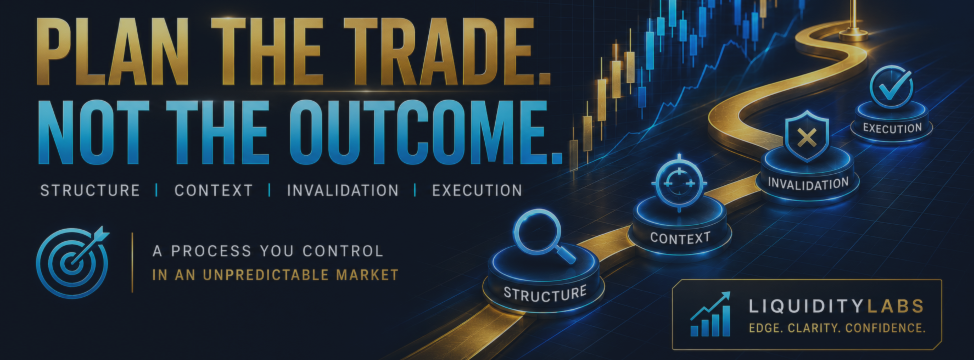
A Simple Pre-Trade Process
Before taking a position, consider answering these questions.
1. What Is the Market Doing?
Describe the environment before focusing on the signal.
2. Why Does This Setup Matter?
Explain the structural and contextual reason.
3. What Supports the Thesis?
Identify the evidence currently available.
4. What Invalidates It?
Know what would make the original interpretation wrong.
5. Is the Entry Still Good?
Do not chase a valid idea from a poor location.
6. Is the Risk Appropriate?
Position size and invalidation should make sense together.
7. Can I Accept Either Outcome?
If one normal loss would cause emotional or financial damage, risk is too high.
Once those questions are answered, execute the plan and allow the market to determine the outcome.
After the Trade, Ask Better Questions
Instead of asking only:
“How much did I make?”
or:
“Why did I lose?”
ask:
Did I follow the setup?
Did I enter where planned?
Did I respect invalidation?
Did I manage risk correctly?
Did I interfere because of emotion?
Was there information available beforehand that I ignored?
What can be improved without judging the trade purely from its outcome?
These questions produce much better feedback.
Final Thoughts
Trading is unusual because good decisions can produce bad outcomes and bad decisions can produce good outcomes.
That makes short-term results psychologically misleading.
The trader who learns only from profits and losses can accidentally reinforce exactly the wrong behaviour.
Instead, build a process.
Define what a valid setup looks like.
Understand the market context.
Know the invalidation.
Control the risk.
Execute consistently.
Then review the decision honestly.
The market controls the outcome.
You control the process.
Judge yourself on the part you can actually control.
LiquidityLabs FVG PRO for MetaTrader 5:
https://www.mql5.com/en/market/product/189564
Trading-risk disclaimer: Trading Forex, CFDs, cryptocurrencies and other leveraged instruments involves substantial risk and may not be suitable for every trader. Fair Value Gaps, technical indicators, trading plans and risk-management techniques cannot guarantee future market behaviour or profitable results. Always evaluate trades independently, use appropriate risk management and never risk capital you cannot afford to lose.