MT5 Trade Copier: How to Choose the Right Drawdown Limits for Your Copy Trading Account

Product link:
https://www.mql5.com/en/ market/product/191385
Drawdown protection is one of the most important risk-management features available in an MT5 Trade Copier. But enabling the feature is only the first step. The more important question is: what drawdown limits should be configured?
There is no single daily or total drawdown percentage that is appropriate for every trading account. The correct configuration depends on the strategy being copied, historical drawdown, account objectives, position sizing, market conditions, and the amount of loss the account is designed to tolerate.
A limit that is too tight may block a strategy during a normal losing period. A limit that is too loose may provide protection only after the account has already suffered substantial damage.
The objective is therefore not to find the smallest possible number. The objective is to establish a protection level that is consistent with the strategy and the purpose of the account.
1. Understand What Drawdown Protection Actually Does
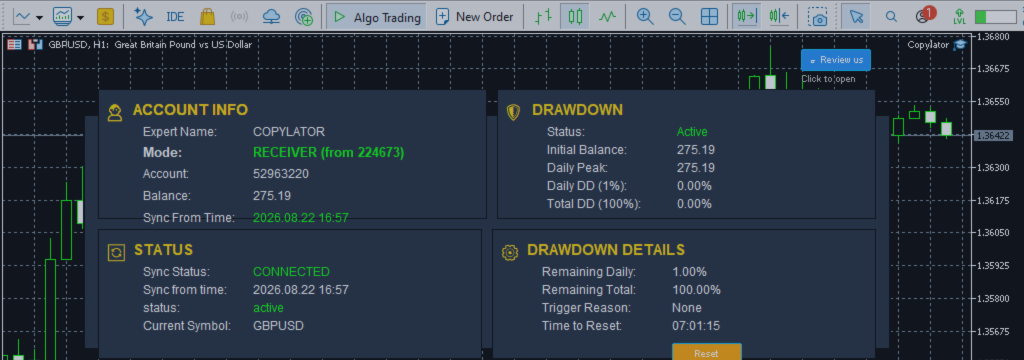
COPYLATOR can monitor both Daily Drawdown and Total Drawdown on the Receiver account.
The daily drawdown limit is designed to control losses within the current trading day, while the total drawdown limit monitors the account against its configured initial balance baseline.
When a configured limit is exceeded, new copying is blocked. Depending on the configuration, COPYLATOR can also close positions opened by COPYLATOR and delete COPYLATOR pending orders.
The relevant settings include:
- EnableDrawdownProtection
- CloseOrdersOnDrawdown
- MaxDailyDrawdownPercent
- MaxTotalDrawdownPercent
- DrawdownBasedOn — EQUITY or BALANCE
- ResetHour
- ResetMinute
Understanding these parameters is important before deciding what percentages to use.
2. Start With the Strategy, Not the Account
One of the most common configuration mistakes is choosing a drawdown limit based only on what feels comfortable.
Suppose a strategy historically experiences drawdowns of around 15%. Setting the total drawdown limit to 5% may cause the copier to stop copying during a normal period of strategy volatility.
On the other hand, setting the limit extremely high simply because the historical drawdown was high may expose the account to a larger loss than the account owner actually intends to tolerate.
The first step should therefore be to examine the strategy itself.
Review Historical Drawdown
Look at the Sender's available trading history and identify:
- Maximum historical drawdown
- Typical drawdown periods
- Frequency of losing streaks
- Largest single-day decline
- Recovery time after previous drawdowns
- Changes in drawdown behavior during volatile markets
Historical performance does not guarantee future behavior, but it provides useful context for deciding whether a proposed protection limit is likely to interfere with normal strategy operation.
3. Historical Drawdown Is a Reference, Not a Guarantee
A strategy that has never experienced a 30% drawdown does not necessarily mean that a 30% limit is safe.
Past data describes what happened in the available sample. Future market conditions can be different.
Therefore, a drawdown limit should consider both:
- What the strategy has historically experienced
- What loss level the account is actually designed to tolerate
These two requirements can sometimes conflict.
If the strategy's historical drawdown is greater than the account's acceptable loss level, the problem is not solved simply by increasing the copier's drawdown limit. The strategy, position sizing, or account allocation may need to be reconsidered.
4. Daily Drawdown and Total Drawdown Have Different Jobs
Daily and total drawdown limits should not be treated as two versions of the same setting.
Daily Drawdown
Daily drawdown is designed to identify concentrated losses occurring during the current trading day.
It can provide an additional protection layer against situations such as:
- Unexpected market volatility
- News-driven price movements
- Multiple losses within a short period
- Abnormal spread conditions
- Unexpected execution conditions
The daily protection cycle can be reset automatically according to the configured broker-server time.
Total Drawdown
Total drawdown addresses cumulative account deterioration relative to the configured initialBalance baseline.
Unlike the automatic daily reset, the total baseline is not automatically replaced every day.
This makes total drawdown an account-level protection mechanism rather than simply a daily trading limit.
5. Do Not Automatically Derive One Limit From the Other
It can be useful to make the daily limit smaller than the total limit, but there is no universal mathematical ratio that works for every strategy.
For example, a configuration might use:
Daily Drawdown: 5% Total Drawdown: 15%
Another account might use:
Daily Drawdown:  2%
Total Drawdown: 8%
The appropriate relationship depends on the strategy's normal daily volatility and the account's overall risk framework.
The important principle is that the daily limit should protect against an unusually damaging trading day, while the total limit should protect against sustained deterioration.
6. Consider the Purpose of the Account
The same Sender strategy can require different drawdown configurations on different Receiver accounts.
For example, a personal long-term account, a prop firm account, and a small experimental account can have very different objectives.
Personal Trading Account
A personal account may have a relatively long investment horizon and may be designed to tolerate larger fluctuations. The appropriate limit depends on the owner's capital allocation and actual tolerance for loss.
Prop Firm Account
Prop firm accounts require special attention because the firm's rules may impose maximum daily or overall drawdown limits.
The internal COPYLATOR limit should normally be configured with enough margin below the firm's hard limit to account for real-world execution, spreads, slippage, commissions, and other conditions.
For example, if a firm specifies a hard maximum loss, using the exact same number inside the copier leaves little room for unexpected execution differences.
Always verify the current rules of the specific prop firm because requirements vary between firms and account programs.
Experimental Account
A small testing account may intentionally use a tighter drawdown limit because its purpose is to evaluate a strategy or configuration with limited capital exposure.
In this case, the limit reflects the purpose of the account rather than necessarily reflecting the historical maximum drawdown of the strategy.
7. The Buffer Principle
A configured drawdown limit should not necessarily be interpreted as an exact guarantee that the account will never lose more than that percentage.
Several factors can cause actual losses to differ from a configured threshold.
Execution Delay
Market prices can move between the moment a threshold is detected and the moment an order is actually processed.
Slippage
If positions are closed after a drawdown trigger, the actual execution price may differ from the price observed when the threshold was reached.
Spread Changes
Rapid spread expansion can affect equity and execution, especially during volatile market conditions.
Swap and Commission
Trading costs can affect the account balance or equity and therefore influence drawdown calculations.
For these reasons, traders should avoid assuming that a configured percentage represents a perfectly precise hard-loss boundary under every market condition.
8. Equity vs. Balance: An Important Configuration Choice
COPYLATOR allows drawdown calculations to be based on either EQUITY or BALANCE through the DrawdownBasedOn setting.
Balance-Based Drawdown
Balance reflects realized account results. Open floating profit or loss does not change the balance until positions are closed.
Equity-Based Drawdown
Equity reflects the account's current value including floating profit and loss.
Therefore, equity-based protection can react to an adverse floating position before that position is closed.
The appropriate choice depends on how the account manager wants drawdown protection to respond to unrealized losses.
9. Position Sizing Directly Affects Drawdown Behavior
Drawdown limits cannot be evaluated separately from position sizing.
A Receiver using a large lot multiplier can reach its drawdown threshold much faster than another Receiver using a smaller multiplier, even when both copy exactly the same Sender.
COPYLATOR supports several volume-management approaches:
- Fixed lot
- Lot multiplier
- Balance-ratio scaling
- Maximum lot cap
Therefore, when changing lot size, the drawdown configuration should also be reviewed.
10. Maximum Lot Cap as a Secondary Protection Layer
The MaxLotSize setting can provide an additional boundary for copied volume.
For example, a balance-ratio calculation or lot multiplier may produce a larger volume as the account grows. A maximum lot cap prevents the resulting copied position from exceeding the configured volume limit.
This does not replace drawdown protection. It serves a different purpose:
- Lot cap: limits individual position volume.
- Drawdown protection: limits account-level loss exposure according to the configured drawdown model.
11. Do Not Use Drawdown Protection to Repair Bad Position Sizing
If a Receiver regularly reaches its drawdown limit because every copied trade is simply too large, repeatedly increasing the drawdown limit is not a solution.
The first question should be whether the position size is appropriate.
For example, if a Receiver reaches a 5% daily drawdown after only a few normal losing trades, possible causes include:
- Lot multiplier is too high
- Fixed lot is too large
- Balance-ratio settings are inappropriate
- Maximum lot cap is missing or too high
- Receiver balance is significantly different from the Sender
In such cases, reviewing position sizing may be more appropriate than simply increasing the drawdown threshold.
12. When a Limit May Be Too Tight
A drawdown limit may be too restrictive if it repeatedly interrupts normal strategy operation.
Possible signs include:
- Protection triggers frequently during ordinary losing streaks.
- The strategy historically recovers from similar drawdowns.
- The Receiver is blocked before the strategy completes its normal trading cycle.
- Daily protection triggers repeatedly without an unusual market event.
However, frequent triggers should not automatically lead to increasing the limit. They may indicate that the strategy's risk is simply too high for that particular account.
13. When a Limit May Be Too Loose
A limit may be too loose if it allows the account to experience a drawdown substantially larger than the account's intended risk tolerance before protection becomes active.
Warning signs include:
- The account reaches a loss level that would already be unacceptable to its owner.
- The configured limit is close to an external hard-loss rule.
- The strategy's recent behavior is materially worse than its historical behavior.
- The account has experienced a significant change in capital or objectives.
Again, the correct response may involve both adjusting the drawdown limit and reviewing the strategy or position sizing.
14. Do Not Change Limits Based on One Losing Trade
A common emotional mistake is changing risk parameters immediately after a single loss.
One losing trade does not necessarily demonstrate that the drawdown configuration is wrong.
Similarly, one profitable week does not prove that a more aggressive drawdown limit is appropriate.
Changes should be based on meaningful observations, preferably across a sufficiently large sample of trades and market conditions.
15. Test the Limits on Demo
Before deploying a new drawdown configuration on a live Receiver, demo testing can help reveal whether the limits interact with the strategy as expected.
Monitor:
- How often daily protection triggers
- How often total protection triggers
- Whether normal losing periods are interrupted
- Whether the account reaches unacceptable exposure before protection activates
- How the reset mechanism behaves
- How equity and balance calculations affect the result
Demo testing does not reproduce every live-market condition, but it can expose configuration problems before real capital is involved.
16. Review the Limits Periodically
Drawdown settings should not necessarily remain unchanged forever.
They may need to be reviewed when:
- The account balance changes significantly.
- The Sender strategy changes.
- The lot multiplier changes.
- The account's purpose changes.
- Market volatility changes materially.
- The broker or account type changes.
- External risk rules change.
A documented review process is preferable to changing limits emotionally after individual trades.
17. A Practical Framework for Setting Limits
A structured approach can make the process easier.
- Analyze the Sender. Review historical drawdown and losing periods.
- Define the Receiver's purpose. Determine whether it is conservative, balanced, experimental, long-term, or subject to external rules.
- Define acceptable account loss. Determine the maximum loss that the account owner is genuinely prepared to tolerate.
- Review position sizing. Check fixed lots, multipliers, balance ratio, and maximum lot size.
- Choose the drawdown model. Decide whether EQUITY or BALANCE better matches the intended protection.
- Set daily and total limits independently. Each should have a specific purpose.
- Consider execution conditions. Allow for spread, slippage, commission, and swap.
- Test on demo. Observe how often the protection activates.
- Document the configuration. Record the reason for the chosen values.
- Review periodically. Change the limits when the underlying conditions change.
18. Example: Three Different Receivers
Suppose the same Sender is connected to three Receiver accounts.
| Receiver | Purpose | Daily DD Example | Total DD Example |
|---|---|---|---|
| Receiver A | Conservative | 2% | 5% |
| Receiver B | Balanced | 5% | 15% |
| Receiver C | Higher-risk | 8% | 25% |
These figures are only an illustration of how different profiles can be configured. They should not be treated as universal recommended settings.
All three Receivers can follow the same Sender while applying different protection levels.
19. Drawdown Protection and Multi-Receiver Copying
One of the advantages of an advanced MT5 Trade Copier is that each Receiver can have its own independent drawdown configuration.
This allows a single Sender strategy to be distributed across accounts with different risk mandates.
For example:
SENDER | +------------+------------+ | | | v v v RECEIVER A RECEIVER B RECEIVER C 5% Total 15% Total 25% Total Conservative Balanced Higher Risk
The same signal is distributed, but the risk controls remain specific to each Receiver.
20. Drawdown Limits and Manual Reset
The choice of drawdown limit is also connected to the reset mechanism.
The automatic daily reset clears the daily drawdown cycle but does not change the initialBalance used for total drawdown.
A manual reset on the Receiver establishes the current account balance as the new baseline for total drawdown.
Therefore, traders should understand the reset behavior before selecting drawdown limits. A limit cannot be evaluated independently from the way the baseline is maintained and reset.
21. Common Mistakes to Avoid
- Choosing a percentage because it looks comfortable: The strategy and account purpose should be considered.
- Copying the same limit to every Receiver: Different accounts may require different protection profiles.
- Ignoring position sizing: Large lots can make even a reasonable drawdown limit trigger quickly.
- Using the exact external hard limit: Execution conditions can cause actual losses to exceed expectations.
- Confusing daily and total drawdown: They serve different purposes.
- Ignoring equity vs. balance: The choice affects how floating losses are treated.
- Increasing the limit after every loss: This can gradually eliminate the intended protection.
- Never reviewing the configuration: Account conditions and strategies can change.
22. Final Drawdown Configuration Checklist
- Historical Sender drawdown has been reviewed.
- Largest historical losing periods have been identified.
- Account purpose has been defined.
- Acceptable loss level has been considered.
- Daily drawdown has been configured separately from total drawdown.
- EQUITY or BALANCE calculation has been selected intentionally.
- Lot sizing has been reviewed.
- Maximum lot size has been considered.
- Spread and execution conditions have been considered.
- Swap and commission have not been ignored.
- External account rules have been considered where applicable.
- Demo testing has been performed.
- Reset behavior is understood.
- The configuration has been documented.
- Limits will be reviewed when account conditions materially change.
Conclusion
Choosing the right drawdown limits for an MT5 Trade Copier is not simply a matter of selecting a percentage that feels comfortable.
The process should begin with the strategy's historical behavior and then incorporate the Receiver account's purpose, position sizing, acceptable loss level, execution conditions, and external constraints.
Daily Drawdown and Total Drawdown serve different purposes. Daily protection provides a shorter-term control mechanism, while total protection monitors cumulative deterioration against the configured baseline.
The best configuration is not necessarily the tightest one. A limit that is too restrictive can interfere with normal strategy behavior, while a limit that is too loose may provide protection too late for the account's objectives.
A practical approach is to analyze historical drawdown, define the account's real risk tolerance, consider execution costs and slippage, configure position sizing carefully, test the settings on demo, and review them periodically.
When properly configured, drawdown protection should remain relatively unobtrusive during normal trading while providing a clearly defined response when losses exceed the account's intended risk boundaries.
Product link:
https://www.mql5.com/en/ market/product/191385