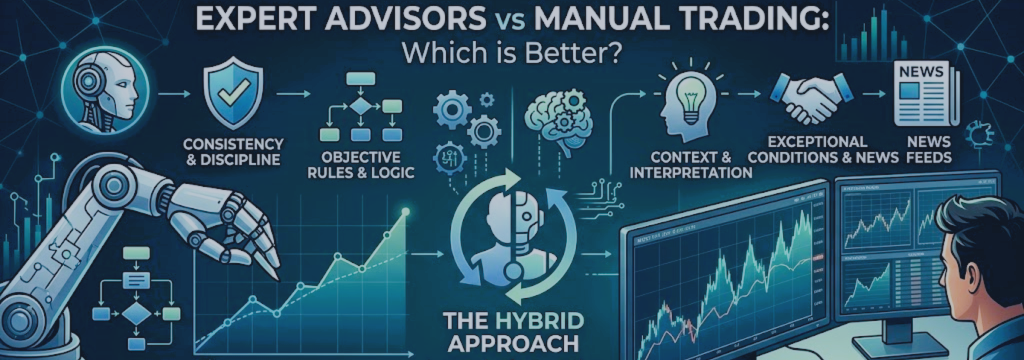

There is no universal winner between Expert Advisors and manual trading. The better approach depends on the strategy, the trader’s skills, available time, risk tolerance, and ability to follow a plan consistently.
An Expert Advisor, or EA, is a program that runs in MetaTrader 5 and follows predefined rules. It can analyze prices, check indicators, manage positions, and send trading requests automatically when its programmed conditions are met.
Manual trading means that the trader analyzes the market, decides whether to trade, chooses position size, and places or manages orders personally.
Both approaches can be useful. Both can also fail. A strong manual strategy can be damaged by fear, hesitation, revenge trading, or inconsistent risk. A strong EA can fail if its rules are weak, its assumptions are unrealistic, its technology is not monitored, or the market changes beyond what the system was designed to handle.
The goal is not to defend one method blindly. The goal is to understand where each method is strongest and build a trading process that fits your actual needs.
Risk warning: Manual and automated trading both involve substantial risk. An EA does not guarantee profits, and a discretionary trader cannot reliably predict market direction. Historical performance, backtests, and demo results do not guarantee future results.
Quick Answer
Use an EA when you have clear, objective rules that can be tested and executed consistently. EAs are especially useful for repeated setups, multi-symbol monitoring, time-sensitive rules, systematic position management, and reducing emotional mistakes.
Use manual trading when your strategy depends heavily on context, qualitative judgment, macroeconomic interpretation, market structure that is difficult to define objectively, or a small number of selective trade ideas.
For many traders, the most practical solution is a hybrid approach:
- Use EAs for repeatable rules, execution, trade management, alerts, and risk controls.
- Use human judgment for supervision, strategy research, macro context, and exceptional market conditions.
What Is Manual Trading?
Manual trading means the trader makes each decision personally. The trader may use charts, indicators, economic news, market structure, order flow, fundamentals, or a written trading plan to decide when to enter and exit positions.
A manual trader is responsible for every stage of the trading process:
- Choosing which markets to watch.
- Identifying a possible trade setup.
- Checking news, volatility, and market conditions.
- Selecting trade direction.
- Choosing lot size and risk.
- Placing stop loss and take profit levels.
- Managing open positions.
- Closing trades or adjusting stops.
- Recording and reviewing results.
Manual trading gives the trader flexibility. It also requires focus, discipline, experience, and the ability to follow a plan when the market is moving quickly.
What Is EA Trading?
EA trading uses a MetaTrader 5 Expert Advisor to automate some or all of the trading process. An EA can run according to rules defined by the developer or trader.
For example, an EA may be instructed to:
- Trade only EURUSD on the M15 chart.
- Buy only when a moving-average trend condition is bullish.
- Require RSI confirmation before entering.
- Trade only during selected market hours.
- Refuse entries when spread is too high.
- Risk a fixed percentage of equity per trade.
- Place an ATR-based stop loss.
- Stop trading after a maximum daily loss.
Once these rules are programmed, the EA can follow them without hesitation while MetaTrader 5 is running, connected, and permitted to use automated trading. MetaTrader 5 supports Expert Advisors for automating analysis and trading operations based on predefined signals and rules. [7]
The Discipline Advantage of EAs
For many traders, the most meaningful advantage of an EA is not speed or complexity. It is consistency.
A manual strategy can be logically sound but still produce poor real-world results if the trader does not execute it consistently. Common manual mistakes include:
- Skipping a valid trade after a previous loss.
- Entering too early because of fear of missing out.
- Closing a winning trade before the planned exit.
- Moving a stop loss farther away to avoid accepting a loss.
- Increasing lot size after a loss to recover quickly.
- Taking trades outside the plan.
- Trading while tired, stressed, distracted, or emotional.
- Continuing to trade after reaching a daily loss limit.
An EA does not feel fear, greed, frustration, or excitement. It does not decide to skip a setup because the last trade lost. It does not revenge-trade unless revenge trading has somehow been programmed into its logic.
That does not mean an EA is intelligent. It means that it applies its programmed rules consistently. Automated systems can reduce human error and emotional bias when they operate from clearly defined parameters, but they still carry technical, design, and market risks. [92]
Example: Same Strategy, Different Execution
Imagine a strategy that has been tested over hundreds of trades and requires entering every valid breakout setup with 0.5% risk per trade.
A manual trader may take only some of the setups because:
- They were away from the screen.
- They doubted the setup after a recent loss.
- They felt the market “looked different.”
- They entered late after waiting for extra confirmation.
- They increased risk after several losses.
An EA can take every valid setup according to the same rules. If the strategy is genuinely robust, this consistency may produce results closer to the tested process. If the strategy is weak, the EA will execute that weak strategy consistently as well.
Where Expert Advisors Can Be Stronger
Consistent Rule Execution
EAs are useful when a strategy can be defined clearly. They can apply the same entry, filter, sizing, and exit rules repeatedly without changing behavior because of mood or recent performance.
This is particularly useful for traders who already have a written strategy but struggle to follow it consistently.
Monitoring Several Markets
A human trader can monitor only a limited number of charts carefully. An EA can monitor multiple symbols, timeframes, and indicator conditions at the same time.
For example, a portfolio of EAs could monitor:
- EURUSD for a London-session breakout.
- GBPUSD for a trend-following pullback.
- XAUUSD for a volatility expansion setup.
- USDJPY for a mean-reversion condition.
This does not make every trade good. It simply allows more consistent coverage than one person can maintain manually throughout the day.
Operating During Multiple Sessions
Forex markets operate across major global sessions. A manual trader cannot remain alert and focused for every Asian, London, and New York market period.
An EA can monitor a strategy during the sessions it was designed to trade. For example, it can check a London-open breakout while the trader is asleep or manage an existing position after normal working hours.
The terminal must remain running and connected for the EA to operate. Traders often use a VPS for more reliable continuous operation, but a VPS does not remove market risk or guarantee order execution.
Fast and Repeatable Trade Management
EAs can apply trade-management rules immediately when their conditions occur. This may include:
- Placing stop loss and take profit levels.
- Moving a stop to break-even after a defined price move.
- Trailing a stop behind price.
- Closing part of a position at a specified level.
- Closing positions before a defined time.
- Stopping new trades after a daily loss limit.
- Reducing exposure when multiple correlated positions are open.
These actions can be difficult for a manual trader to perform consistently, especially when monitoring several positions or when markets move quickly.
Testing Before Live Use
One advantage of algorithmic trading is that the exact rules can be tested historically in the MetaTrader 5 Strategy Tester before being used live.
A backtest can help answer questions such as:
- How did the strategy behave during past trends and ranges?
- What was the largest historical drawdown?
- How many consecutive losses occurred?
- How sensitive was the system to spread and commission?
- Did the strategy work on out-of-sample data?
- Does the system remain stable when inputs change slightly?
Backtesting is not proof of future performance. It can be misleading when spreads, commissions, slippage, execution delays, or market conditions are modeled poorly. However, it provides a more structured starting point than relying only on memory or subjective impressions.
Portfolio Risk Management
An EA can calculate and monitor account-level conditions faster and more consistently than a trader who is managing several charts manually.
For example, a portfolio-management EA may:
- Limit total risk across all open positions.
- Prevent duplicate exposure in correlated currency pairs.
- Restrict the total number of positions.
- Pause new entries after a daily loss threshold.
- Close or reduce positions if equity drawdown reaches a defined limit.
These protections must be coded correctly and tested carefully. They are tools for risk control, not guarantees against loss.
Where Manual Traders Can Be Stronger
Interpreting Context
Manual traders can incorporate context that may be difficult to program objectively. This can include central-bank communication, geopolitical events, unusual market reactions, shifts in liquidity, changes in market sentiment, or broader macroeconomic narratives.
For example, an EA may see a technical breakout. A discretionary trader may decide not to take it because a major central-bank statement is due in a few minutes or because the market has been reacting unpredictably to recent news.
An EA can use a scheduled-news filter if that information is available and coded into its rules. However, interpreting the tone, surprise, or market reaction to news is much harder to define consistently.
Handling Exceptional Conditions
Automated systems are designed around assumptions. They may not behave as intended during unusual conditions such as:
- Extreme spread widening.
- Trading halts or reduced liquidity.
- Unexpected geopolitical events.
- Broker connection problems.
- Abnormal price gaps.
- Major changes in market volatility.
- Unexpected changes to symbol specifications.
A knowledgeable trader may recognize that conditions are unusual and decide to reduce risk, pause trading, or avoid entering new positions. An EA will only do this if such protective behavior has been designed and tested in advance.
Low-Frequency, High-Conviction Analysis
Some traders focus on a small number of carefully researched setups rather than frequent trading. They may use higher timeframes, macro themes, long-term market structure, or event-driven analysis.
For these traders, the value may come from patience, deep research, and selective decision-making rather than taking hundreds of mechanical trades each year.
Such a process may still benefit from automation. For example, an EA or script can calculate lot size, place protective stops, monitor levels, or manage exits while the trader keeps final discretion over entry.
Developing New Strategy Ideas
Humans are often better at noticing new patterns, questioning assumptions, and recognizing that a strategy may no longer fit current market behavior.
An EA cannot independently decide that a strategy is outdated unless it has specific programmed conditions for detecting performance deterioration or market-regime change. Even then, the method must be designed by a human.
Manual analysis is therefore valuable for research, oversight, and deciding whether an automated strategy should be modified, paused, or retired.
EA Trading vs Manual Trading
| Area | Expert Advisor Trading | Manual Trading |
|---|---|---|
| Decision process | Uses predefined rules and programmed conditions. | Uses trader analysis, judgment, and a written or unwritten plan. |
| Emotion | Does not experience emotion, but can execute poor rules consistently. | Can apply judgment, but may be affected by fear, greed, stress, or overconfidence. |
| Consistency | High when the EA is working correctly and settings remain unchanged. | Depends on the trader’s discipline and ability to follow the plan. |
| Speed | Can react automatically to programmed conditions. | Limited by human attention, decision time, and order-entry speed. |
| Multi-market coverage | Can monitor several symbols and conditions simultaneously. | Limited by screen time and cognitive workload. |
| Adaptability | Limited to rules, filters, and safeguards that were programmed. | Can adapt quickly when the trader understands changing conditions. |
| Testing | Rules can be backtested and forward-tested systematically. | More difficult unless decisions are recorded with precise rules. |
| Technical risk | Requires correct installation, reliable connection, logs, monitoring, and maintenance. | Less dependent on software automation, but still depends on platform and connection availability. |
| Time required | Can reduce active screen time after setup, but still requires supervision. | Usually requires more direct chart time and decision-making. |
The Hybrid Approach
A hybrid approach combines the consistency of automation with the oversight and context of a human trader.
This does not mean the trader should override the EA randomly. Random intervention can destroy the ability to evaluate whether a strategy works. Instead, the roles should be clearly defined.
What the EA Can Handle
- Monitoring charts and symbols for defined technical conditions.
- Calculating trade volume from a risk setting.
- Checking spread and session filters.
- Placing stop loss and take profit levels.
- Managing trailing stops and break-even rules.
- Enforcing a maximum number of positions.
- Applying daily-loss or account-drawdown limits.
- Logging trades and important system events.
What the Trader Can Handle
- Researching and validating strategy logic.
- Monitoring market conditions and execution quality.
- Checking whether the EA is running correctly.
- Reviewing drawdown, exposure, and performance changes.
- Pausing or reducing risk during exceptional conditions according to a documented plan.
- Improving the system only after structured testing.
- Deciding whether the strategy still fits the intended account and risk tolerance.
For example, a trader may allow an EA to execute a tested London-session strategy every day, while manually deciding whether to disable new entries during an extraordinary event. The key is to document this rule beforehand rather than making emotional decisions after a trade has already moved against the account.
How New Traders Should Choose
Consider Starting With Manual Trading If:
- You are still learning basic market mechanics and order types.
- You do not yet understand stop loss, leverage, margin, spread, and position sizing.
- Your strategy depends on discretionary chart reading or macro analysis.
- You enjoy analyzing markets directly and can commit time to it.
- You want to develop a written trading plan before automating it.
Consider Starting With an EA If:
- You have objective, repeatable trading rules.
- You want to reduce missed entries and emotional execution mistakes.
- You cannot monitor markets during the strategy’s required trading hours.
- You want to test one clear rule set in MetaTrader 5.
- You understand that an EA needs monitoring, testing, and risk limits.
Consider a Hybrid Process If:
- You have manual ideas but want automation for entries or exits.
- You want an EA to calculate lot size and manage risk automatically.
- You want alerts for manual confirmation rather than fully automatic entries.
- You want to trade a systematic strategy while still supervising major market conditions.
- You are gradually converting a manual trading plan into objective rules.
Before You Use an EA
Whether you created the EA or obtained it from another developer, complete these steps before allowing it to trade a live account:
- Read the full documentation and understand the strategy type.
- Confirm the required symbol, timeframe, broker conditions, and account type.
- Review every important input, especially lot size and risk settings.
- Backtest with realistic spread, commission, and historical data.
- Review drawdown, losing streaks, and exposure behavior.
- Use Visual Mode to inspect representative trades.
- Forward-test on a demo account.
- Check the Experts and Journal tabs for errors.
- Use conservative risk if you decide to begin a live forward test.
- Monitor the EA regularly rather than assuming it can be ignored.
Frequently Asked Questions
Can an EA replace a manual trader completely?
An EA can automate a fully defined strategy, including entries, exits, and risk management. It cannot automatically replace human research, system design, monitoring, technical maintenance, or judgment unless those functions have been defined and programmed carefully.
Are EAs always more disciplined than humans?
An EA follows its programmed rules without emotion. However, the trader can still interfere by changing settings, disabling the EA after losses, increasing risk, or using an unsuitable strategy. The system is only as disciplined as the overall process around it.
Can manual trading outperform an EA?
Yes. A skilled discretionary trader may identify context, market changes, or selective opportunities that are difficult to encode into fixed rules. However, the trader must also manage emotional bias and maintain consistent risk control.
Can an EA trade while I sleep?
Yes, provided MetaTrader 5 is running, connected to the broker, and algorithmic trading is enabled. A VPS can help maintain operation when a personal computer is off, but it does not eliminate trading or technical risk.
Should I pause an EA during major news?
That depends on the strategy. Some EAs are designed to avoid high-impact news, while others may be built specifically for volatility events. Follow a documented rule based on the EA’s design and testing rather than making inconsistent decisions after a trade is already open.
Final Thoughts
Expert Advisors and manual trading are not opposites. They are different methods of applying a trading strategy.
An EA is strongest when rules are objective, repeatable, and tested. Manual trading is strongest when informed human judgment and context genuinely add value. For many traders, the best long-term approach is to use automation for consistency and risk enforcement while retaining human responsibility for research, supervision, and strategic decisions.
Risk disclosure: This article is for educational purposes only and does not constitute investment advice, a recommendation, or a guarantee of results. Forex, CFDs, futures, cryptocurrencies, and other leveraged products involve substantial risk. Past performance, backtests, simulations, and demo results do not guarantee future performance.