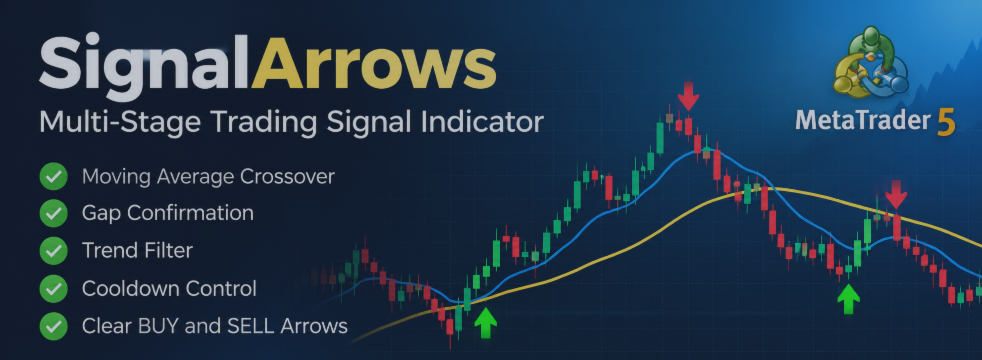
SignalArrows - A Multi-Stage Trading Signal Indicator for MetaTrader 5

Reading a price chart often involves combining several technical conditions before reaching a trading decision. A Moving Average crossover can provide an initial indication of a possible change in direction, but a single crossover does not always provide enough context.
SignalArrows is a MetaTrader 5 indicator built around a multi-stage signal confirmation process. Instead of treating every Moving Average crossover as a final signal, the indicator evaluates additional conditions before displaying a BUY or SELL arrow on the chart.
A Multi-Stage Signal Process
The SignalArrows workflow consists of five stages:
1. Moving Average Cross
The process starts when the fast Moving Average crosses the slow Moving Average. A bullish crossover occurs when the fast Moving Average moves above the slow Moving Average, while a bearish crossover occurs in the opposite direction.
2. Gap Confirmation
After a crossover is detected, the indicator checks whether the required gap develops within a configured number of bars. This creates a defined confirmation window rather than allowing a crossover to remain active indefinitely.
3. Trend Filter
The next stage compares the current price with a separate Trend Moving Average. This condition is used to evaluate whether the potential signal satisfies the selected trend direction.
4. Cooldown Check
A minimum number of bars can be required between consecutive signals. This allows the indicator to control how frequently signals can appear after a previous signal has been generated.
5. Signal Arrow
When the required conditions are satisfied, the indicator plots the corresponding BUY or SELL arrow on the chart.
Why Use Multiple Conditions?
A simple crossover can occur several times during a period of sideways or changing price movement. A multi-stage design separates the initial event from the conditions that confirm it.
The signal process can be represented as:
Moving Average Cross
↓
Gap Confirmation
↓
Trend Filter
↓
Cooldown Check
↓
Signal Arrow
This structure also makes the indicator easier to analyze and test because each stage has a specific role.
Adjustable Parameters
SignalArrows provides configurable parameters for the main parts of the calculation. These include:
- Fast Moving Average Period
- Slow Moving Average Period
- Trend Moving Average Period
- Gap Confirmation Bars
- Minimum Bars Between Signals
- Moving Average Method
- Applied Price
The relationship between these parameters affects how the complete signal process behaves. For example, changing the Moving Average periods changes the crossover behavior, while changing the confirmation window changes how long a potential signal can remain eligible for confirmation.
Working With MetaTrader 5 Charts
The final output is displayed directly on the chart using directional arrows. This allows the user to inspect the signal together with the surrounding price structure and Moving Average relationships.
This visual approach can also help during development and testing. When an arrow appears, the chart can be reviewed to see whether the crossover, confirmation gap, trend condition and cooldown rules were satisfied.
Testing the Signal Logic
A structured testing process is useful when developing a multi-condition indicator.
The crossover condition can first be checked on historical charts. The gap confirmation can then be tested by changing its confirmation window. The trend filter and cooldown conditions can also be evaluated independently before the complete signal process is tested.
Testing on different symbols and timeframes is also useful because price movement and bar structure can vary across markets. A configuration used on XAUUSD, for example, may behave differently when applied to another instrument or timeframe. For reproducible testing, the symbol, timeframe, test period and parameter configuration should be recorded.
Backtest Verification
MetaTrader 5 provides testing tools that can be used to examine indicator behavior under defined historical conditions.
When presenting a backtest, the test configuration should be kept together with the results. This includes the symbol, timeframe, testing period, initial deposit and other relevant settings.
Backtest results are historical simulations based on the selected data and conditions. They should not be interpreted as a guarantee of future market behavior.
A Practical Signal Example
Consider a bullish setup.
First, the fast Moving Average crosses above the slow Moving Average. The indicator then checks whether the required gap develops within the confirmation window.
If the gap condition is satisfied, the trend filter is evaluated. When the price relationship meets the configured trend condition, the cooldown check is performed.
If the required number of bars has passed since the previous signal, the conditions are complete and a BUY arrow can be plotted.
A bearish setup follows the same general process in the opposite direction.
Implementation Approach
From a development perspective, separating the signal logic into independent stages can make an MQL5 indicator easier to maintain.
Crossover detection, gap confirmation, trend filtering and cooldown validation can each be implemented as separate logical components. This makes it easier to debug the indicator and to modify one part of the process without rewriting the entire signal calculation.
The same architecture can also be extended with additional technical conditions in future versions.
SignalArrows on the MetaTrader 5 Market
SignalArrows is available as a MetaTrader 5 product on the MQL5 Market.
SignalArrows Trading Signal Indicator
Conclusion
SignalArrows demonstrates how a Moving Average crossover can be developed into a structured multi-stage signal process.
The indicator combines crossover detection, gap confirmation, trend filtering and cooldown control before displaying a visual BUY or SELL arrow. This approach keeps the signal rules clearly separated and provides configurable inputs for different chart-analysis requirements.
SignalArrows is a technical analysis tool for MetaTrader 5. It does not provide financial or investment advice and does not guarantee trading profits or future performance. Users are responsible for their own analysis and risk management.