MT5 Trade Copier: Copy Trading During Major News Events – Advanced Protection Strategies

Product link:
https://www.mql5.com/en/ market/product/191385
Major economic news events can create some of the most challenging conditions for automated copy trading. Interest-rate decisions, inflation reports, employment data, central-bank statements, GDP releases, and other high-impact events can cause rapid price movements, widening spreads, slippage, rejected orders, and sudden changes in available liquidity.
For traders using an MT5 Trade Copier, the challenge is even more important because the Sender and Receiver may experience different execution conditions.
A trade that opens normally on the Sender may experience a different price, spread, or execution result on the Receiver. Therefore, protecting a copy-trading system during major news is not simply about stopping all trades. It is about deciding in advance how the Receiver should behave when market conditions become abnormal.
1. Why Major News Events Are Different
During normal market conditions, spreads and execution conditions may remain relatively stable. Around major announcements, however, market conditions can change within seconds.
Potential changes include:
- Rapid price movement.
- Wider spreads.
- Increased slippage.
- Reduced available liquidity.
- Pending-order activation at unexpected prices.
- Stop Loss execution at prices different from the requested level.
- Temporary trading restrictions.
- Different execution conditions between brokers.
These conditions can affect both the Sender and Receiver, but they do not necessarily affect them in exactly the same way.
2. The Sender and Receiver Can Experience Different News Conditions
One of the most important concepts in news-event copy trading is that the Receiver does not inherit the Sender broker's execution environment.
Suppose a Sender opens a position immediately after an economic announcement.
Sender: Entry = 1.1000 Receiver: Entry = 1.1008
The difference may result from spread, liquidity, execution speed, or slippage.
If the strategy uses a relatively small Stop Loss, even a modest execution difference can materially change the trade's risk/reward characteristics.
For this reason, news-event protection should always be evaluated from the Receiver's perspective as well as the Sender's.
3. The First Protection Layer: Time Filters
A time filter can restrict copying to predefined trading hours.
This can be useful when a trader does not want new trades copied during specific periods surrounding scheduled events.
For example, a trading plan could define a restricted window around an important announcement:
Normal Copying
      ↓
Pre-News Restriction
      ↓
Major Announcement
      ↓
Post-News Restriction
      ↓
Normal Copying
The exact window should be determined by the strategy and the trader's risk plan. There is no universal number of minutes that is appropriate for every market or every news event.
4. Time Filters Should Be Planned in Advance
The psychological advantage of a predefined time filter is that the trader does not have to decide whether to copy a trade while the market is moving rapidly.
Instead, the system follows the schedule that was configured beforehand.
COPYLATOR provides configurable day and time filtering, allowing traders to define when copying is permitted. The time-filter configuration uses the specified GMT start and end times, so the trader should account for the relationship between the configured schedule and the relevant market/news time.
5. The Importance of the Spread Filter
Spread can change dramatically around major news.
A trade that is acceptable under normal conditions may become considerably more expensive when the Receiver spread widens.
A spread filter can therefore act as an additional protection layer.
For example:
Normal Receiver Spread: 1.0 pip News-event spread: 5.0 pips Configured maximum: 3.0 pips
If the Receiver's spread exceeds the configured threshold, the copier can prevent the trade from being copied according to the configured filter behavior.
The threshold should be based on the actual Receiver's trading conditions rather than assumptions about the Sender.
6. Spread Protection Does Not Predict News
A spread filter should not be confused with a news calendar.
It does not know whether an economic announcement is about to occur. Instead, it evaluates the configured market condition, such as the current spread.
This distinction is important because a major announcement can sometimes cause abnormal conditions without the spread immediately exceeding a chosen threshold, while a wide spread can also occur for reasons unrelated to scheduled economic news.
7. Drawdown Protection During News Volatility
News events can produce unusually rapid changes in account equity.
Drawdown protection can provide another layer of predefined risk control.
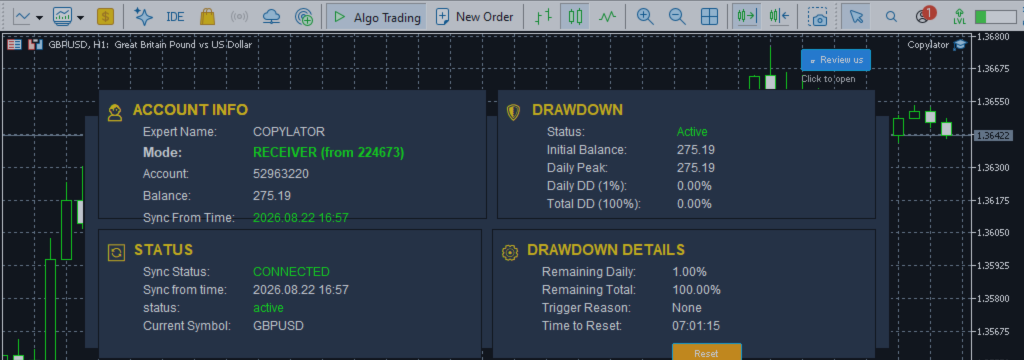
COPYLATOR supports daily and total drawdown protection on the Receiver. When the configured limit is reached, new copying can be blocked. If CloseOrdersOnDrawdown is enabled, positions opened by COPYLATOR can also be closed and its pending orders deleted according to the protection logic.
If the option is disabled, the system can block new copying without automatically closing existing positions.
The trader should understand this distinction before enabling the feature.
8. Daily Drawdown vs Total Drawdown
These two controls serve different purposes.
| Protection | Purpose |
|---|---|
| Daily Drawdown | Controls losses relative to the current trading-day reference |
| Total Drawdown | Controls losses relative to the configured initial baseline |
During major news events, a sudden move can cause both measurements to change rapidly.
Traders should therefore configure limits before going live and understand exactly how the chosen drawdown basis, such as Equity or Balance, affects the calculation.
9. Pending Orders Require Special Attention
Pending orders can be particularly sensitive to major news.
A Buy Stop or Sell Stop may be triggered when price moves rapidly through the specified level.
However, the actual execution price can differ substantially from the pending-order level during fast markets.
In addition, broker restrictions such as minimum distance and execution rules can affect pending orders on the Receiver.
Therefore, traders who do not want pending orders exposed to major announcements should define this rule in advance rather than manually deleting them during the event.
10. CopyPending Should Be Deliberate
COPYLATOR allows traders to control whether pending orders are copied.
If a strategy depends heavily on pending orders, disabling them may change the strategy significantly.
On the other hand, if pending orders are not required during specific high-volatility periods, a trader may choose to structure the configuration accordingly.
The important point is consistency: the decision should be part of the trading plan rather than an emotional response to a rapidly moving chart.
11. Stop Loss Does Not Eliminate News Risk
A common misconception is that placing a Stop Loss guarantees that the maximum loss will be exactly the distance between entry and Stop Loss.
During fast markets, execution can occur at a different price because of gaps, slippage, or insufficient liquidity.
Therefore:
Stop Loss = predefined exit level
≠
Guaranteed execution price
This distinction is especially important around major economic announcements.
12. Real-Time SL/TP Synchronization During Volatility
Some strategies actively modify Stop Loss and Take Profit after a trade has been opened.
COPYLATOR can synchronize supported SL/TP changes between Sender and Receiver, including changes made after the original position was opened.
However, synchronization does not eliminate broker-side execution restrictions.
If the Receiver broker imposes different Stop Level or Freeze Level conditions, a modification that is valid on the Sender may not be immediately executable on the Receiver.
Therefore, SL/TP synchronization should also be tested under realistic conditions.
13. News Events and Symbol Mapping
Symbol mapping remains important during volatile markets.
A Sender may trade a symbol such as:
XAUUSD
while the Receiver may use:
XAUUSDm
If the corresponding symbol is not correctly mapped, the Receiver cannot execute the copied trade regardless of the news filter configuration.
COPYLATOR provides automatic symbol mapping and supports manual mappings when automatic detection cannot identify the correct symbol.
14. Gold and News Events
Gold can experience significant volatility around events involving interest rates, inflation, central-bank policy, and major U.S. economic releases.
A Sender and Receiver trading XAUUSD can therefore experience substantially different execution conditions during a fast move.
For gold copy trading, traders should pay particular attention to:
- Receiver spread.
- Contract specifications.
- Minimum volume.
- Stop Level.
- Slippage.
- Margin requirements.
- Trading session.
15. Forex News and Currency Pairs
Currency pairs can also experience rapid movements following central-bank decisions, inflation data, employment reports, GDP releases, and other major economic indicators.
For example, a high-impact release affecting the U.S. dollar can influence several USD-related pairs simultaneously.
When multiple Senders are active, this can create correlated exposure across several Receiver positions.
Therefore, news-event risk should not be evaluated one trade at a time.
16. Correlated Exposure During News
Suppose a Receiver simultaneously copies:
- EUR/USD Buy
- GBP/USD Buy
- AUD/USD Buy
Although these are three separate positions, they may all have significant exposure to the same underlying market factor—in this example, the U.S. dollar.
A major USD event can therefore affect several positions simultaneously.
Multi-position exposure should be considered when setting lot sizes and drawdown limits.
17. Multi-Sender News Risk
Multiple Senders can create an additional layer of complexity.
Different Senders may respond to the same news event in different ways.
For example:
Sender A → Buy EUR/USD Sender B → Sell EUR/USD Sender C → Buy GBP/USD Sender D → Sell Gold
On a Hedging account, these positions can coexist independently. On a Netting account, positions on the same symbol can interact through the account's net-position structure.
This makes it important to understand the Receiver account type before copying multiple strategies simultaneously.
18. Lot Management During High-Volatility Events
Lot size determines the scale of exposure, but it does not determine whether a trade will be profitable.
During major news events, traders should understand how their chosen lot-sizing method behaves.
COPYLATOR supports approaches such as:
- Fixed lot.
- Lot multiplier.
- Balance-ratio scaling.
- Maximum lot cap.
A maximum lot cap can prevent calculated volume from exceeding a predefined limit.
This can be useful when a Receiver account is smaller than the Sender or when several strategies are being copied simultaneously.
19. The Maximum Lot Cap Is Not a News Filter
It is important not to confuse volume control with event protection.
A maximum lot cap limits position volume. It does not identify economic news and does not prevent slippage.
Similarly, a spread filter does not calculate the future impact of a central-bank decision.
Different protection mechanisms address different risks.
20. A Layered Protection Model
A robust news-event configuration can be viewed as multiple independent layers:
Layer 1 — Time Rules
        ↓
Layer 2 — Spread Conditions
        ↓
Layer 3 — Direction / Trading Rules
        ↓
Layer 4 — Lot Management
        ↓
Layer 5 — Maximum Lot Cap
        ↓
Layer 6 — Drawdown Protection
        ↓
Layer 7 — Broker Execution Rules
No single layer can eliminate every risk.
The purpose of layered protection is to ensure that if one control does not address a particular market condition, another predefined control may still limit the resulting exposure.
21. Should All Copying Be Stopped During Major News?
There is no universal answer.
Some strategies are specifically designed to trade news volatility. Other strategies may be designed to avoid it completely.
Therefore, stopping all copying around every economic announcement can itself change the strategy.
The appropriate approach depends on the strategy's documented rules, execution characteristics, and risk model.
The important point is to decide this before the event rather than making the decision after a large price movement has already occurred.
22. Pre-News Protection vs Post-News Protection
There are two fundamentally different approaches.
Pre-News Protection
The trader prevents new trades from being copied during a predefined period before and after an event.
Post-News Protection
The trader allows the strategy to operate but relies on existing risk controls such as spread limits, drawdown protection, and lot caps if market conditions become abnormal.
These approaches can also be combined.
23. Example of a Structured News Policy
A trader could define a policy such as:
Before major scheduled event: → Restrict new copying During abnormal spread: → Reject new trades according to spread filter If drawdown limit is reached: → Block further copying If CloseOrdersOnDrawdown is enabled: → Close applicable copied positions → Delete applicable copied pending orders After the restricted period: → Resume copying according to normal rules
The exact timing and thresholds should be determined by the trading strategy and Receiver conditions.
24. Why Manual Intervention Can Be Dangerous
Major news often creates extremely fast price movements.
A trader may see a position moving rapidly against the account and manually close it. Another trader may see a rapid profit and manually increase exposure.
Both decisions can change the original strategy.
Predefined rules are generally easier to evaluate because they can be tested and documented before live execution.
25. News Protection and VPS Operation
A stable MT5 environment is particularly important when time-based restrictions are being used.
A VPS is strongly recommended for continuous automated operation, although it is not technically mandatory if a dedicated computer can reliably remain powered on, connected, and running the required MT5 terminals.
The important requirement is that the Sender and Receiver terminals remain active and connected when the configured rules are supposed to operate.
26. Testing News Protection on Demo
Before relying on a news-protection configuration with significant capital, test the complete setup on a demo account.
Testing should include:
- Normal market conditions.
- High-spread conditions.
- Market-order copying.
- Pending-order behavior.
- SL/TP synchronization.
- Partial closes where applicable.
- Drawdown protection.
- Time-filter transitions.
- Symbol mapping.
- Multiple Receiver positions.
Historical backtesting alone cannot reproduce every live execution condition surrounding a major news release.
27. Common Mistakes During Major News
| Mistake | Potential Problem |
|---|---|
| Using Sender spread assumptions | Receiver may experience very different costs |
| Assuming Stop Loss guarantees exact loss | Slippage can occur during fast markets |
| Ignoring pending orders | Orders may activate during rapid price movement |
| Using excessive lot size | Small price movements can create large equity changes |
| Changing settings during the announcement | Creates inconsistent strategy execution |
| Ignoring correlated positions | Several trades may react to the same event |
| Never testing the protection logic | Actual behavior may differ from expectations |
28. Practical News-Event Checklist
- Identify the events that are relevant to the instruments being copied.
- Decide whether the strategy is intended to trade during those events.
- Configure the time filter if a restricted window is required.
- Set a Receiver-side spread limit where appropriate.
- Review the lot-sizing method.
- Consider a maximum lot cap.
- Review daily and total drawdown limits.
- Decide how pending orders should be handled.
- Verify symbol mapping.
- Check Receiver margin and leverage.
- Keep Sender and Receiver terminals running.
- Review logs after important events.
29. Final Perspective
Major news events are an unavoidable part of financial markets, but the way a copy-trading system responds to them can be planned in advance.
An MT5 Trade Copier cannot eliminate market volatility, guarantee execution prices, prevent slippage in every situation, or predict the outcome of an economic announcement.
What it can do is provide configurable mechanisms for implementing a predefined trading and risk-management process.
Time filters can restrict when copying occurs. Spread filters can respond to abnormal transaction costs. Lot management can control exposure. Maximum lot caps can limit copied volume. Drawdown protection can define what happens when account losses reach predetermined thresholds. Symbol mapping and execution monitoring can help maintain reliable synchronization between different MT5 environments.
The most important principle is therefore not to search for one perfect news filter.
It is to build a layered system in which each protection mechanism has a clearly defined purpose.
Plan before the news.
Configure before the news.
Test before the news.
Then let the predefined rules do their job.
This approach can make copy trading during major economic events more structured, measurable, and consistent with the trader's predefined risk-management plan.
Product link:
https://www.mql5.com/en/ market/product/191385