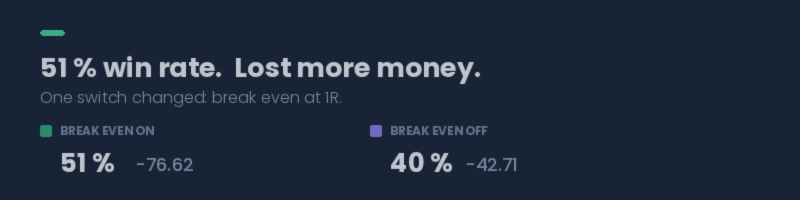

Break even looks like pure prudence. You move the stop loss to the entry price as soon as the trade has gained what it was risking, one R, and from that moment the trade cannot turn around and close at a loss. I had always used it without discussing it. It protects capital. It seemed an obviously sensible choice. Then I measured it. Same expert advisor, same symbol, same two months of EURUSD M15 data. One switch changed: break even at 1R, on and off. Everything else identical. Break even ON: 45 trades, 23 won and 22 lost, 51% win rate, 16 of the 23 wins were worth less than 5 EUR, 5 closed on target, net result -76.62. Break even OFF: 43 trades, 17 won and 26 lost, 40% win rate, 4 of the 17 wins were worth less than 5 EUR, 9 closed on target, net result -42.71. The average loss was the same in both runs, -9.59. With break even on the robot won more often and lost more money. The reason is in the size of the wins. A stop moved to the entry price sits very close to the price. The normal breathing of the market touches it, and a trade that was going well closes at two euros instead of running. Sixteen of the twenty-three winning trades were worth less than five euros. The losses stayed full size. A 51% win rate made of two euro wins is a statistical illusion. WHY I DID NOT LOOK FOR A BETTER VALUE The obvious next step is to try break even at 1.5R, then at 2R, and keep the value that produces the best result. I did not do that, and I think it is the wrong thing to do. Turning parameters on the same history until the numbers come out well is curve fitting. It makes the robot look good on that particular chart and it guarantees nothing about the future. The rule was not discovered, it was manufactured. If a filter or a rule is worth anything, it has to be found on one part of the data, in sample, and then verified on a part that was not looked at while finding it, out of sample. If it does not hold there, it was an illusion and it goes in the bin. WHAT THIS DOES NOT PROVE One symbol, one period, two months. The strategy behind the test is a placeholder with no edge: both configurations lose money, and neither is a way to make any. The two runs have 45 and 43 trades, not the same ones, because break even changes when a position closes and that changes which later signals pass the one position at a time filter. Turning break even off is not advice. It is a result on this data. On a different strategy it may well go the other way. What travels is the measurement, not the conclusion.