Building My First MT5 Expert Advisor: Development Process, Challenges and Results

Developing an Expert Advisor is much more than writing MQL code and running an optimizer until the equity curve looks like a straight line.
When I set out to build my first commercial Expert Advisor, EMA Trinity Pulse, my goal was not to create another automated trading system based on unrealistic expectations or over-optimized historical data. My goal was to build something structured, robust, and mathematically sound.
After months of intensive coding, testing, and refinement, EMA Trinity Pulse is now live on the MQL5 Marketplace. But getting here was not easy. Here is the journey of how it was built, the traps I fell into, and the statistical edge that finally made it work.
⚠️ The Biggest Development Challenges
Throughout the development process, I encountered the same hurdles every algo-developer faces. Here is how I solved them:
1. The Trap of Over-Optimization (Curve Fitting)
One of the easiest mistakes in algorithmic trading is optimizing a system too tightly to historical data. A strategy can achieve a 95% win rate on a specific 3-year dataset, only to fall apart the moment market regimes shift.
-
The Solution: I stopped trying to maximize the win rate. Instead of adding complex filters to avoid every historical loss, I kept the core logic simple and robust, allowing the EA to accept small losses while waiting for strong market momentum.
2. Redefining "Good" Risk Management
A profitable system is not only about winning trades. I had to find the perfect balance between trade frequency, maximum drawdown, and recovery capability. I quickly learned that capital preservation must always come before aggressive profit optimization.
3. Embracing the Asymmetric Edge
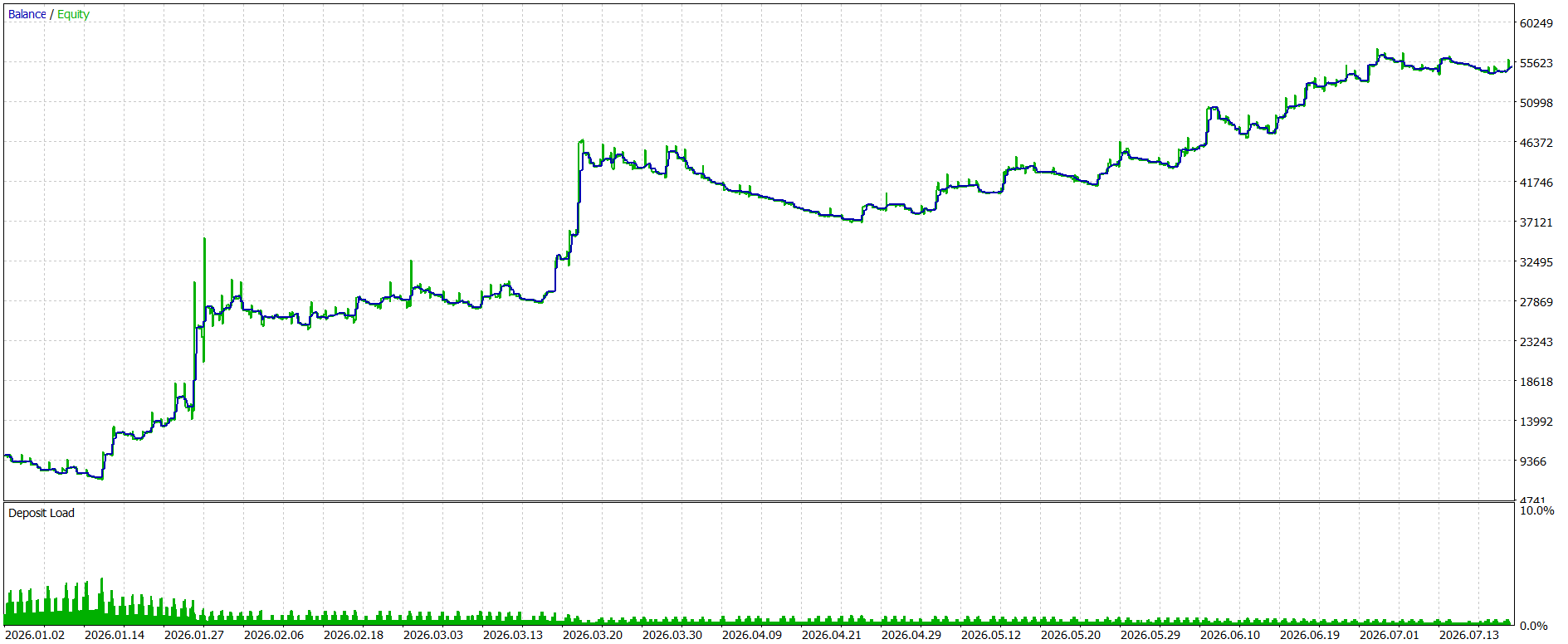
If you look at the stats of my final 68+ million tick backtest (attached as a screenshot), you might notice a surprising metric: The Win Rate is only 41.14%.
Beginners hate this number, but quantitative developers understand it. Here is the math that makes it work:
-
Average Profit Trade: +$494.02
-
Average Loss Trade: -$176.72
By maintaining an asymmetric Risk-to-Reward Ratio of nearly 2.8 : 1, the system doesn't need to win every trade. It absorbs small losses during consolidation (avg -$176), and lets winners run during high volatility (avg +$494).
📊 The Final Results (99% Quality Backtest)
After avoiding the curve-fitting trap and trusting the math, the long-term stress tests over 13,000+ bars finally validated the concept:
-
Net Profit: +$45,125.71 (on a 10k deposit)
-
Sharpe Ratio: 5.44 (Exceptional risk-adjusted return)
-
Recovery Factor: 4.23 (Rapid recovery after drawdowns)
-
Maximal Balance Drawdown: 17.74%
-
Linear Regression (LR) Correlation: 0.94 (Stable, consistent equity growth)
This data proves that a system doesn't need a dangerous grid or martingale logic to achieve a massive top-line return. It just needs patience and a mathematical edge.
🛠️ What Comes Next?
Publishing EMA Trinity Pulse is just the beginning. My goal is to continue improving the system, collecting feedback, and building transparent solutions for traders who respect systematic approaches.
If you are a fellow developer or an algo-trader interested in testing how an asymmetric risk system behaves under different market conditions, I highly encourage you to stress-test the logic yourself.
👉 [You can find EMA Trinity Pulse and download the Free Demo on the MQL5 Marketplace here.]
I would be happy to hear thoughts, backtest results, and experiences from other traders. Feel free to send me a DM here on MQL5 if you want to discuss algorithmic structures or broker latency setups!
Thank you for reading, and I wish everyone successful trading.
Jonathan
Creator of EMA Trinity Pulse