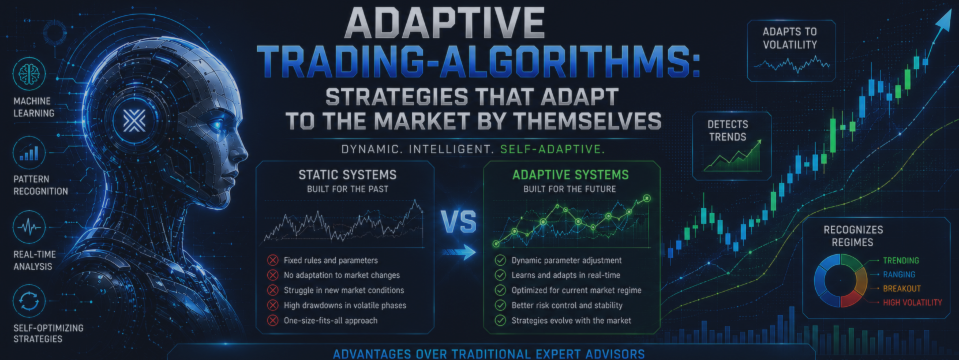
Adaptive Trading Algorithms: The Complete Anatomy of Systems Built to Actually Survive

Adaptive Trading Algorithms: The Complete Anatomy of Systems Built to Actually Survive
Your static Expert Advisor is dying right now, and it has no idea. This is not a metaphor. Every fixed rule set calibrated once and deployed unchanged is on a countdown that started the exact moment it went live, because the market it was tuned for began drifting away from it on day one, and it has no internal mechanism to notice, let alone correct for, that drift. Adaptive architecture is not a premium feature bolted onto a good idea. It is the only category of automated trading engineered to survive contact with a market that categorically refuses to hold still.
This is a long, deliberately exhaustive breakdown, because the subject deserves genuine depth rather than another shallow listicle repeating the same three bullet points every other article in this category recycles. We are going to dissect adaptation as three genuinely distinct layers, surface level parameter adjustment, deep architectural self modification, and coordination level intelligence spanning multiple markets, using ICONIC BTC AI+ and the flagship ICONIC KYBERNETIC AI+ as the working, verified proof of every claim made along the way.
Static Versus Adaptive: A Death Sentence Versus a Living Process
A static system is calibrated once and executes that exact calibration forever, with zero internal capacity to notice the world has moved on. It has no idea whether the trend that once justified its logic still exists. It has no idea whether volatility has doubled or halved since the day it was tuned. It has no idea whether the specific regime it was built for has quietly given way to something structurally different. It simply keeps firing the same instructions with the same blind confidence, on trade one thousand exactly as it did on trade one, regardless of how far reality has diverged from the assumptions baked into it at birth.
An adaptive system operates on a categorically different premise. It perceives current conditions, it incorporates genuine feedback from live outcomes, and it changes its own behavior, sometimes its parameters, sometimes its actual internal structure, in direct response to what it observes. This is not a difference in degree between two similar approaches. It is the difference between a photograph, frozen the instant it was taken, and a living organism that keeps sensing and responding to its environment for as long as it continues operating.
The Three Layers of Adaptation Almost Nobody Explains Properly
Most discussion of adaptive trading systems flattens everything into one vague category, the system adapts, as though adaptation were a single, undifferentiated capability. It is not. Genuine adaptive architecture operates across three distinct layers, each solving a different problem, and understanding all three separately is what actually separates informed evaluation from marketing language. Layer one is surface parameter adaptation, where specific, external settings such as stop distance and position size scale mechanically with real time conditions. Layer two is architectural self modification, where the model's own internal structure, the actual strength of its internal connections, changes in response to accumulated feedback. Layer three is coordination level adaptation, where an intelligence spanning multiple markets adjusts not just its own behavior but the relationship it understands between those markets. Every section that follows walks through one of these layers in genuine depth, verified directly against working code.
Layer One: Surface Parameter Adaptation, The Foundation Everything Else Builds On
This is the layer most systems marketed as adaptive actually stop at, and even here, most of them do it badly. A fixed stop distance makes a silent, dangerous bet, that today's volatility resembles whatever volatility existed the day that number was chosen. That bet loses constantly on an asset as genuinely volatile as Bitcoin. ICONIC BTC AI+ calculates stop distance directly from live Average True Range rather than a static point value, meaning protective distance genuinely scales with real, current conditions on every single trade. Position sizing is derived from a defined percentage of account equity combined with that same ATR based stop distance, so that as volatility widens and the calculated stop grows, position size mechanically shrinks to compensate, holding actual dollar risk consistent regardless of whether the market is calm or violent at that specific moment. Even the touch tolerance determining whether price has genuinely reached a breakout level scales relative to current ATR rather than a fixed point distance, ensuring trigger sensitivity tracks real volatility rather than a number calibrated once and left untouched.
None of this requires a trader to notice anything. No login, no manual adjustment, no spreadsheet tracking recent volatility to decide whether today's stop should be wider. The mathematics forces the correction automatically, on every single trade, whether the trader is watching or asleep.
Surface adaptation extends beyond sizing and stops into the gates governing whether a trade happens at all. Live spread is checked against a defined maximum threshold before any entry proceeds, rejecting a setup outright the instant execution conditions turn genuinely unfavorable, precisely the moments a static system with no spread awareness gets quietly punished trade after trade. Range and volatility conditions are checked to ensure current structure genuinely supports the stop and target relationship being proposed, rather than assuming favorable conditions exist by default. And account level drawdown state is monitored continuously, with risk posture adjusting automatically as accumulated drawdown grows, rather than treating every single trade as though the account had just been opened fresh regardless of recent history. A static system has none of this. It has one fixed rule, applied identically whether the account is thriving or already bleeding.
Layer Two: Architectural Self Modification, Where Adaptation Stops Being a Setting and Becomes the System
This is where ICONIC BTC AI+ leaves every static competitor behind entirely, and where most products marketed as adaptive reveal they never actually reached this layer at all. Differentiable plasticity through Hebbian neuromodulation means the effective strength of every connection inside the network is not a fixed number set once during training. It is calculated as a base weight plus a live, continuously updated plasticity coefficient multiplied by an ongoing Hebbian activation trace, meaning the network's actual behavior evolves in direct response to real, live market feedback rather than remaining frozen at whatever state it held on deployment day. This is not a parameter being tweaked. It is the model's own internal structure genuinely rewiring itself, continuously, for as long as the system keeps operating.
An in RAM MAP Elites archive, structured as a three by three grid of specialist behavioral niches, extends this further. Rather than forcing one universal strategy to handle every possible market condition adequately, the engine maintains a library of tuned specialist responses across combinations of trend character and volatility character, and when conditions shift, it draws on the elite genuinely suited to the new regime rather than applying one compromised, average behavior indiscriminately. Transitions between these specialist niches happen through genuine Riemannian metric tensor blending along geodesic distance, the mathematically correct notion of shortest path across a curved parameter space, ensuring the handoff between one specialist and another remains smooth and valid rather than a jarring, distorted jump between incompatible behaviors.
Hindsight Experience Replay reinforces this learning process directly, revisiting closed trades and extracting usable training signal even from outcomes that never reached their original target, treating a near miss as genuine data rather than a discarded failure, precisely the discipline a professional trader applies reviewing every close call rather than only celebrating clean wins. An epigenetic methylation gate provides the safeguard almost no competing system bothers to build, automatically freezing the plastic weights the instant the engine detects choppy, directionless conditions or an accelerating drawdown, specifically preventing the network from learning the wrong lesson during exactly the periods markets are least trustworthy to learn from. And long memory momentum perception runs through Grunwald Letnikov fractional calculus, a mathematical technique specifically capturing how past price behavior continues influencing the present over a considerably longer horizon than any conventional, fixed lookback indicator could ever represent, tuned specifically to Bitcoin's genuinely persistent, trending character rather than borrowed unmodified from an unrelated market.
Trend Adaptation, Refusing to Trust Every Move Equally
A static breakout system treats every level touch as equally tradeable, regardless of whether the broader structure actually supports continuation. This is precisely the mistake that destroys naive systems during choppy, directionless conditions. ICONIC BTC AI+ evaluates trend character through a one hundred period EMA establishing strategic bias, combined with a genuine trend linearity measurement, an R squared statistic computed over sixty bars of the higher timeframe, quantifying precisely how cleanly price has actually followed a directional path rather than merely noting that price ended up somewhere directional by coincidence. A high reading confirms genuine, orderly conviction. A low reading signals disorderly noise, and the system treats that low reading as a genuine reason to withhold action entirely, adapting its own willingness to trade based on the honest quality of current structure rather than firing blindly on every level touch regardless of context.
Trade Management Adaptation, Where Most Systems Never Even Try
Almost every system marketed as adaptive stops applying that adaptation the instant a position opens. This is precisely where ICONIC BTC AI+ goes considerably further than the rest of this category, applying genuine, verified learning to the two decisions that actually destroy most trading accounts, whether to hold or cut a struggling position, and how tightly to protect a winning one.
Smart Bail Out trains an online logistic model estimating genuine recovery probability for a position sitting in adverse territory, but it does not act on a whim. A minimum of thirty observed lessons must accumulate before the model is ever trusted to cut a single trade early. Evaluation only begins after a five minute minimum holding period, since a position barely negative in its first few minutes usually reflects nothing more than ordinary entry slippage. Once that window passes, the model re evaluates on a fixed sixty second cadence, with every raw estimate Bayesian shrunk toward a neutral fifty percent baseline weighted by a defined strength of twenty five pseudo lessons, specifically preventing an undertrained model from acting confidently on too little evidence. Even then, two consecutive sub threshold readings are required before an early cut actually fires, a genuine debounce against a single noisy data point triggering an unwarranted intervention.
Adaptive Trailing mirrors this same rigor for the opposite problem, learning a dynamic multiplier ranging from zero point seven five, the tightest setting genuinely locking in profit, to one point four zero, the loosest setting deliberately letting a genuine runner breathe rather than exiting on a completely normal pullback. Both systems learn through honest counterfactual labeling, revisiting every closed trade and asking whether an earlier decision to hold, cut, tighten, or loosen would genuinely have produced a better outcome, converting every single closed position into a real, accumulated lesson rather than an isolated, unexamined event.
Entry Structure Adaptation, Levels That Refresh Instead of Fossilizing
A bot that calculates its structural levels once at startup and never revisits them is trading against a map of the market that grows more outdated by the hour. ICONIC BTC AI+ places pending stop orders at three distinct classes of structural level, daily and previous day high and low points representing genuine liquidity concentration, support and resistance zones identified across a meaningful window of recent history, and order block levels marking recent concentrated buying or selling pressure. Crucially, this entire pending structure is refreshed at regular intervals through a smart re arm process, ensuring the specific levels being traded reflect current, recent market structure rather than a stale calibration drawn hours before conditions genuinely changed underneath it.
Layer Three: Coordination Level Adaptation, Where the Flagship Operates Alone
This is the layer nothing else in this category even attempts, and it is where the flagship ICONIC KYBERNETIC AI+ lives permanently. Coordinating two structurally different markets under one adaptive intelligence is a categorically harder problem than adapting to one market alone, because the system must adapt not only its own behavior, but its understanding of how the two markets it trades genuinely relate to each other, continuously, as that relationship itself evolves.
A binned Transfer Entropy causal gate measures the actual, directed flow of information between Bitcoin and Gold, rather than assuming a fixed statistical relationship that can silently break down the moment conditions shift. A Liquid State Machine reservoir with an exponentially weighted recursive least squares readout grants the system genuine, dynamic memory of market sequence, kept regime adaptive through a real forgetting factor rather than frozen. Every feature feeding this entire stack passes through online Welford normalization, a numerically stable running statistic keeping the system mathematically sound as conditions shift across years of live operation.
Adaptive Conformal Inference regulates the engine's own confidence gate continuously online, so its realized error rate converges toward a defined target, a genuine, ongoing self calibration most systems never attempt at all, trusting instead a fixed number chosen once during development and never revisited. Action selection runs through Boltzmann softmax exploration over a persistent, per symbol Q table, refined through TD lambda learning with genuine eligibility traces for its primary sequential decision process, while a separate Experience Replay ring buffer deliberately does not apply those same eligibility traces to its randomly sampled tuples, correctly recognizing that sequential credit assignment logic is mathematically incoherent when applied to non sequential, randomly drawn data. Getting this distinction right is precisely the kind of nuance separating genuine reinforcement learning engineering from a superficial implementation borrowing the right vocabulary without the right mathematics underneath it.
Regime Adaptation That Learns From Its Own Track Record, Not a Fixed Assumption
Entry eligibility is governed by a five bucket ADX regime filter, dividing trend strength into distinct ranges, each tracking its own running, continuously updated reward estimate independently. This is not a fixed rule set. A bucket originally assumed too weak to trade can be reopened once genuine accumulated evidence shows it has actually proven profitable, and a bucket originally assumed favorable can be closed once real results prove otherwise. The system's own definition of what counts as a genuinely tradeable regime shifts based on demonstrated experience, not a static assumption configured once and trusted forever.
Portfolio Level Adaptation, Risk That Escalates Automatically as Conditions Deteriorate
Adaptation at this layer extends directly into risk enforcement itself. A Physics Informed margin axiom embeds a hard, structural free margin floor of thirty five percent the engine is mechanically incapable of violating, not a configurable preference that erodes quietly under pressure. Daily portfolio drawdown is monitored continuously and enforced across three escalating tiers, both engines forced into a defensive posture at the first threshold, all new pending orders blocked entirely at the second, and an emergency close liquidating every open position at the third, followed by an enforced cooldown before trading resumes. Capital allocation between Bitcoin and Gold is solved through Stochastic Tunneling toward an annealed Nash equilibrium, continuously re optimized as conditions evolve rather than a fixed ratio set once and left untouched indefinitely. This is adaptation applied to the single most important layer of the entire system, risk itself, escalating automatically the instant conditions genuinely deteriorate rather than depending on a human noticing danger in time.
The Real Evolution From Simple Scripts to This Architecture
Understanding where this architecture actually came from clarifies why it represents a genuine endpoint rather than an arbitrary marketing claim. The earliest automated trading systems were, in essence, hardcoded versions of a discretionary trader's fixed rulebook, if a moving average crosses a certain level then buy, with zero learning and zero adaptation of any kind. The next stage layered in multiple indicators and basic statistical filters, more inputs feeding the same fundamentally deterministic decision structure, still frozen the moment it was calibrated. Machine learning enhanced systems followed, using a trained model to generate a prediction, but frequently still wrapping that prediction in a largely static, hand coded decision and risk layer, a genuine improvement that nonetheless inherited a structural weakness, optimizing prediction accuracy does not automatically optimize actual trading outcomes.
The architecture verified throughout this article represents the actual current frontier of that evolution, systems combining genuine adaptive decision making, continuous online learning, and hard, code enforced risk boundaries operating together as one coordinated whole. This is not distant speculation about where the field might eventually head. It is the current, deployed reality inside ICONIC BTC AI+ and ICONIC KYBERNETIC AI+ right now, verified directly in working code rather than promised for some future release.
A Complete Case Study: Watching Both Layers Fail Inside a Static System
Walk through a realistic, composite scenario to see exactly how a static system's blindness compounds across every layer this article has covered. A developer calibrates a fixed stop distance and a fixed trend filter against several months of historical Bitcoin data, a period that happened to feature comparatively contained volatility and a clean, persistent uptrend. The system launches, and for several weeks, live conditions happen to resemble that calibration period closely enough that results look reasonable, and confidence grows.
Then volatility genuinely expands, a violent, multi day repricing event completely unlike anything in the original calibration window. The fixed stop distance, never designed for this magnitude of movement, is either triggered repeatedly by ordinary noise now dwarfing its original calibration, or, if set wide enough to survive the new volatility, sits so far from entry that risk per trade has silently ballooned far beyond what was ever intended. The fixed trend filter, never designed to distinguish this new, more violent regime from the calm trend it was tuned against, continues firing on level touches with the same blind confidence it always has, unable to recognize that the statistical character of what it is watching has genuinely changed beneath it. There is no methylation gate here to pause learning during the dangerous transition, because there was never any learning process to pause in the first place. There is no regime bucket quietly closing itself based on accumulated evidence, because there is no bucket system at all. The static system does not fail because its original logic was unsound. It fails because it was never built with any mechanism to notice that the world it was built for had already ended.
Every Layer of This Architecture, Mapped Directly Against That Failure
Trace the exact same scenario through ICONIC BTC AI+ instead. Surface adaptation means the stop distance and position size recalibrate automatically the instant ATR expands, holding real risk consistent rather than silently exploding. Trend adaptation means the R squared trend linearity read genuinely degrades the moment the new, more violent regime replaces the calm trend the system was originally exposed to, and the system treats that degraded reading as a genuine reason to reduce confidence rather than continuing blindly. Architectural adaptation means differentiable plasticity is already reshaping the network's own internal weighting in response to the new conditions as they unfold, while the methylation gate stands ready to freeze that learning entirely if the transition itself becomes dangerously choppy rather than cleanly trending. None of this requires the developer to notice anything happening and intervene manually. Every single layer was built specifically to notice and respond to exactly the kind of regime transition that silently destroys a static system with no equivalent architecture underneath it.
The Maintenance Economics Nobody Talks About
There is a practical, financial dimension to this entire discussion worth stating plainly, because it rarely appears in comparisons that focus purely on performance. A static system's ongoing maintenance burden compounds relentlessly over time. Markets evolve continuously, and a fixed calibration requires a human to notice the drift, diagnose exactly what changed, and manually re optimize the system, an exhausting, never ending cycle that repeats indefinitely for as long as the system remains deployed, since the underlying architecture has no capacity to perform any part of this process itself.
An adaptive system's maintenance burden is structurally different, not zero, but categorically lighter, because a meaningful share of what would otherwise require manual intervention is instead handled automatically by the architecture itself, continuous parameter recalibration, regime aware behavior shifts, self correcting confidence gates. The hours a trader would otherwise spend manually re tuning a static system are hours reclaimed entirely, not because the market stopped changing, but because the system stopped needing a human to notice and react to that change on its behalf.
Why Single Asset Adaptation and Coordinated Adaptation Are Genuinely Different Problems
It is worth being precise about why ICONIC BTC AI+ and ICONIC KYBERNETIC AI+ represent two genuinely different tiers of adaptive complexity rather than the same architecture simply relabeled. Adapting to one market requires perceiving that market's own conditions and adjusting behavior accordingly, a genuinely hard problem, but a bounded one. Coordinating two markets adaptively requires everything the single asset problem requires, applied independently to each market, plus an entirely additional layer, understanding how the relationship between those two markets itself evolves over time. A causal relationship measured as strong last month may weaken this month. A capital allocation considered balanced under one volatility regime may become genuinely imbalanced under another. ICONIC KYBERNETIC AI+ was built specifically to adapt across this additional dimension, its Transfer Entropy causal gate and Stochastic Tunneling allocation continuously re evaluating that relationship rather than assuming it once and trusting the assumption forever, precisely the reason coordinating two markets well is a categorically harder engineering achievement than adapting to one market alone, regardless of how well built that single asset system happens to be.
The Complete Layer By Layer Comparison
Stepping back across everything covered in this article, the contrast between static and genuinely adaptive architecture holds consistently at every single layer examined.
- Position sizing. Static systems apply a fixed lot size or a stop distance chosen once. Adaptive systems recalculate both from live ATR on every single trade.
- Trend assessment. Static systems apply an unchanging directional rule. Adaptive systems quantify trend quality through genuine statistical measurement and adjust confidence accordingly.
- Internal structure. Static systems never change their own logic after deployment. Adaptive systems built on differentiable plasticity continuously rewire their own internal connections in response to live feedback.
- Trade management. Static systems apply a fixed stop and a fixed trailing distance. Adaptive systems apply counterfactually trained models that learn when to cut early and when to give a winner room to run.
- Entry structure. Static systems calculate levels once and trade them indefinitely. Adaptive systems refresh structural levels continuously so the map being traded reflects current reality.
- Cross market relationships. Static multi symbol systems assume a fixed relationship between instruments. Coordinated adaptive systems measure that relationship continuously and adjust allocation as it genuinely shifts.
- Risk enforcement. Static systems apply one fixed risk rule regardless of account state. Adaptive systems escalate protection automatically as real, accumulated drawdown grows.
- Maintenance burden. Static systems require perpetual manual re optimization as markets drift. Adaptive systems absorb a meaningful share of that recalibration automatically, reclaiming the trader's time rather than consuming it indefinitely.
What Happens the Day the Market Genuinely Changes
This is the single question that actually separates these two categories in practice, and it deserves to be asked directly of any system before trusting it with real capital. What happens the day the market genuinely, structurally changes. A static system has exactly one answer, it keeps doing exactly what it was doing, with the same confidence, regardless of whether that behavior still makes any sense at all. An adaptive system answers this question at every single layer covered throughout this article, its position sizing recalibrates, its trend assessment degrades honestly, its internal weighting reshapes itself, its trade management applies newly relevant lessons, and, for a coordinated system, its understanding of cross market relationships updates as well. This is not a marginal difference in quality. It is the entire difference between a system built to survive the one certainty every market eventually delivers, genuine, unannounced change, and one that was never built to notice it happened at all.
Why This Intelligence Does Not Reset Every Time the Platform Restarts
A learning system that forgets everything it has accumulated every time a terminal restarts would be genuinely worthless in practice, regardless of how sound its underlying mechanics are in theory. Every layer of accumulated intelligence described throughout this article, the MAP Elites archive of specialist behaviors, the Smart Bail Out and Adaptive Trailing models, the entire OMNI NEXUS learning stack inside ICONIC KYBERNETIC AI+, persists to disk rather than existing only in volatile memory. A platform restart does not erase this progress and force every warmup clock and every learned specialist back to zero. The system running after months of live operation genuinely knows more, and has genuinely adapted further, than the system that was first attached to a chart, and that accumulated advantage compounds indefinitely rather than resetting on every reboot, precisely the property that separates a system genuinely capable of getting better over time from one that merely simulates adaptation in a demo environment and starts over the moment it matters.
Why Retail Traders Chase Entries While Institutions Obsess Over This Exact Architecture
There is a telling asymmetry worth naming directly. Retail trading education overwhelmingly focuses on entry technique, patterns, indicators, signals, because entries are visually dramatic and easy to package into an engaging lesson. Institutional and quantitative operations invest disproportionately in exactly the architecture covered throughout this article, adaptive risk sizing, regime aware behavior, continuous recalibration, coordinated multi asset intelligence, because this is where genuine, durable edge actually lives once a strategy idea itself has been reasonably well established. The retail market has been trained to evaluate the wrong layer, and every system marketed purely on entry technique, with no genuine discussion of how it adapts across the layers covered in this article, is quietly exploiting exactly that misdirected attention.
Frequently Asked Questions
What is the fundamental difference between a static and an adaptive trading algorithm? A static algorithm executes fixed rules indefinitely regardless of whether conditions have changed. An adaptive algorithm perceives current conditions and genuinely changes its own parameters, or in the deepest implementations its own internal structure, in response to live feedback.
How many distinct layers of adaptation exist in genuinely advanced trading architecture? Three, surface parameter adaptation such as volatility scaled position sizing, architectural self modification where the model's internal structure itself changes, and coordination level adaptation where a system spanning multiple markets adjusts its understanding of the relationship between them.
What does differentiable plasticity actually mean in practice? The effective strength of a network's internal connections is calculated from a base weight plus a live, continuously updated activation trace, meaning the model's actual behavior evolves in response to real feedback rather than remaining frozen after initial training.
Why does Smart Bail Out require thirty observed lessons before it can act? To prevent an undertrained model from making consequential early exit decisions based on too little genuine evidence, a hard structural safeguard against premature, overconfident intervention.
What is the purpose of the epigenetic methylation gate? It automatically freezes the network's plastic weights during choppy or high drawdown conditions, preventing the system from learning misleading lessons during exactly the periods markets are least trustworthy to learn from.
How does ICONIC KYBERNETIC AI+ adapt differently than a single asset system? Beyond adapting its own behavior per market, it continuously re evaluates the causal relationship between Bitcoin and Gold through Transfer Entropy and re optimizes capital allocation between them through Stochastic Tunneling, an entirely additional adaptive dimension single asset systems do not require.
Why does eligibility trace usage differ between the online learning core and Experience Replay? Eligibility traces are only mathematically valid for genuinely sequential experience. Replay draws random past tuples from a buffer, and applying sequential credit assignment logic to randomly sampled data would be mathematically incoherent, so replay instead uses a simpler, reduced rate update.
Does adaptive architecture eliminate the need for hard risk management? No, the opposite. Genuine adaptive systems pair continuous learning with hard, structurally enforced risk boundaries, a code level margin floor, tiered drawdown protection, precisely because intelligence alone was never a substitute for enforced discipline.
Why do adaptive systems require less ongoing manual maintenance than static ones? Because a meaningful share of the recalibration a static system would otherwise require a human to notice and manually perform is instead handled automatically by the architecture itself, reclaiming time rather than demanding it indefinitely.
Does learned intelligence survive a platform restart? Yes. Accumulated learning across every system described in this article persists to disk rather than existing only in volatile memory, meaning a restart does not erase progress or force learned specialists and warmup counters back to zero.
Stop Renting a Photograph. Start Owning a Living System.
A static Expert Advisor is a frozen snapshot of a strategy that made sense on one specific day. Every hour you spend manually re tuning it is an hour spent fighting a battle genuinely adaptive architecture already won by design, across every single layer this article has dissected in full. ICONIC BTC AI+ adapts its sizing, its trend assessment, its own internal structure, and its trade management automatically, on every single trade, without requiring you to notice anything. The flagship ICONIC KYBERNETIC AI+ takes every one of these layers further still, coordinating Bitcoin and Gold under one continuously self calibrating intelligence, with risk enforced as unbreakable structural law regardless of how confident any other layer of the system currently feels.
The market has never once stopped moving long enough for a static system's original calibration to remain honest. Stop trading with an architecture that was already obsolete the day it launched. Deploy ICONIC BTC AI+, or step up to the flagship ICONIC KYBERNETIC AI+. Explore the complete lineup, including performance based copytrading, at iconicfx.tech.
Risk Disclaimer. Trading foreign exchange, cryptocurrencies, commodities and other leveraged financial instruments carries a high level of risk and may not be suitable for all investors. The high degree of leverage can work against you as well as for you. Past performance is not indicative of future results. Automated trading systems and Expert Advisors do not guarantee profits and can produce losses. Backtests and simulated results have inherent limitations and do not represent actual trading. ICONIC.FX provides software tools only and does not provide investment advice, portfolio management or financial recommendations. You are solely responsible for your own trading decisions. Seek advice from an independent licensed financial advisor if you have any doubts.
How to Verify Every Claim in This Article Yourself, Rather Than Trusting Marketing Language
Everything described throughout this article was verified directly against working source code, not asserted from a product description, and you deserve to understand exactly what genuine verification looks like before trusting any similar claim from any vendor in this category. A genuinely adaptive parameter shows up as a calculation referencing live market data, an ATR value, a volatility reading, not a fixed constant buried in a settings file. A genuinely learning system shows up as persisted state, files that grow and change as the system accumulates trading history, not a static configuration that looks identical on day one and day one thousand. A genuinely enforced risk boundary shows up as a hard check with no override path, not a setting that can be silently disabled under pressure. Demanding this level of specificity before trusting any adaptive claim, from any vendor, in any product, is precisely the discipline that separates an informed buyer from one relying purely on confident sounding language.
The Psychological Dimension of Trusting a System That Keeps Changing
There is an uncomfortable irony worth naming directly. Traders often instinctively distrust a system whose behavior visibly evolves over time, preferring the false comfort of a fixed, predictable rule set even when that fixed predictability is precisely what guarantees eventual failure. A static system feels safer specifically because its behavior never surprises you, right up until the moment that unchanging behavior meets a market condition it was never built to handle, at which point the very predictability that felt reassuring becomes the mechanism of the account's destruction. A genuinely adaptive system asks something harder of the trader deploying it, trust built on understanding the architecture rather than trust built on the comforting illusion of a fixed number that never moves. This article exists specifically to make that harder form of trust available, grounded in verified mechanics rather than blind faith in either direction.
A Second Worked Example: The Slow Regime Grind Nobody Notices Until It Is Too Late
Not every failure mode is a sudden, violent event. Consider a genuinely more insidious scenario, a market that does not crash or spike, but slowly, gradually transitions from a clean trending character into a genuinely choppy, directionless one over the course of several weeks, with no single dramatic moment marking the transition. A static system has no mechanism to notice this kind of slow drift at all, since nothing about its fixed logic changes regardless of how gradually or suddenly conditions shift. Trade after trade, it continues applying the exact same breakout logic that worked beautifully during the trending phase, slowly bleeding through the transition without ever recognizing that the game it is playing has fundamentally changed.
ICONIC BTC AI+ handles this exact scenario through the continuous nature of its trend linearity measurement, which degrades gradually and honestly as the underlying character genuinely shifts, rather than requiring a single dramatic threshold crossing to register the change. ICONIC KYBERNETIC AI+ handles the equivalent scenario through its regime bucket tracking, where a bucket's running profitability estimate degrades gradually as real trade outcomes within that bucket genuinely worsen, eventually triggering a closure once sufficient evidence has accumulated, rather than requiring a single obvious signal that a slow, gradual grind rarely provides. This is precisely why continuous, quantified adaptation matters more than a system that only responds to dramatic, obvious events, because the slow, quiet regime shifts are often the ones that do the most cumulative damage to a static system precisely because they never trigger any single alarm loud enough to be noticed manually.
What This Means for How You Should Actually Deploy Capital
Given everything covered throughout this article, the practical deployment decision becomes considerably clearer. A trader focused purely on a single, extremely volatile asset with no need for cross market coordination has a direct, purpose built answer in ICONIC BTC AI+, an architecture engineered specifically for that exact problem with no unnecessary complexity layered on top. A trader who wants genuine diversification, coordinated exposure across two structurally different markets, Bitcoin and Gold, under one continuously adapting risk framework, has a considerably more sophisticated answer in the flagship ICONIC KYBERNETIC AI+, where the additional coordination layer genuinely earns its added complexity through capabilities a single asset system structurally cannot provide. Neither choice is a compromise. Both represent the same underlying philosophy of genuine, verified adaptation, applied at the specific scope that matches what you are actually trying to accomplish.
The Compounding Advantage of Adaptation Over Long Time Horizons
It is worth stating explicitly why the advantage of genuine adaptation grows rather than shrinks the longer a system operates, a property almost entirely absent from static architecture. A static system's edge, if it ever genuinely had one, degrades monotonically over time as the market drifts further and further from the exact conditions it was calibrated against, with no counterforce slowing that decay. An adaptive system's relationship with time works in the opposite direction. Every additional month of live operation feeds more genuine evidence into its learning mechanisms, deepening the MAP Elites archive's specialist coverage, sharpening Smart Bail Out and Adaptive Trailing's counterfactual calibration, refining the regime bucket estimates inside ICONIC KYBERNETIC AI+ toward genuinely demonstrated profitability rather than initial assumption. A static system's best day was the day it launched, calibrated against the freshest possible historical data it would ever see. A genuinely adaptive system's best day has not happened yet, because it is still accumulating the evidence that will continue sharpening its own judgment for as long as it keeps running.
Why This Distinction Will Only Matter More, Not Less, Going Forward
Markets are not becoming more stable or more predictable over time, if anything the opposite trend has been visible for years, faster information flow, more automated participants, more rapid regime transitions than markets exhibited in earlier eras. This means the specific weakness of static architecture, its inability to notice and respond to genuine change, becomes more costly with each passing year, not less. A fixed calibration that might have remained honestly relevant for a year or more in a slower moving market environment now faces a considerably shorter honest shelf life before drift renders it dangerously outdated. Genuinely adaptive architecture is not a temporary competitive advantage destined to be commoditized away. It is a structural necessity for operating in exactly the kind of market environment that has become the norm rather than the exception, and every year that passes without adopting it is a year spent accepting a structural handicap that compounds in exactly the wrong direction.
The Honest Limits Even Genuinely Adaptive Architecture Cannot Escape
Intellectual honesty requires acknowledging what adaptive architecture does not solve, even at the depth described throughout this article. No system, however sophisticated its learning mechanisms, eliminates market risk entirely, and any product implying otherwise deserves informed skepticism regardless of how impressive its underlying architecture genuinely is. Adaptation reduces the specific risk of a system remaining blindly calibrated to a past that no longer exists. It does not, and cannot, guarantee profit on any individual trade, nor does it eliminate the fundamental uncertainty inherent to trading any genuinely liquid market. This is precisely why every layer of adaptation described throughout this article operates underneath, not instead of, hard, non negotiable risk enforcement, a stop loss on every single position, a structural margin floor, tiered drawdown protection escalating automatically as conditions deteriorate. Genuine adaptation and genuine risk discipline are not competing priorities. They are the two halves of the same architecture, and a system offering only one without the other was never actually complete in the first place.
Bringing Every Layer Together, One Final Synthesis
Step back across everything this article has covered and the complete picture becomes clear. Surface parameter adaptation ensures every single trade's risk genuinely reflects current conditions rather than a stale assumption. Architectural self modification ensures the model's own judgment continuously improves rather than remaining frozen at deployment. Trade management adaptation ensures the hardest decisions, when to cut and when to hold, are governed by accumulated evidence rather than a fixed rule. Entry structure adaptation ensures the map of the market being traded stays genuinely current. And, for the flagship, coordination level adaptation ensures the relationship between two markets is continuously understood rather than assumed once and trusted forever. No single layer alone would justify the claims made throughout this article. Together, verified across every layer simultaneously, they represent something genuinely rare in this entire product category, an architecture built from the ground up around the one certainty every trader eventually learns the hard way, that the market they are trading today will not be the same market they are trading a year from now, and that only a system built to notice and respond to that fact has any genuine claim to calling itself professional.
Frequently Asked Questions, Continued
Why does adaptive architecture become more valuable the longer a system operates? Because ongoing live operation continuously feeds genuine evidence into its learning mechanisms, deepening specialist coverage and sharpening calibration, while a static system's edge, if it ever existed, degrades monotonically as the market drifts further from its original, unrevisited calibration.
Does adaptive architecture eliminate the fundamental uncertainty of trading? No. It reduces the specific risk of remaining blindly calibrated to outdated conditions, but it does not guarantee profit on any individual trade or eliminate the genuine uncertainty inherent to any liquid market, which is precisely why hard risk enforcement operates underneath every adaptive mechanism described throughout this article rather than replacing it.
How can I distinguish a genuinely adaptive system from one merely marketed as adaptive? Look for calculations that reference live market data rather than fixed constants, persisted learning state that genuinely changes over time rather than a static configuration, and hard risk boundaries with no override path rather than a setting that can be quietly disabled.