
Adaptive Market Intelligence
- Göstergeler
- Syamsurizal Dimjati
- Sürüm: 1.0
Adaptive Market Intelligence (AMI)
What is Adaptive Market Intelligence?
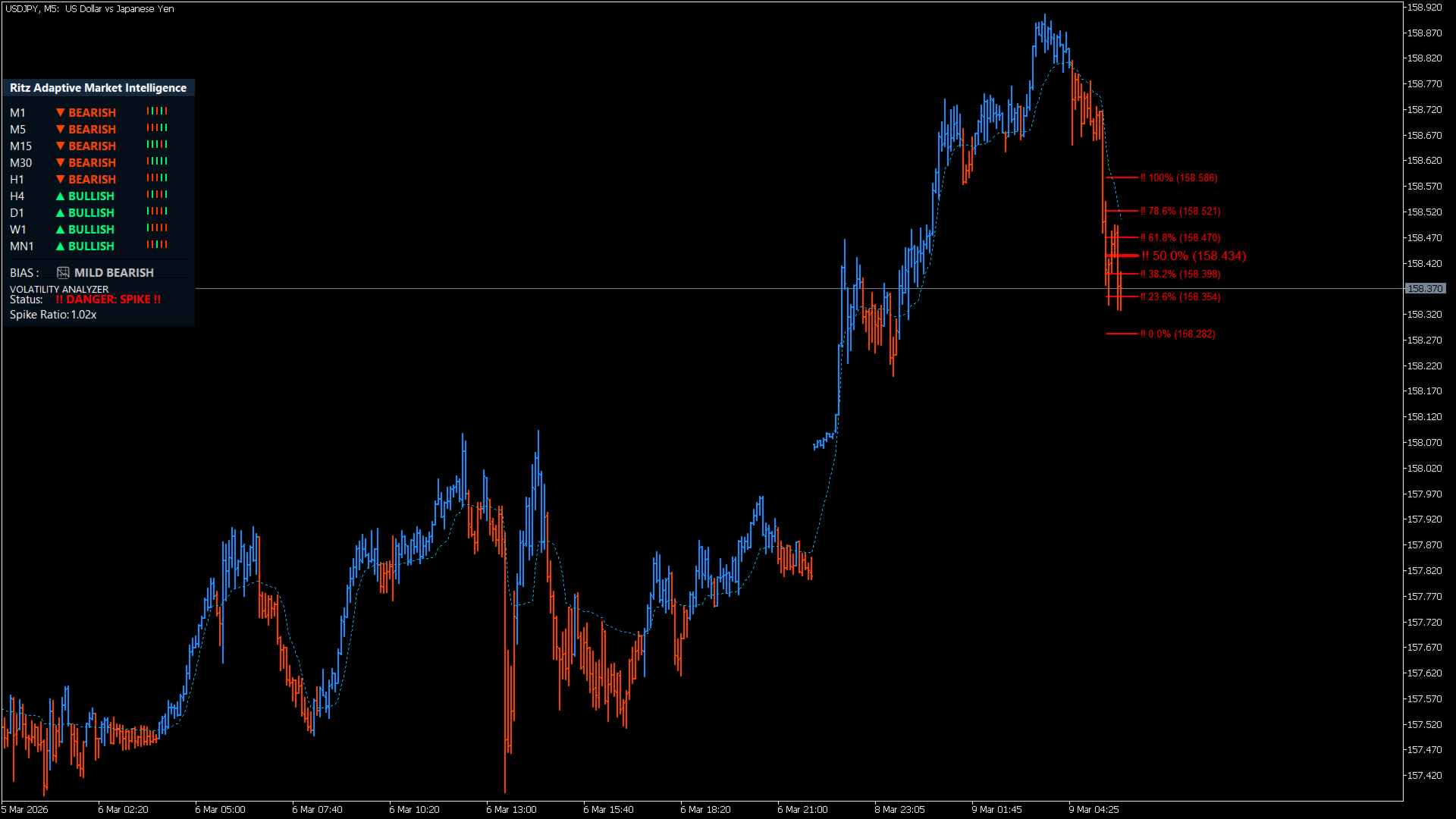
Adaptive Market Intelligence (AMI) is a professional multi-layer technical indicator designed to analyze trend behavior, volatility dynamics, and structural price zones within a single integrated framework.
The indicator combines adaptive trend analysis, volatility monitoring, sideways market detection, and dynamic Fibonacci mapping to provide traders with a clearer understanding of current market conditions.
Instead of relying on a single technical signal, AMI evaluates multiple market factors simultaneously to help identify trend strength, consolidation phases, and key price reaction zones.
Core Analytical Framework
Adaptive Market Intelligence is built around four essential analytical components that together provide a comprehensive view of market behavior.
1. Adaptive Trend Engine
The indicator uses an adaptive trend model designed to follow price movements while filtering out minor fluctuations.
This allows traders to observe the underlying trend direction without being overwhelmed by short-term market noise.
The adaptive approach helps maintain responsiveness during active trends while remaining stable during slower market conditions.
2. Volatility & Market Activity Monitor
Market volatility plays a critical role in determining trading opportunities.
The volatility engine evaluates price expansion and contraction phases, helping traders understand whether the market is entering a period of increased activity or returning to a quieter state.
By monitoring volatility behavior, traders gain additional insight into potential breakout environments and momentum shifts.
3. Sideways Market Detection
Financial markets frequently transition between trending phases and consolidation phases.
The built-in sideways detection mechanism helps identify when the market is moving within a narrow range, where directional signals are often less reliable.
Recognizing these conditions can help traders avoid entering trades during periods of low directional clarity.
4. Dynamic Fibonacci Structure Mapping
The indicator also highlights important Fibonacci-based price zones derived from recent market structure.
These zones help visualize areas where price may encounter support, resistance, or potential reaction levels, allowing traders to better understand how price interacts with key structural regions.
Market Interpretation
By combining these analytical layers, Adaptive Market Intelligence provides a structured overview of the market environment, allowing traders to quickly evaluate whether the market is:
-
Trending with directional strength
-
Consolidating within a narrow range
-
Experiencing volatility expansion
-
Approaching important structural price zones
This holistic perspective helps traders interpret market behavior with greater clarity and confidence.
Key Advantages
-
Adaptive Trend Detection — Adjusts to changing market conditions
-
Volatility Awareness — Highlights expansion and contraction phases
-
Sideways Market Filter — Identifies consolidation environments
-
Structural Price Mapping — Displays key Fibonacci reaction zones
-
Integrated Dashboard View — Combines multiple analyses into one system
Conclusion
Adaptive Market Intelligence (AMI) is designed to provide traders with a clear, structured interpretation of market conditions by integrating trend analysis, volatility monitoring, and structural price mapping into a unified analytical tool.
Rather than focusing on isolated signals, AMI helps traders understand how different market forces interact, enabling more informed and disciplined trading decisions.
















































































Hello, it would be great if you add phone notifications to the nice indicator.