Golden Hour Gold Trader
- Эксперты
-
Homesh Nasre
 I am a software engineer and a seasoned trader with a decade of experience. My journey started with heavy losses, which pushed me to master the markets and develop data-driven strategies.
- Версия: 1.43
- Активации: 5
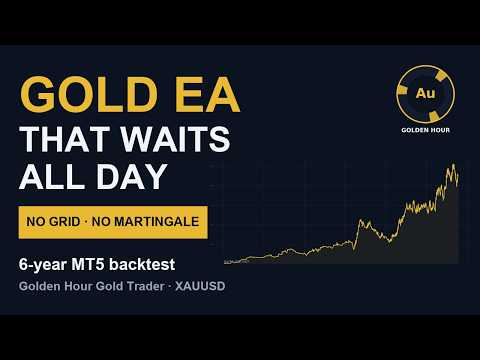
A patient gold EA. Golden Hour Gold Trader ignores most of the trading day and acts only in a few short moments that held up over six years of testing. It takes one trade at a time, every trade has a stop and a target, and there is no grid and no martingale.
Recommended setup
- Symbol: XAUUSD (gold), any broker suffix.
- Chart timeframe: M1 recommended. The EA reads its own data internally, so other chart timeframes give the same trades.
- Minimum balance: 500 USD (0.01 lot). Recommended 1,000 USD or more.
- Leverage: 1:100 to 1:500.
- Broker: low-spread gold account on a GMT+2/GMT+3 (New York close) server, or set Hour shift. VPS recommended.
I didn't plan to build a "patient" EA. I planned to build a busy one.
My first versions traded gold all day. Every scalping idea I tried looked fine until I added the real spread, and then it quietly lost, session after session. Gold is expensive to trade when you trade often. I also tried the grid and recovery approach that so many EAs use. It made a little money over six years, lost in three of them, and its drawdowns went over 50 %. I deleted it. I didn't want to sell something I wouldn't run on my own account.
What finally worked was the opposite: doing almost nothing. I went through six years of gold data and kept only the few moments of the day where the same behaviour showed up again and again. I chose them using 2021 to 2023 only, then checked them on 2024 to 2026, data the strategy had never seen. Most of what I tested failed. A handful held up, and Golden Hour Gold Trader trades only those.
There were more surprises along the way.
- Sizing. The first honest build made almost nothing on a 1,000 USD account. The signals were fine; the problem was position sizing. Small accounts were rounding away the best trades. Fixing how the lot is calculated changed the result more than any signal tweak.
- A trap. One time slot looked amazing in the tester, until I delayed the entry slightly and the edge disappeared. It was a pricing quirk, not a real pattern. Since then I trust a backtest only after trying hard to break it.
- Less is more. Trailing stops, profit locks and spike filters all sounded smart. I tested each one, and each one made the results worse, so they're gone. The EA is simpler and calmer because of it.
What you get:
- One trade at a time. No grid, no martingale, no averaging, no hedging.
- Stops on every trade. A hidden stop that adapts to volatility, plus a wider safety stop placed with the broker in case your terminal disconnects.
- A clear exit. A fixed target, plus a time exit so trades don't drag on.
- Weekend care. No new trades late on Friday; open trades are closed before the weekend.
- Your risk, your choice. The lot comes from your risk % per trade. The minimum lot is used only if its risk stays under a cap you set.
- A daily brake. When the daily loss limit is reached (default 3 %), the EA stops for the day.
- Filters. No entries with a wide spread, in a market too quiet to cover the cost, after a price gap, or without enough free margin.
Strategy Tester backtest (XAUUSD, January 2021 to October 2026, 1,000 USD, 1:500, 1-minute OHLC, 1 % risk):
- 835 trades, profit factor 1.19, recovery factor 3.54.
- Drawdown, both ways MT5 reports it: the largest drop in percent was 28.7 % (in 2021, when the account was small), and the largest drop in money was 634 USD (17.6 % of the balance at that time).
- Each calendar year closed positive: 2021 +163, 2022 +93, 2023 +268, 2024 +158, 2025 +824, 2026 (to mid-October) +739 USD.
- About 39 % of trades win. The average win is about 1.8 times the average loss, so a run of losses is normal. Please size your risk with that in mind.
These are backtest results, not live trading results. Past performance does not guarantee future results. Please run the free demo in the Strategy Tester on your own broker's data before you decide.
Setup:
- Chart. Attach the EA to one XAUUSD chart (any suffix). Any timeframe works.
- Server time. It runs on broker server time. The defaults are for GMT+2 winter / GMT+3 summer servers (New York close), which most gold brokers use. On other servers, set Hour shift to your server's GMT offset minus 2 (for example, GMT+0 → −2).
- Account. A low-spread gold account; 500 USD or more for 0.01 lots (tested on 1,000 USD). Leverage 1:100 to 1:500. A VPS is recommended.
- Inputs. Risk per trade %, minimum-lot risk cap %, daily loss limit %, max spread (points), hour shift and magic number. The strategy itself is fixed: these are the settings I tested, and I don't want anyone to "optimise" them into a curve fit.
Frequently asked questions
- Which symbol and timeframe? XAUUSD (gold) only. Attach to one chart; M1 is recommended, and other chart timeframes give the same trades.
- What is the minimum deposit? 500 USD for 0.01 lots; 1,000 USD or more is recommended, with leverage from 1:100 to 1:500.
- Does it use martingale, grid or hedging? No. One position at a time and a stop loss on every trade.
- Does it work on prop-firm accounts? It has a daily loss limit and fixed risk per trade, but every firm has its own rules, so check them and test on a demo first.
- Which brokers? Any MT5 broker with a low gold spread. Defaults assume a GMT+2/GMT+3 (New York close) server; use Hour shift for others.
- Can I test it before buying? Yes. Download the free demo and run it in the Strategy Tester on your own broker data.
If you have a question, write in the comments or send me a message here on MQL5. I read everything.