InsideBar Trading System
- インディケータ
- Ich Khiem Nguyen
- バージョン: 1.0
- アクティベーション: 10
Inside Bar Trading System — Breakout Trading Precision --MANUAL--
Introductory Pricing: This indicator is offered at introductory pricing that increases based on sales milestones. The current price is $49. After 10 sales, the price increases to $59. After 30 sales, it increases to $69. After 60 sales, the final price of $79 takes effect. All buyers receive the same full-featured indicator regardless of purchase price.
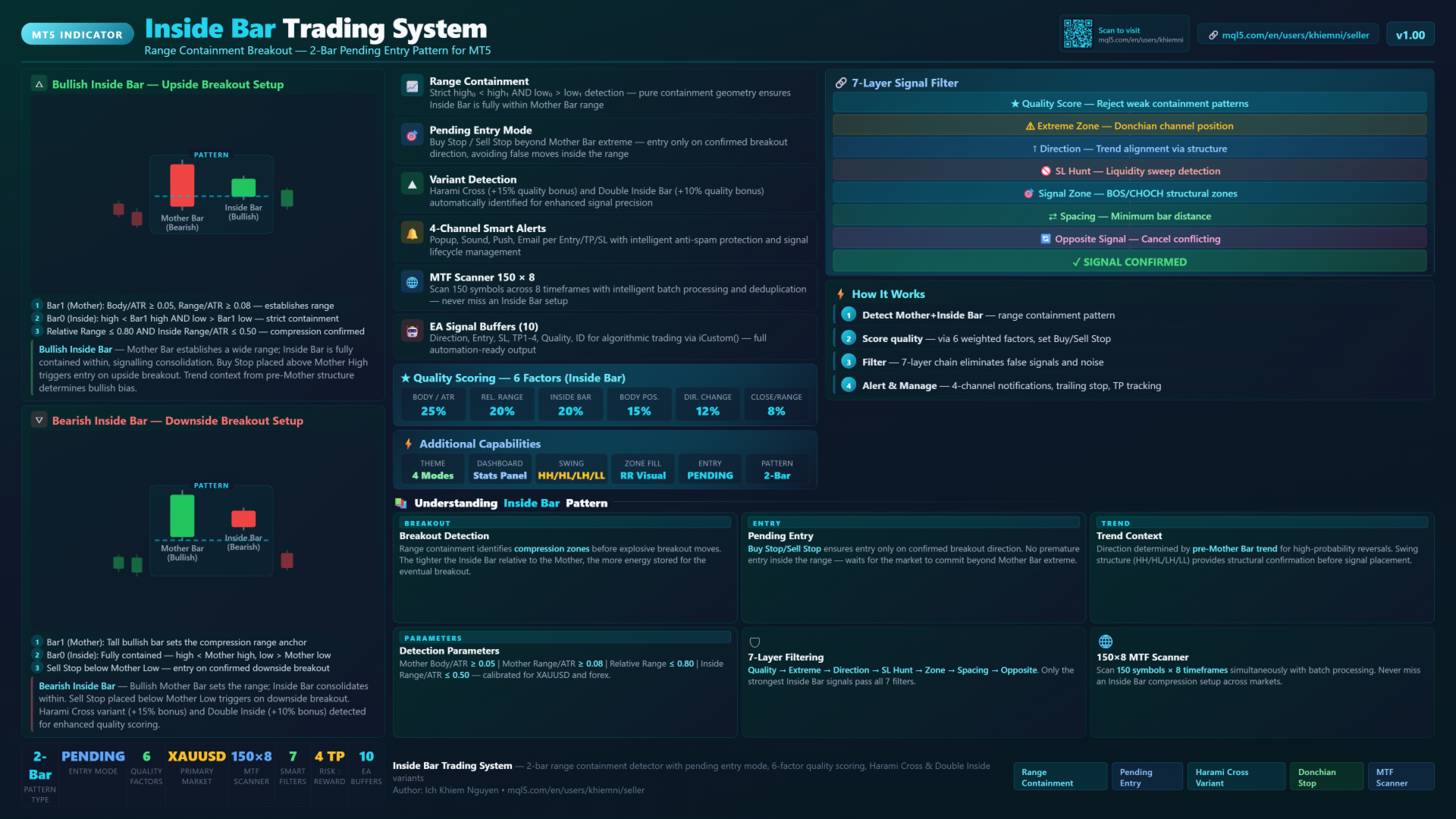
Captures breakout opportunities from Inside Bar compression patterns — a 2-bar structure where one candle is fully contained within the range of the preceding candle. When this compression releases, price tends to move strongly in one direction. The indicator places pending orders (Buy Stop / Sell Stop) at the Mother Bar extremes to catch the breakout automatically.

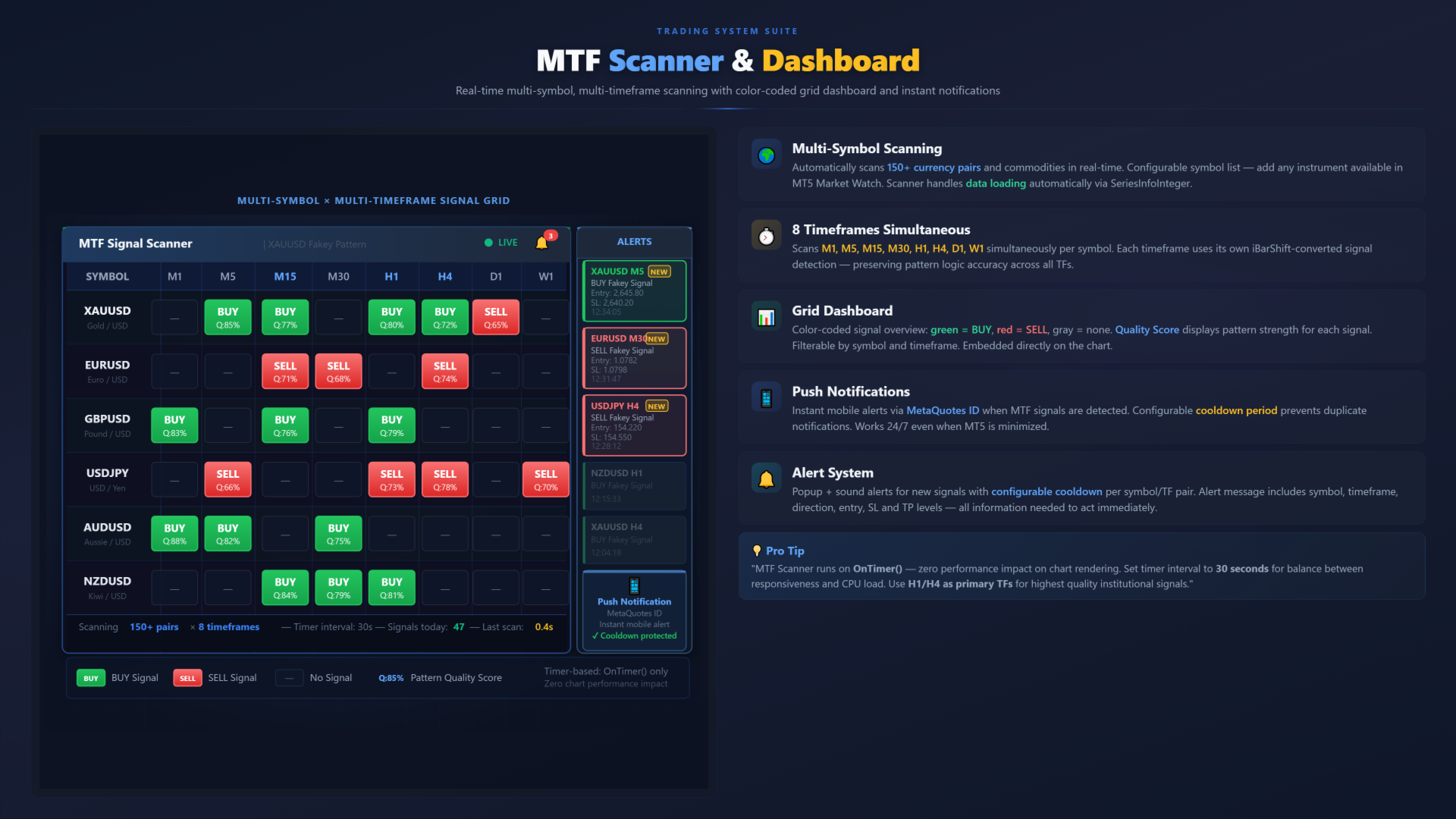
This indicator detects Inside Bar formations on any symbol and timeframe, draws automated Entry/SL/TP trading levels, and tracks signal performance in real-time. Includes a multi-timeframe scanner monitoring up to 150 symbols across 8 timeframes simultaneously.
Included Tools
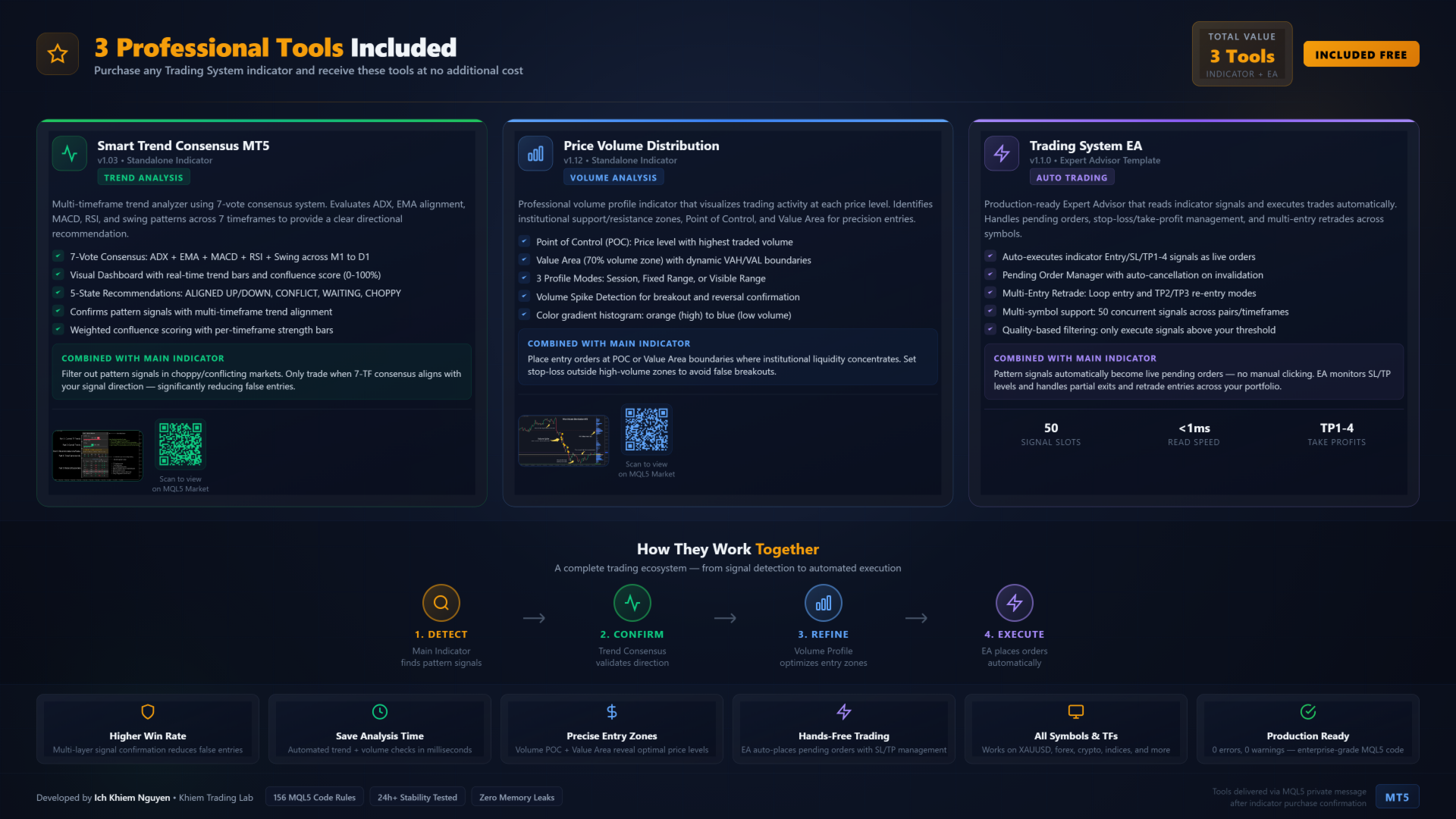
Each Inside Bar Trading System purchase includes access to the following companion tools at no additional cost:
-
Smart Trend Consensus MT5 — Multi-timeframe trend agreement indicator. Displays trend direction across up to 7 timeframes on a single dashboard. Helps filter Inside Bar breakout signals by confirming trend alignment before entry. https://www.mql5.com/en/market/product/160553
-
Price Volume Distribution MT5 — Volume profile and price distribution analysis. Identifies high-volume price zones where institutional orders cluster. Useful for confirming support/resistance confluence with Mother Bar ranges. https://www.mql5.com/en/market/product/160452
-
Inside Bar Trading System EA — Automated signal execution based on indicator output buffers. Reads Entry/SL/TP levels from the indicator and places pending orders automatically. Configurable lot sizing, risk per trade, and session filters. (Delivered via MQL5 private message after purchase confirmation.)
Contact the author through MQL5 messaging after purchase to receive access to the companion tools.
How Inside Bar Detection Works
The indicator scans for a specific 2-bar compression structure:
- Mother Bar — A candle with sufficient body and range relative to ATR that establishes the containment boundary for the setup
- Inside Bar — The next candle must have its high below the Mother Bar high AND its low above the Mother Bar low (complete range containment)
- Containment Ratio — The Inside Bar range divided by the Mother Bar range must be below a configurable threshold (tighter compression stores more energy)
- Trend Context — Multiple bars before the Mother Bar establish directional bias, determining whether the breakout signal is bullish (Buy Stop) or bearish (Sell Stop)
Entry is placed as a pending order beyond the Mother Bar extreme (Buy Stop above Mother High or Sell Stop below Mother Low with ATR buffer). Stop Loss is set at the opposite Mother Bar extreme or via Donchian Channel.
6-Factor Quality Scoring evaluates:
- Mother Bar body/ATR: larger body relative to volatility = stronger containment (weight 25%)
- Relative range: tighter Inside/Mother ratio = more compression energy (weight 20%)
- Containment confirmation: structural validation gate (weight 20%)
- Body position: close location within candle range (weight 15%)
- Direction change: opposite polarity between bars (weight 12%)
- Close vs previous range: close position relative to prior bar (weight 8%)
Variant Detection:
- Harami Cross: When the Inside Bar is a doji (body ratio below 10%), quality score receives a bonus
- Double Inside: When the Mother Bar is itself inside its preceding bar, quality score receives an additional bonus
Pattern-Specific Settings:
- Detection Preset (Standard / Strict / Custom)
- Min Mother Body/ATR and Range/ATR thresholds
- Max Inside/Mother Range Ratio
- Entry and Stop Loss ATR buffer multipliers
- Trend context bar requirement
- Harami Cross and Double Inside variant toggles
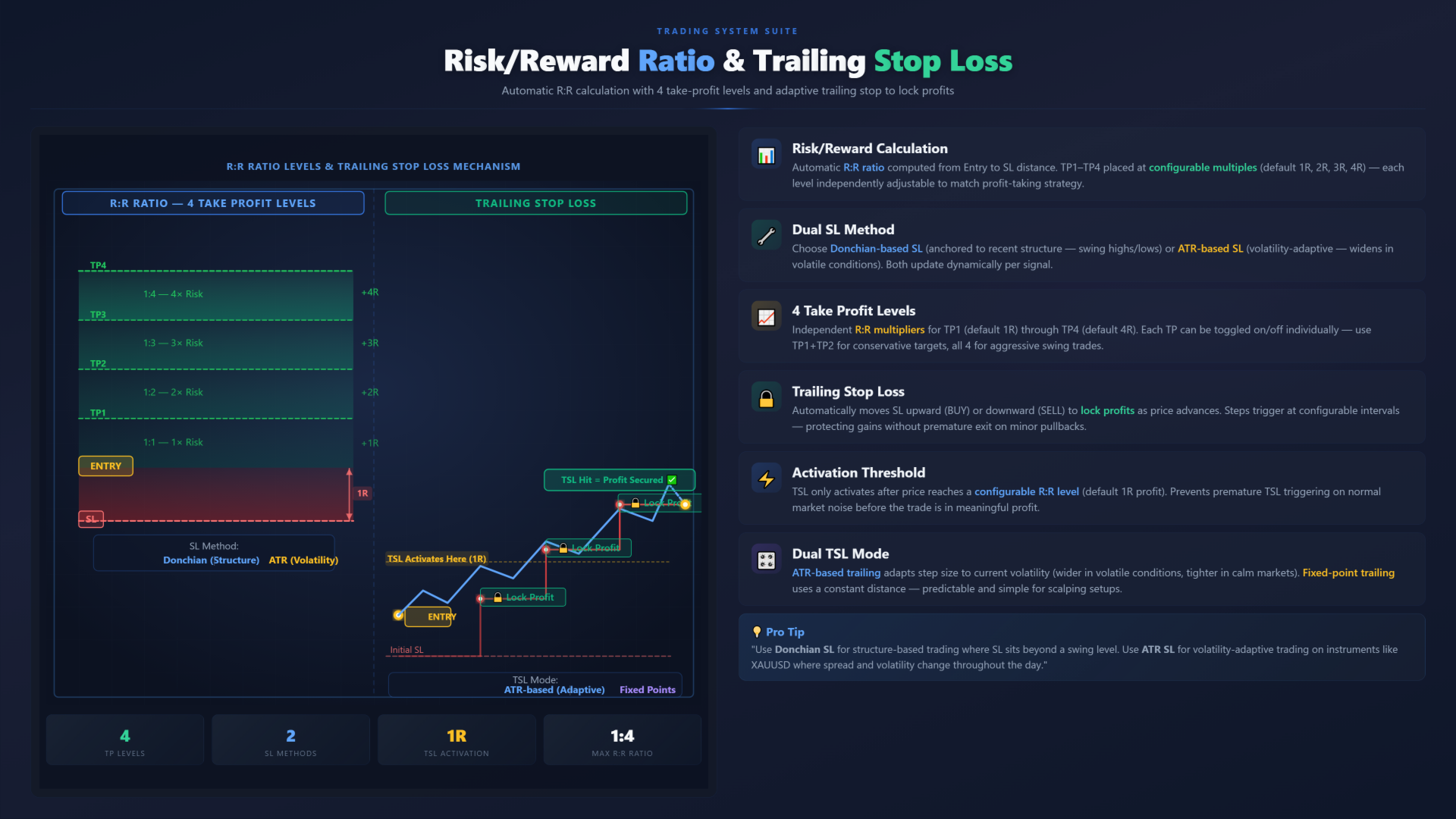
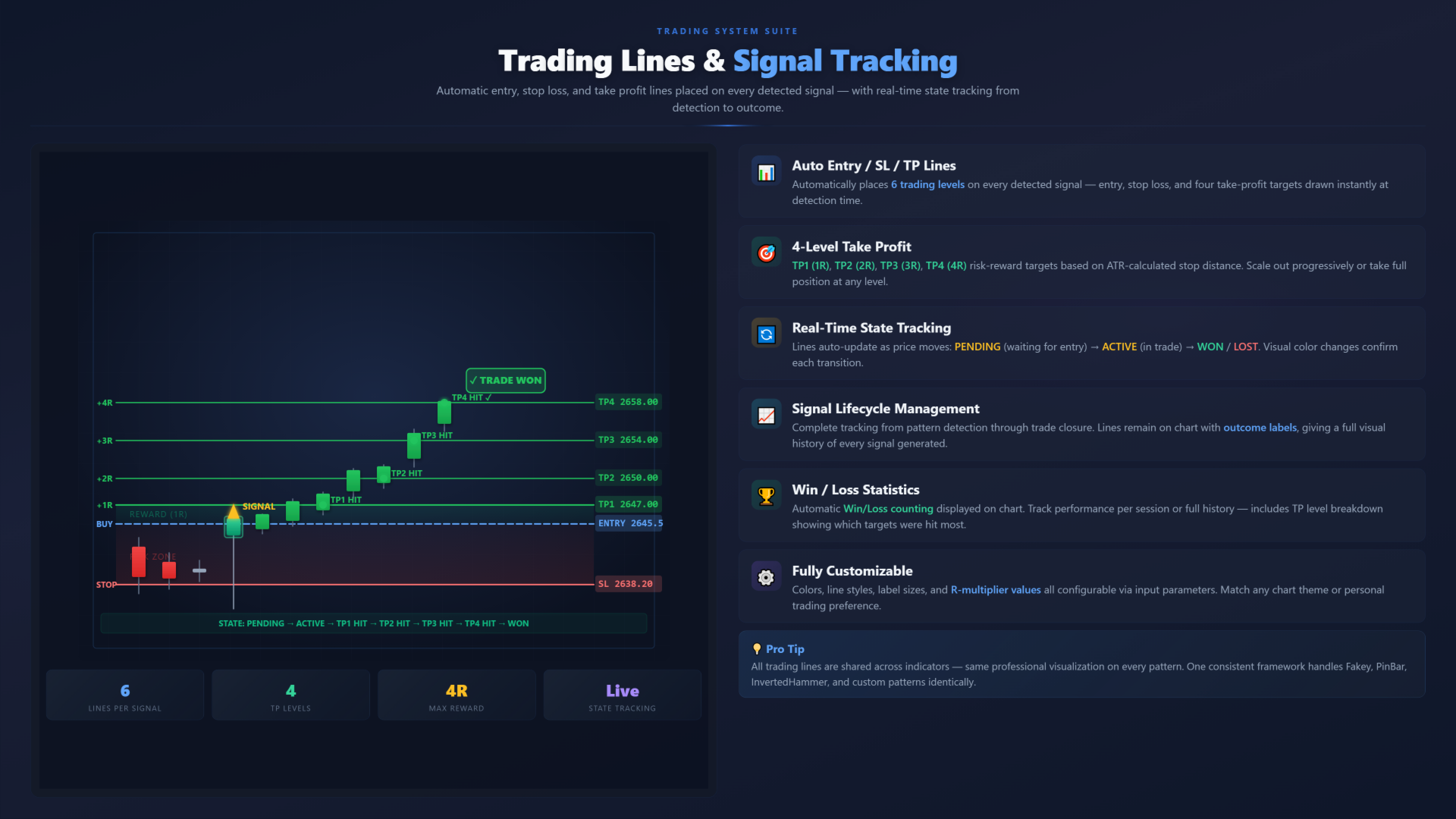
Automated Trading Levels: Every detected pattern automatically draws Entry, Stop Loss, and up to 4 Take Profit levels directly on the chart. Stop Loss can be calculated using Donchian Channel (recent swing extreme), ATR multiplier (fixed distance), or Pattern method (buffer beyond Mother Bar extreme).
Live Signal Tracking: Each signal is tracked from detection through resolution. The indicator monitors whether pending orders are triggered, which TP levels are reached, or whether the signal is cancelled due to timeout or invalidation. Signal state is shown visually on the chart at all times.
Donchian Channel Trailing Stop: Optional trailing stop system uses the Donchian Channel to dynamically adjust stop loss as price moves favorably, preserving open profit without requiring a fixed exit target.
Multi-Timeframe Scanner (150 Symbols × 8 Timeframes): Monitor patterns across the entire market from a single chart. The scanner checks up to 150 symbols across 8 timeframes simultaneously and displays results in a sortable panel with symbol, timeframe, signal direction, quality score, and current signal state.
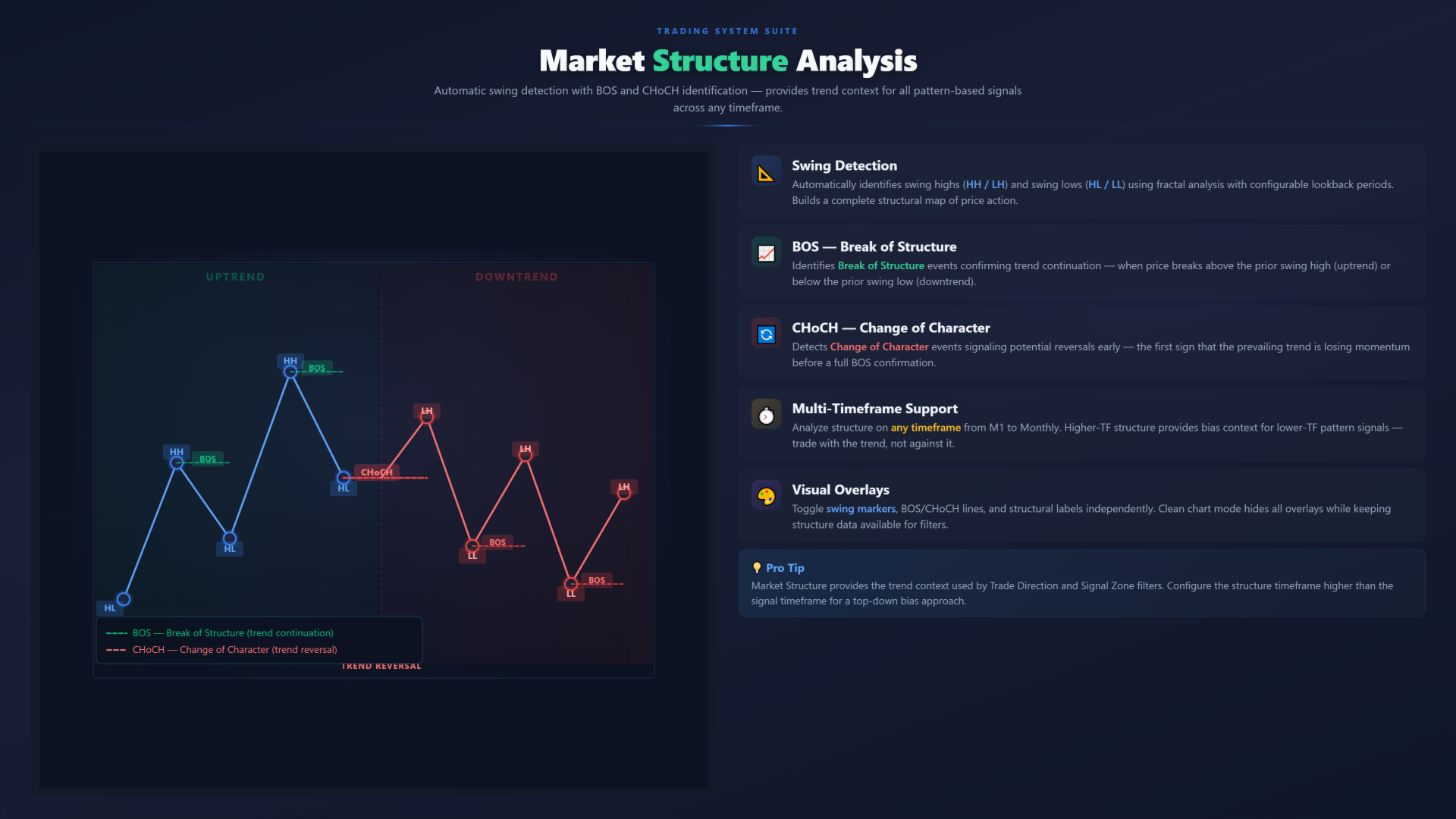
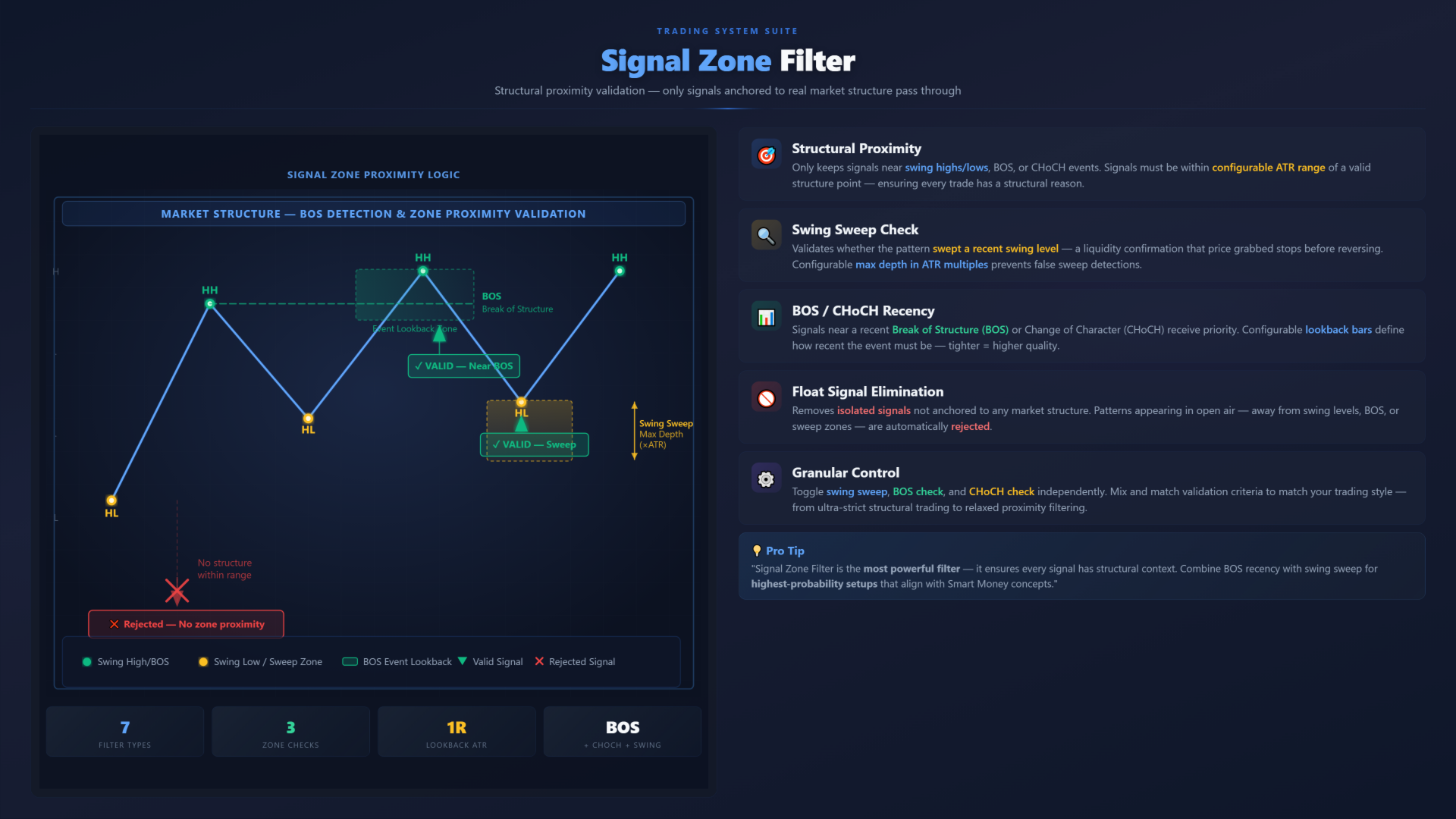
Market Structure Analysis (BOS/CHOCH): Built-in Break of Structure and Change of Character detection identifies key swing points and labels structural shifts on the chart for context evaluation.
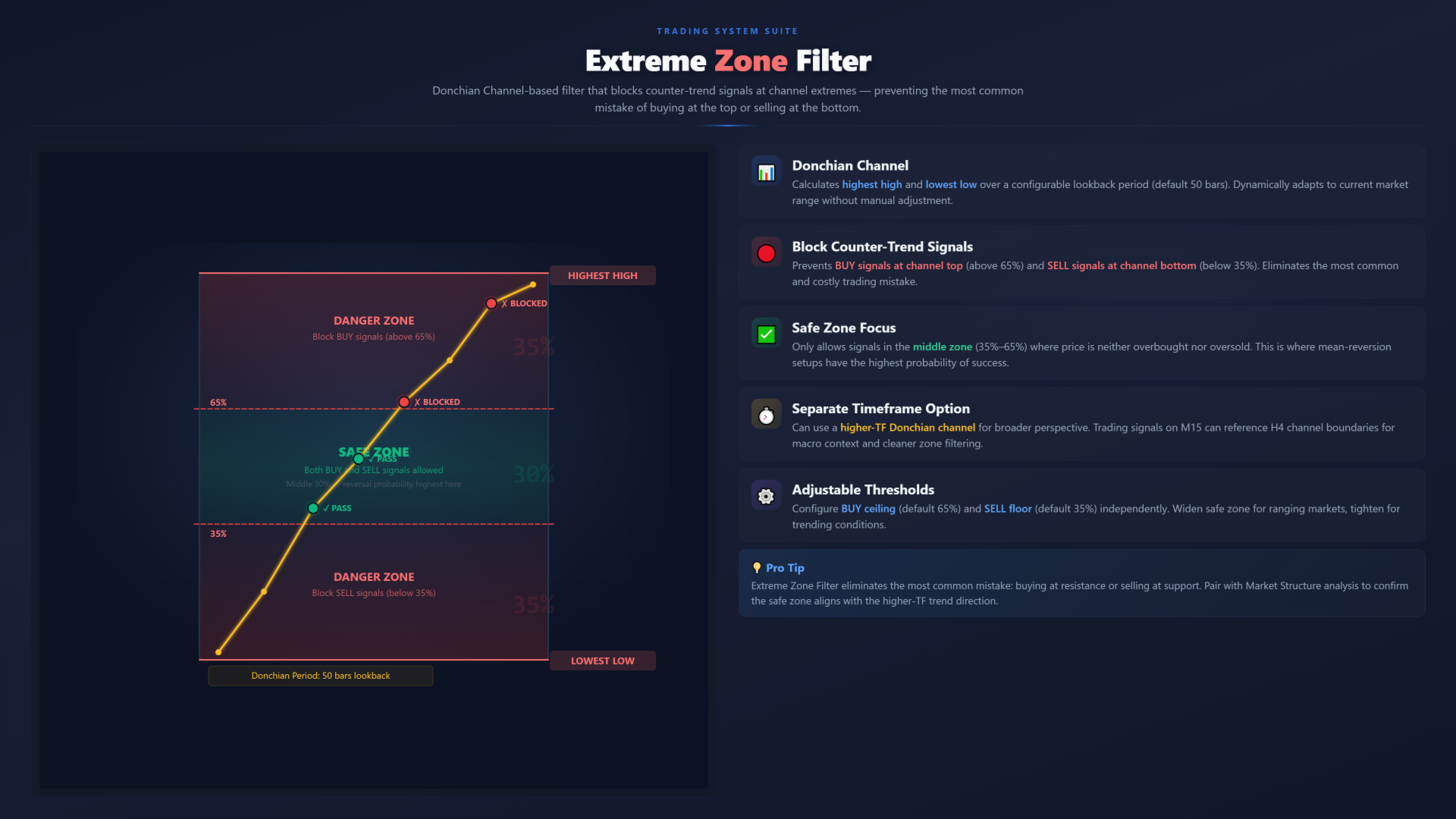
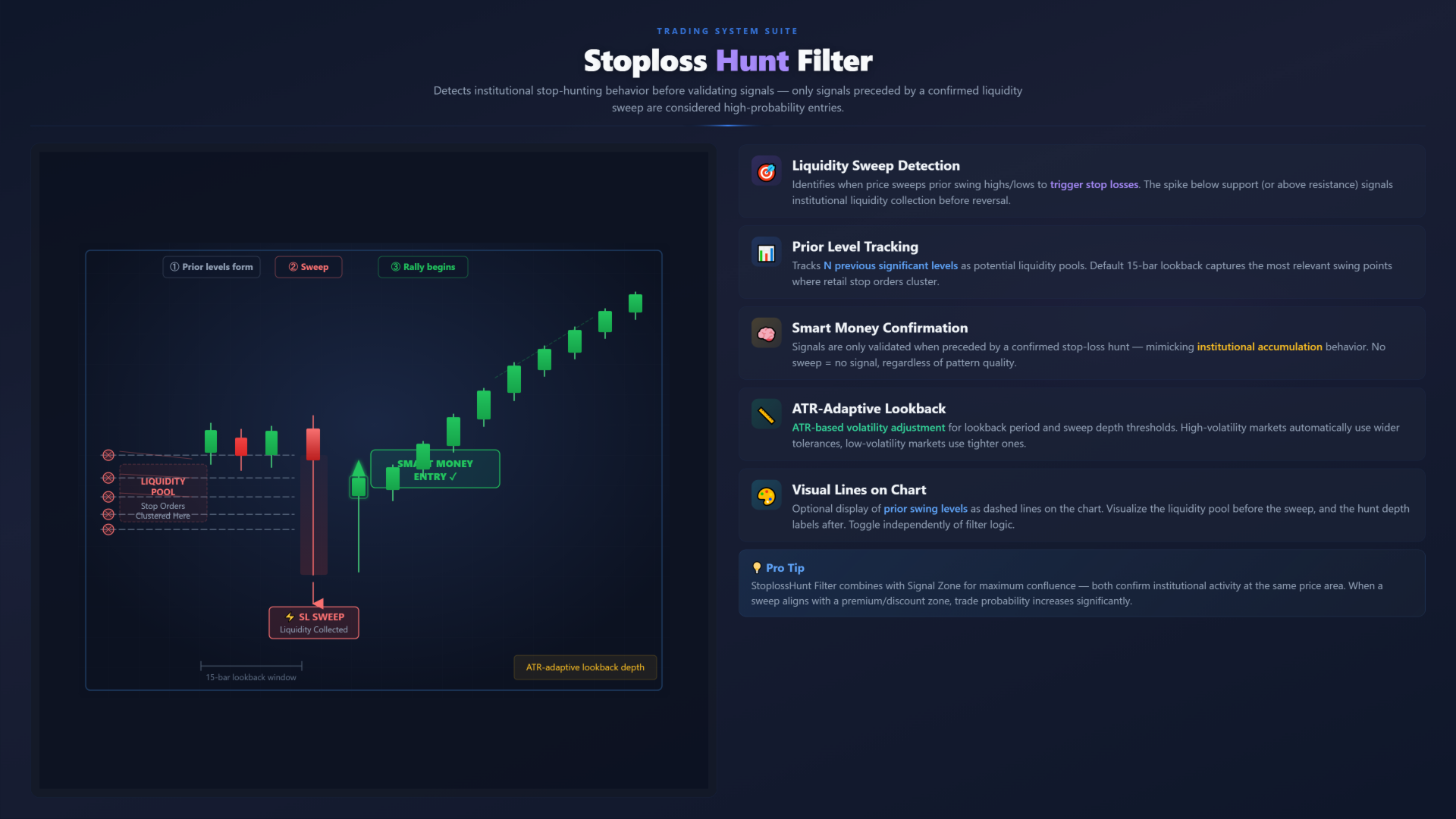
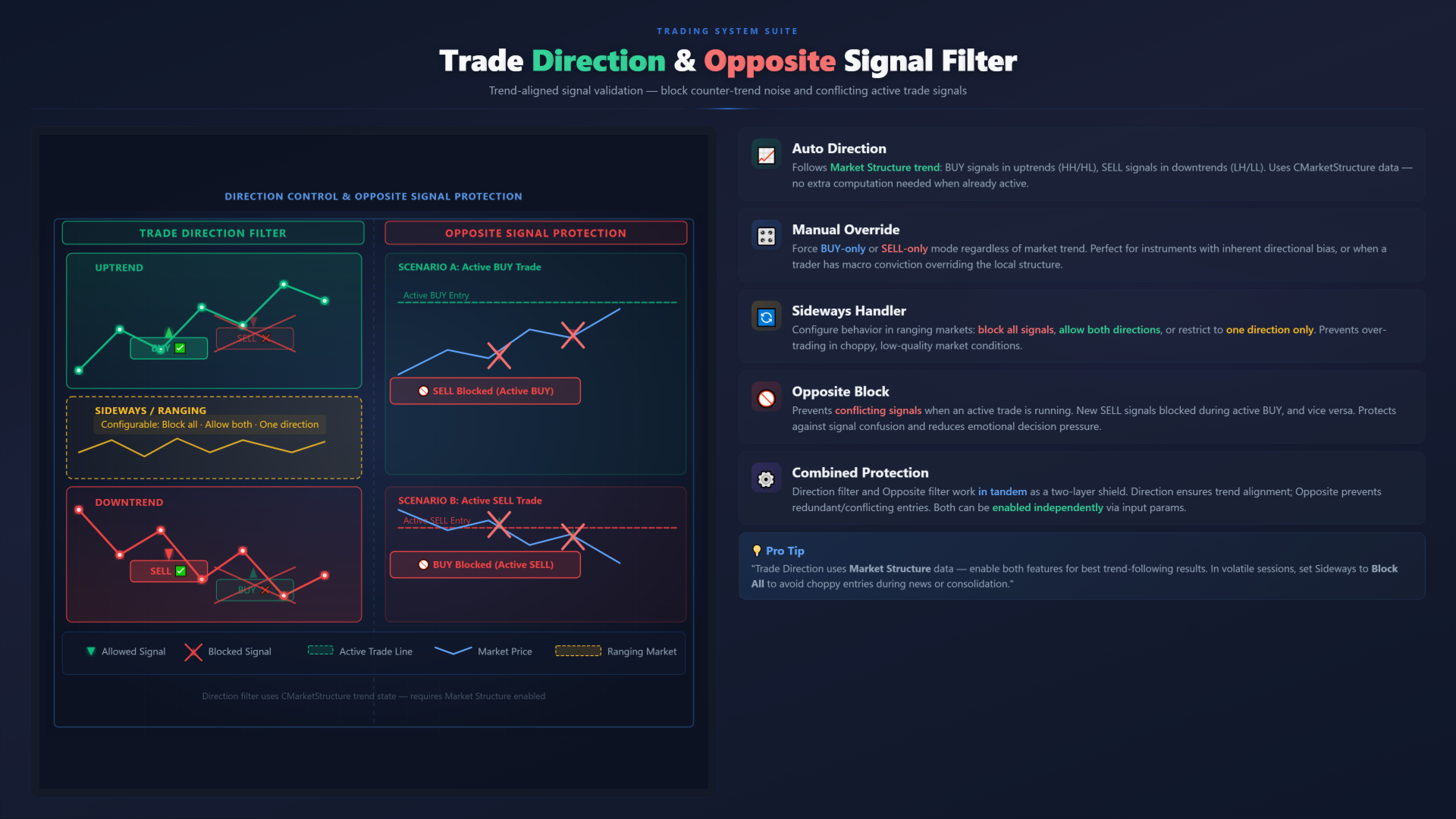
Multi-Layer Signal Filtering: Seven independent filters can be enabled or disabled individually: quality filter, extreme zone filter (overbought/oversold rejection), direction filter (higher-timeframe trend alignment), stoploss hunt filter (sweep validation), signal zone filter (market structure proximity), spacing filter (minimum bar gap), and opposite signal filter (prevent conflicting signals).
4-Channel Alert System: Alerts are delivered through MT5 pop-up notification, MT5 push notification to mobile app, email, and sound alert with selectable audio file. Alerts fire at pattern detection and optionally at TP hits and SL hit.
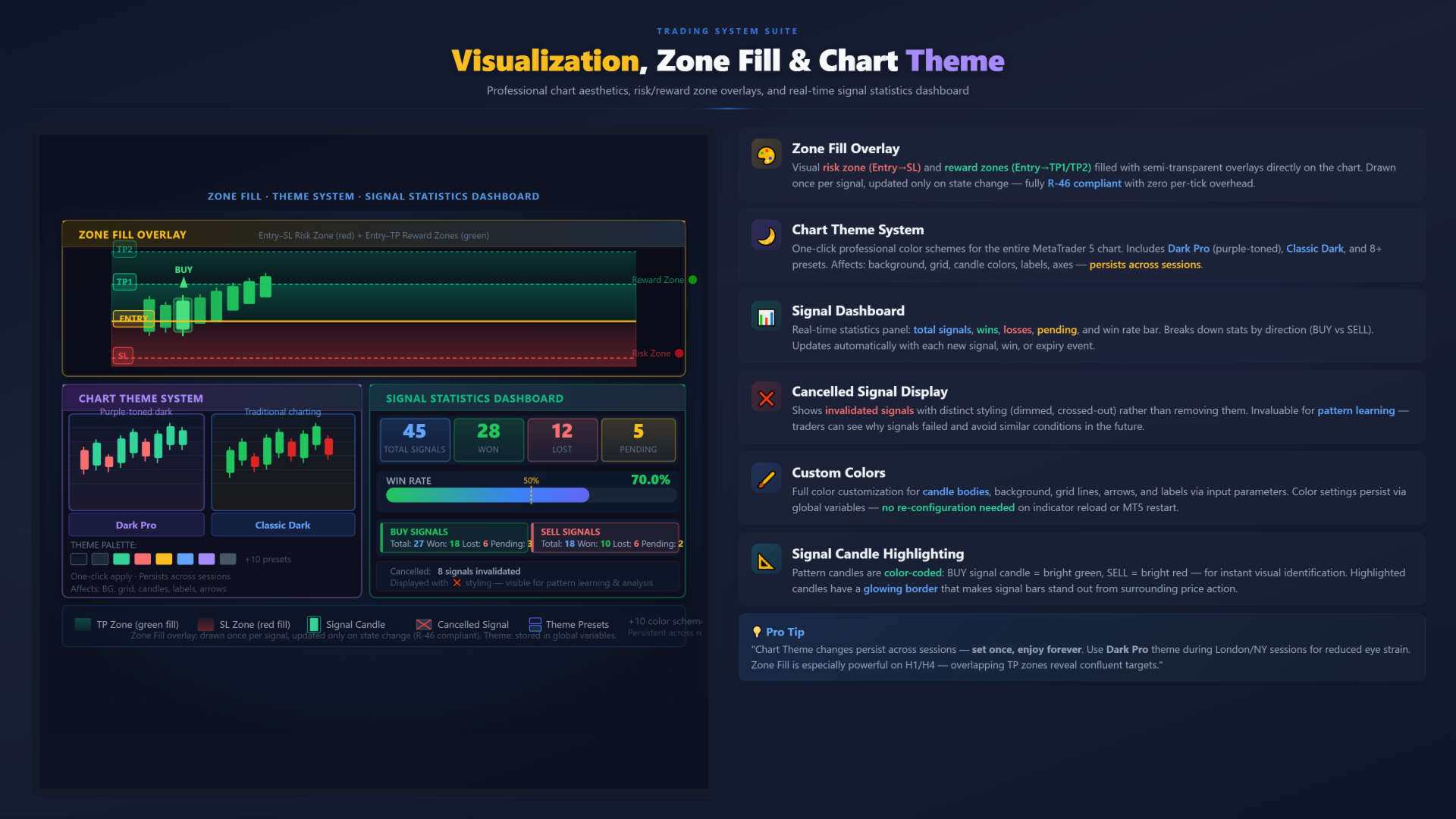
Signal Statistics Dashboard: A draggable panel displaying real-time performance metrics including total signals, entry trigger rate, TP1-TP4 hit rates, SL hit rate, average quality score, and win rate.
Professional Chart Themes: Built-in color schemes (Dark, Light, Custom) allow switching the indicator's visual style to match different chart backgrounds with custom color overrides.
EA Signal Buffers: Indicator outputs are available as data buffers for Expert Advisors via iCustom() for automated signal consumption without modifying indicator source.
Recommended Settings
- Timeframes: M30, H1, H4, D1 (Inside Bar signals gain reliability on higher timeframes where compression patterns are more meaningful)
- Symbols: Works on all Forex pairs, Gold (XAUUSD), Indices, and Crypto pairs
- Account type: Any (demo or live)
- Minimum bars on chart: 500+ for reliable market structure analysis
Installation
- Download and place in your Indicators folder
- Drag onto any chart
- Enable "Allow notifications" in MT5 if using push alerts
- Adjust Quality Score threshold to control signal frequency (lower = more signals, higher = fewer but stronger signals)
Notes
- This indicator does NOT repaint — signals are confirmed on bar close only
- All calculations use completed bars (bar index 1+) for stability
- Pending orders are automatically tracked with 3-bar invalidation timeout
- Scanner operates asynchronously to prevent chart lag
- Memory-optimized for 24/7 continuous operation
Documentation and User Guides
Detailed guides for each feature are available on the MQL5 Blog:
| PART | Section | Description | ||
|---|---|---|---|---|
| 1 | INTRODUCTION | Product introduction, what the product helps you with | ||
| 2 | INSTALLATION & SETUP | System requirements, step-by-step installation guide | ||
| Guide to Installing Free Indicators and EAs Included with the Mirage Trading System Purchase | ||||
| 3 | INTERFACE DISPLAY | Explanation of the components displayed on the chart | ||
| User Guide: Trading Lines & Signal Tracking System | The system automatically draws Entry, Stop Loss, and Take Profit lines (TP 1–4) on the chart, tracks price action for hits, records Win/Loss results, and displays real-time performance statistics. | |||
| User Guide : Visualization, Zone Fill, Signal Dashboard & Cancelled Signals | When you attach an indicator to a chart, the system renders the following visual components for each detected signal | |||
| User Guide: MTF SCAN & Dashboard User Guide | MTF SCAN automatically scans all Market Watch symbols across 8 timeframes (M1 to W1) and displays results on a Dashboard grid directly on your chart. | |||
| User Guide : Chart Theme User Guide | Chart Theme is a feature that changes the entire chart color scheme in MetaTrader 5 — including the background, candles, grid, text, and Bid/Ask lines — with a single click. | |||
| 4 | CORE CONCEPTS | Fundamental concepts that the system is built upon | ||
| User Guide: Market Structure Functionality in the Trading System | Identifies trend direction (Uptrend, Downtrend, Ranging) by analyzing swing highs/lows, and detects key events: BOS (trend continuation) and CHoCH (potential trend reversal). | |||
| User Guide : Signal Types, States, and Lifecycle | A signal is the system's notification when it detects a qualifying candlestick pattern on the chart. Each signal tells you the expected price direction and provides suggested entry, stop loss, and take profit levels. | |||
| 5 | SIGNAL FILTERS | Filters that refine and validate trading signals | ||
| User Guide: Trade Direction (Direction Filter) in the Trading System | Defines the allowed trading direction (Buy only, Sell only, both, or neither) as the first filter before searching for entry signals, based on current market trend. | |||
| User Guide: Signal Zone Filter in the Trading System | Eliminates signals not near important price zones, retaining only those connected to market structures (swing high/low, BOS, CHoCH) to reduce noise. | |||
| User Guide: StoplossHunt Filter User Guide — Filtering "SL Sweep" Signals | Identifies higher-probability signals by checking whether price "swept stoploss" before forming a pattern. | |||
| User Guide : Extreme Zone Filter | Extreme Zone Filter is a signal filtering feature that helps avoid entering trades when price is at the top or bottom of a Donchian price channel. | |||
| User Guide: Opposite Signal Filter | The Opposite Signal Filter is an automatic feature that prevents new signals from appearing when you already have an active trade running in the opposite direction.The principle is very simple: Don't buy when you're selling. Don't sell when you're buying. | |||
| User Guide : Quality Filter User Guide | Quality Filter is a feature that helps you receive only the best signals — price patterns formed clearly, with balanced proportions and high reliability — and reject weak signals, dull patterns, and those below standard. | |||
| 6 | TRADE MANAGEMENT | |||
| User Guide : Risk/Reward & SL Method User Guide | Risk/Reward (R:R) is the ratio between the amount of money you accept losing (Risk) and the amount of money you expect to gain (Reward) in a single trade. | |||
| User Guide: Trailing Stop Loss (TSL) User Guide | Regular Stop Loss (SL) stays fixed in one place. You set SL at 1990.00, and it stays there forever — even if price has risen to 2030.00.Trailing Stop Loss (TSL) is different. It automatically moves in your favor when price advances. As price moves up, TSL moves up with it. When price stalls or reverses, TSL holds the best position it reached. | |||
| 7 | CONFIGURATION PARAMETERS GUIDE | Detailed guide to each configuration parameter | ||
| SIGNAL SCANNING CONFIGURATION GUIDE - MIRAGE TRADING SYSTEM EA | Guide to mastering signal scanning settings within the Inputs tab, optimizing trade discovery on a single chart or across the entire market. | |||
| 8 | ALERTS & NOTIFICATIONS | |||
| User Guide: Alerts & Notifications User Guide | Configure push notifications, and on-screen popups when new signals are detected. | |||
| 9 | SYSTEM RISKS & LIMITATIONS | Notes on system risks and limitations |
All guides include parameter explanations, chart examples, and recommended settings for each feature.
Support
- Product comments section on this page
- Direct message to the author via MQL5
- Response time: within 24 hours