Compiling Without Errors" Is Not Enough: Auditing Alpha Formulas for Look-Ahead Leaks and Repainting

How many "high-accuracy" indicators on a historical chart are actually just leaking tomorrow's data into today's bar or mixing incompatible scales?
A quantitative systems paper accepted for ACM ICAIF 2026 ("QBX: A Compiler for Well-Formed, Auditable Alpha Programs", arXiv: 2610.41689) highlights a critical blind spot in modern quantitative development: just because a script compiles without syntax errors does not mean the math is well-formed or auditable.
🔬 Why Unaudited Indicator Scripts Fail in Live Execution
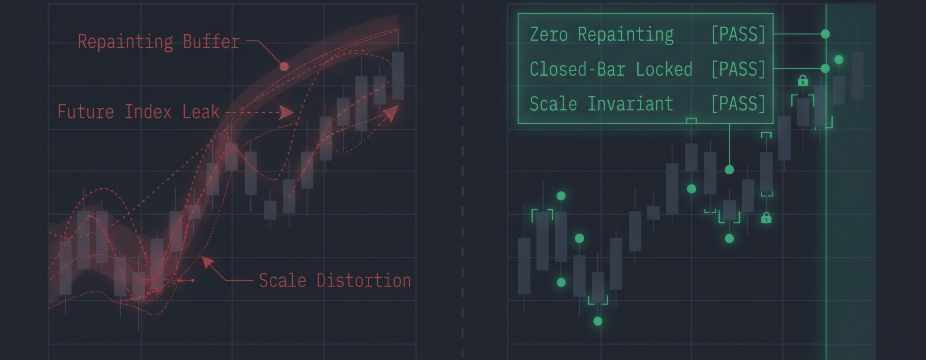
- Silent Temporal Leaks: Standard programming languages allow buffers to reference unclosed bar extremes or future indices during historical recalculation loops—creating pristine historical signals that vanish on a live tick feed.
- Dimensional & Scale Mismatches: Combining raw price differences across pairs with different pip values or volatility regimes produces distorted readings unless strictly normalized.
- Compiler-Level Verification: The QBX architecture enforces strict point-in-time window boundaries and dimensional alignment before an alpha program is ever permitted to touch market data.
Syntax Checks Catch Typos. Falsification Checks Catch Illusions.
With AI coding assistants generating thousands of MQL5 and Python indicator scripts every day, the flood of visually impressive—but mathematically broken—indicators has never been higher. MetaEditor's compiler will verify that your C++/MQL5 syntax is valid, but it will not stop an indicator from repainting three bars back or outputting unscaled noise across symbols.
In a professional quantitative workflow, every indicator must pass an independent black-box audit on closed bars before it is ever wired into an execution engine.
Tools for Auditing Indicator Integrity and Cross-Pair Structure
Every tool I engineer follows a strict falsification-first standard: closed-bar values are permanent, zero repainting is tolerated, and cross-market measurements are mathematically normalized across instruments:
🔬 MEASUREMENT — Point it at any indicator and read what it actually does
- ▸ Indicator Test Report (MT5) · 🆓 · MT4 Version (🆓) — Twelve checks, a plain-language report verifying that closed-bar values are final and nothing leaks from tomorrow
📊 CURRENCY STRENGTH — The eight majors decomposed from all 28 pairs
- ▸ Multi Timeframe Currency Strength Panel (MT5) · 🆓 · MT4 Version (🆓)
- ▸ Currency Strength Oscillator (MT5) · $39 · MT4 Version ($39) — The same decomposition as a history
👉 Explore all 18 non-repainting measurement tools on my MQL5 profile: mql5.com/en/users/naamo (@naamo)
🛠️ That is why I built the Indicator Test Report and Multi-Timeframe Currency Strength suite: instead of trusting an indicator because it looks good on a static chart, audit its closed-bar behavior with 12 objective checks first.
📚 References & Further Reading:
- QBX: A Compiler for Well-Formed, Auditable Alpha Programs (arXiv: 2610.41689, ACM ICAIF 2026): https://arxiv.org/abs/2610.41689