The Hidden Risk of Scaling Into a Trade: Why Three Entries Can Exceed Your Risk Budget

Scaling into a trade can be useful when you want to build a position gradually rather than enter at one price.
But there is a common mistake: calculating the risk of each new entry without checking the combined risk of all open positions.
A trader may believe that every entry is small and controlled, while the total potential loss is much larger than originally planned.
1. The Difference Between Risk Per Entry and Total Risk
Imagine a trader with a $10,000 account who wants to risk no more than $100 on a trading idea.
The trader plans to enter in three parts.
There are two very different ways to interpret that $100 limit.
Method A: $100 risk per entry
Entry 1: $100 risk
Entry 2: $100 risk
Entry 3: $100 risk
Combined risk: $300
The trader has now committed approximately 3% of the account to one idea, assuming all three stop losses are triggered at their planned prices.
Method B: $100 total risk
Entry 1: approximately $33.33
Entry 2: approximately $33.33
Entry 3: approximately $33.34
Combined risk: $100
In the second method, the entire position group shares one risk budget.
Neither method guarantees a particular outcome. The important point is to understand which method you are using before placing additional orders.
2. Why Equal Lot Sizes Do Not Mean Equal Risk
Suppose you enter the same symbol three times with identical lot sizes.
The first entry has a stop-loss distance of 10 pips.
The second has a stop-loss distance of 20 pips.
The third has a stop-loss distance of 30 pips.
Even though the lot sizes are identical, the risk amounts are different.
For a given instrument and lot size, a larger stop-loss distance generally means a larger potential loss.
This is why risk-based position sizing should consider the distance between the entry price and the stop loss, as well as the instrument's tick value and trading costs.
3. Existing Positions Must Be Included
Before adding a new position, ask three questions:
- How much risk is already committed to this trading idea?
- How much of the original risk budget remains?
- How much risk would the next entry add?
For example:
Total risk budget: $100
Existing position risk: $68
Remaining risk budget: $32
If the next entry requires $40 of risk at the broker's minimum lot size, it does not fit within the remaining budget.
The correct response, if the $100 cap is strict, is to skip that entry or reconsider the trade setup rather than exceed the limit.
4. What Happens When a Position Moves to Break-Even?
Moving a stop loss to the entry price can reduce the remaining price risk of an open position.
However, break-even at the entry price does not necessarily mean zero net financial loss.
Spreads, commissions, swaps and execution differences can affect the final result.
A risk calculation should distinguish between the remaining price-based stop-loss exposure and the expected net result after trading costs.
5. A Practical Three-Entry Example
Consider a trading panel configured with:
Risk budget: $100
Risk mode: Total
Planned entries: 3
After three entries, the combined position size is 0.47 lots.
The panel displays an estimated combined stop-loss loss of $96.59.
This is within the configured $100 risk budget under the displayed calculation conditions.
The panel also shows the combined break-even level and individual position controls.
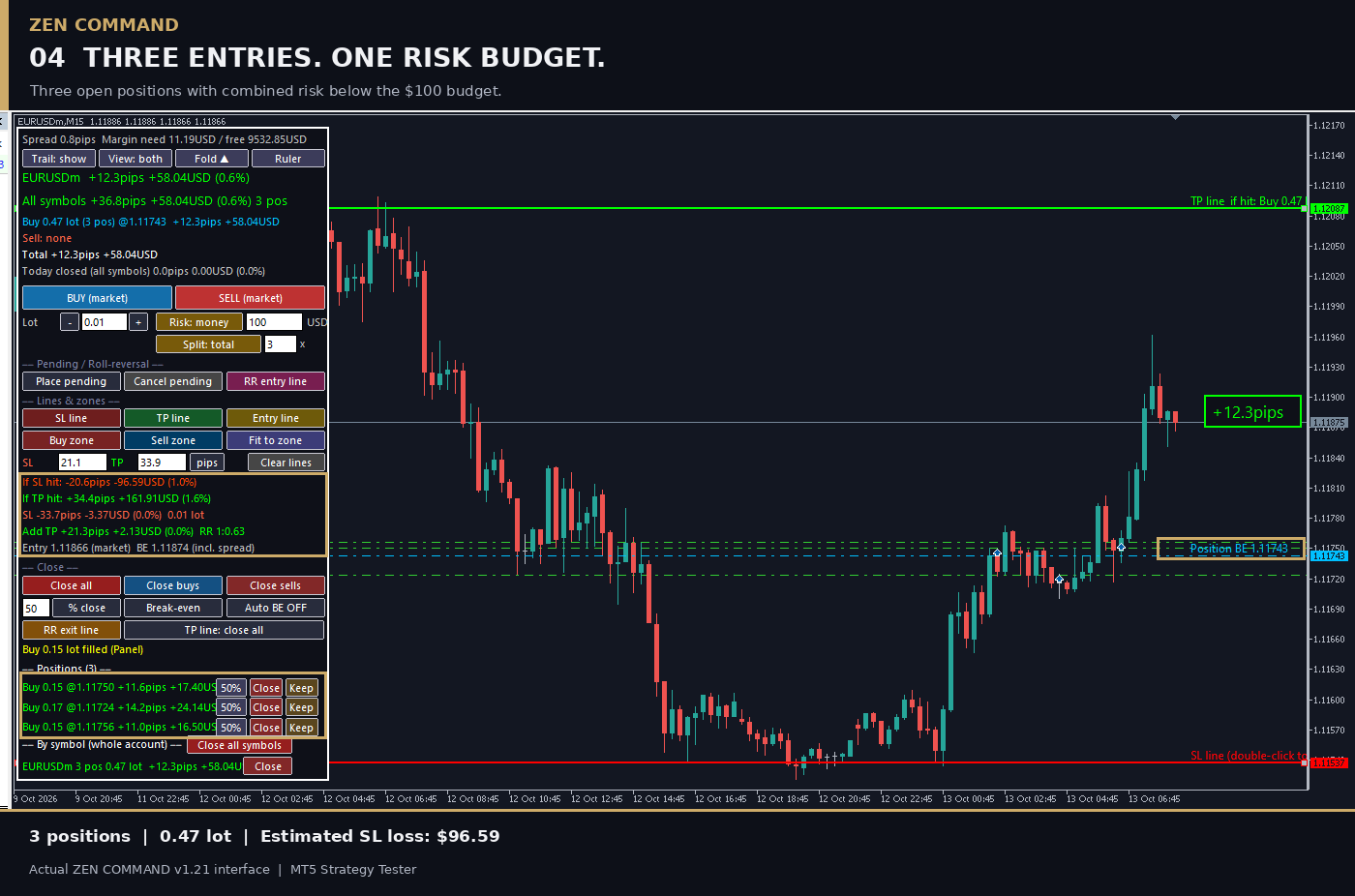
The example illustrates the importance of calculating the risk of the position group rather than considering each entry independently.
It is a demonstration of trade management, not evidence of a profitable trading strategy.
6. A Simple Checklist Before Scaling In
Before every additional entry, verify:
- The total risk budget for the trading idea
- The estimated loss of existing positions
- The stop-loss distance of the new entry
- The minimum lot size and lot step
- Spread and commission assumptions
- The remaining risk allowance
Also remember that stop-loss orders do not guarantee an exact exit price. Gaps, slippage and changing execution conditions may cause actual losses to exceed estimates.
Final Thoughts
Scaling into a trade is not automatically safer than entering all at once.
The result depends on how position sizes, stop losses and the combined risk budget are managed.
A useful principle is simple:
Decide the total amount you are prepared to risk before deciding how many entries to make.
Whether you calculate everything manually or use a trade management panel, the total exposure should remain visible throughout the trade.