
When the euro leads your currency-strength screen, should you buy EUR/USD, buy EUR/JPY, or leave both alone? A ranking narrows the search, but the pair you trade still determines your entry, your exposure and what has to happen for the idea to work. Here is a way to turn one scan into a short watchlist and take a second look at the trades that share the same currency.
Give the ranking a specific job
Currency strength compares how currencies have behaved against a basket of other currencies over a chosen period. A currency can lead on a short timeframe while lagging on a longer one. That difference can be useful. It tells you to investigate whether you are looking at a brief impulse inside a broader move or a change that has started to show up on more than one horizon.
The Forex Top Team CurrencyPower Meter ranks eight major currencies across 28 pairs on three timeframes. Use the timeframe closest to your intended holding period to produce one or two candidates. Check the other displayed timeframes for context. An intraday trader might find a short-term move useful even when the longer-term picture is mixed, provided the trade plan gives that move room and specifies when to exit.
Write down your comparison before opening the individual charts. “Broad euro strength” is a different idea from “dollar weakness.” The first should prompt you to check the euro against more than one counterpart. For the second, compare how several currencies are behaving against USD. A basket can suggest a direction for that investigation. The charts can show where the move is concentrated.
Read both legs before reading the pattern
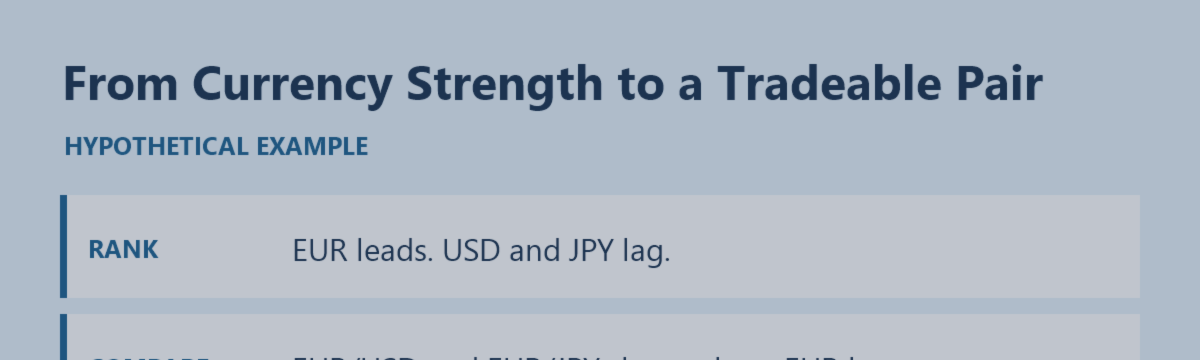
In a hypothetical scan, EUR leads, while USD and JPY both lag. Buying EUR/USD means buying euros and selling dollars. Buying EUR/JPY means buying euros and selling yen. A rise in either quote means the euro is worth more units of that pair’s quote currency. Buying both pairs adds exposure to the same euro leg, even though the other legs differ.
Now suppose that EUR/USD has already extended well above its last consolidation, while EUR/JPY is still testing a defined boundary. The clearer structure may be on EUR/JPY, but check how far the next opposing level is from your executable entry and how much room you would need for the trade to fail on its own terms. If EUR/JPY has an awkward spread or its stop would sit too far away, passing on both is a reasonable outcome of the scan.
View the hypothetical currency-strength diagram.
To see how duplicate exposure builds, suppose each candidate is sized for an estimated USD 100 loss at its planned stop, after converting the EUR/JPY estimate into account currency. If both stops execute at those planned prices, the combined loss is USD 200 before additional charges or slippage. The figures are hypothetical. A broad reversal in EUR could affect both trades, and actual losses can differ from the estimate. Write the combined scenario alongside the two individual trades.
Separate broad movement from a single event
A headline can make several charts appear to confirm one another even when they are reacting to a common driver. For instance, a move on multiple USD pairs around a US release may tell you more about USD than about each counterpart. Check the release time and compare at least one cross without USD if you are trying to make a case for persistent euro strength. Use a consistent observation time on both charts.
FX trading is spread across venues and liquidity providers. A reading tied to your platform feed describes the inputs you can see, and a quote elsewhere can differ. Before choosing between candidates, look at the bid and ask for the actual symbol and note whether the move is still giving you the entry you planned. A strong ranking can coexist with an unattractive entry. BIS research on FX trade execution.
What to record after the scan
- Save the time and timezone, the displayed horizons and your strongest and weakest candidates.
- Record the independent chart reason for selecting each pair, including the level that would invalidate the idea.
- Mark shared currency legs and estimate combined loss in your account currency under a common adverse move.
- Save the pairs you passed on and why. Review those decisions with the trades you took.
A common mistake is to label the highest-ranked currency a buy and expect the ranking to stay put. The order can change, an extended move can reverse, and several pairs can echo the same underlying move. In a journal, check whether the scanner helped you find clearer structures or simply sent you to charts that had already moved. The second outcome points to a timing question you can investigate separately.
For the scanner and its access conditions, see the Forex Top Team Trading Toolkit. The provider describes account-linked access through qualifying partners and discloses that it may receive compensation based on referred clients’ trading activity.
For a separate chart-analysis workflow after shortlisting pairs, see the site’s guide to Forex Top Team’s MT5 indicator collection.