
Even the All Country Index Can Lose to Inflation: The Blind Spot of “Real Returns”


“Just buy the All Country Index and keep investing for the long term. You’ll be fine.”
With the growing popularity of NISA in Japan, statements like this have become increasingly common. It is true that an all-country stock index provides broad diversification across global equities, making it easier to reduce the risk of concentrating on individual stocks.
But let’s stop and think for a moment.
If stock prices are rising, are your assets really increasing in value?
In fact, simply looking at how many percent an investment has gained does not tell you its true investment performance.

AI-powered practice scoring and trade analysis with MT5 AI Assistant.
English | Русский | 中文 | Espanol | Portugues | 日本語 | Deutsch | 한국어 | Francais | Italiano | Turkce🤔 What If Stocks Rise 5% While Prices Also Rise 5%?
Suppose you are investing in a country where inflation is running at 5%, and stock prices also rise by 5%.
Your ¥1 million becomes ¥1.05 million.
You might think, “I made ¥50,000!”
However, if consumer prices have also risen by 5% during the same period, what you can buy with ¥1.05 million is roughly the same as what ¥1 million could buy before.
In other words, your assets have increased by 5% in nominal terms, but there has been almost no increase in real purchasing power.
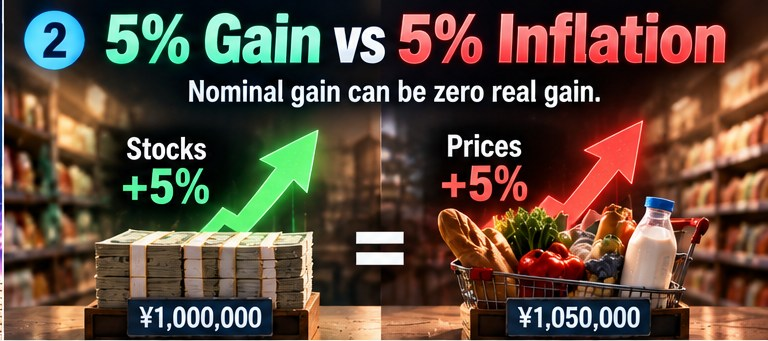
Conversely, if stocks rise by only 3%, they have fallen behind inflation. The number on your investment statement is still positive, but your purchasing power has actually declined.
The All Country Index cannot escape this problem simply because it invests globally.
Global diversification can reduce the risk of choosing the wrong company or country. However, it cannot eliminate the effects of inflation or high stock valuations across global equity markets as a whole.

😵 The Other Side of “You Would Have Made a Fortune by Holding the S&P 500 Since 1980”
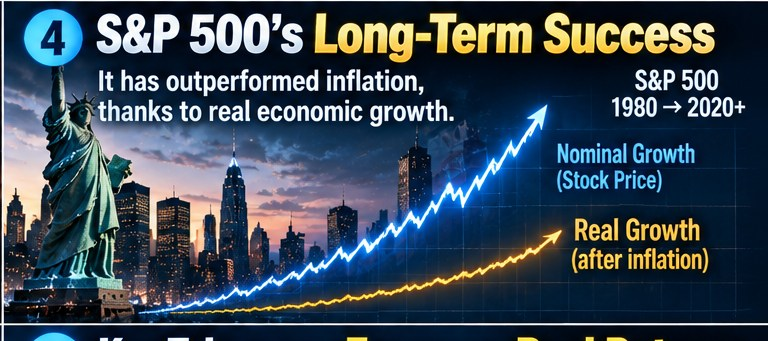
You often hear that “if you had held the S&P 500 since 1980, your investment would have grown enormously.”
That is true.
However, prices in the United States have also risen substantially since 1980.
This is why it is important to separate stock-price gains from inflation.
The S&P 500 has significantly outpaced inflation over the long term. In other words, its rise cannot simply be explained by the declining value of money.
Corporate earnings growth, dividends, productivity improvements, and other factors have contributed to an increase in real economic value.
That is precisely why long-term investment in the S&P 500 and global equities can make sense.
However, this is where things become different if we simply carry past success into the future.
The fact that an asset has risen substantially in the past does not mean it will rise in the same way in the future.
When stock prices rise to high valuation levels, future returns can become lower.
So while saying “the All Country Index is diversified globally, so it is relatively reassuring” is not necessarily wrong, global diversification does not mean guaranteed profits.

🤔 Summary: Don’t Rely Too Heavily on “The All Country Index Is Safe”
The All Country Index is a useful investment product because it provides diversification across stocks around the world. However, assuming that your assets will steadily increase simply because you own it is a different matter.
Since the problems in the Middle East emerged, the All Country Index has also experienced repeated ups and downs and has remained relatively flat for an extended period.
If this situation continues, there is a possibility that inflation could outpace investment returns, reducing the real value of your assets.

What matters is not just nominal profit, but the real return after accounting for inflation.
As an investor, the important question is not simply “How many percent has my investment increased?” but also “Has it increased more than prices have?”
It would certainly be reassuring if the success of stock markets in the past could simply continue into the future. But the fact that this is not necessarily easy is something many traders have experienced firsthand.