Why a Martingale Equity Curve Looks Perfect Until the Day It Doesn't
12 September 2026, 02:00

0
46
Martingale systems produce the most attractive equity curves in this industry: a near-straight line, a win rate above 90%, and a shallow drawdown — right up to the trade that ends the account.
What the curve is actually showing
A martingale does not close losses; it postpones them by adding larger positions until price returns. Each recovery is booked as a win. So the curve records hundreds of small wins and hides one open, growing exposure. The smoothness is not evidence of an edge — it is the accounting of deferred losses.
Why the backtest usually survives
In a historical window, price eventually came back — almost every time. The strategy only needs the one sequence where it did not, and most test windows are short enough that this sequence is absent. That absence is what you are buying when you buy the curve.
Read maximum lot, not maximum drawdown
For these systems the useful numbers are the deepest recovery sequence (how many additions in a row), the largest position size reached, and the lowest margin level touched. A 5% reported drawdown next to a 20-step recovery ladder describes a system that has not yet met its bad week.
Grid recovery is the same shape
Averaging into a losing position on a fixed grid has the same structure with slower arithmetic: no realised loss, growing exposure, a smooth curve. If a description says "no stop-loss needed" or "recovers every trade", it is describing where the risk went, not whether it exists.
Where we do use a grid, and what caps it
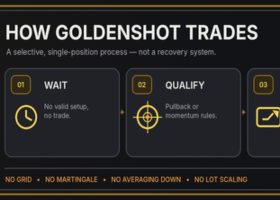
None of our EAs escalate lot size after a loss — that is the line we do not cross. Aureus Gold does use a recovery grid, and we describe it exactly: adverse moves may add at most 3 same-size entries, and a hard ATR group stop-loss always caps the whole basket. We also publish what that costs: at the Aggressive and Ultra tiers its relative equity drawdown reaches about 89%. Bitcoin Glacier sits at the other end — one position at a time, a hard stop on every trade, and a maximum equity drawdown of about 47% at the Ultra default. Both numbers are uglier than the 5% a martingale curve shows, and both are real.
Our three best-selling EAs: GOLD NEURON (AI) https://www.mql5.com/en/market/product/187329 · ATLAS PORTFOLIO https://www.mql5.com/en/market/product/182751
None of our EAs escalate lot size after a loss. Where we use a recovery grid, every added order is the same size, additions are capped, and a hard group stop-loss caps the whole basket. The full list: fxea365.com/ea/ranking