From XAUUSD to BTCUSD: A Complete Migration Guide for TrendCandleEA

How to transform the XAU configuration of TrendCandleEA into the BTC configuration — parameter by parameter, with the reasoning behind every change.
1. Introduction
TrendCandleEA ships with several ready-to-use configurations, one per market. The XAU configuration is calibrated for gold (XAUUSD) on the M30 timeframe. The BTC configuration is calibrated for Bitcoin (BTCUSD) on the same M30 timeframe.
Both share the exact same engine — the same signal logic, the same filter framework, the same position management. Only the input values differ.
This article is a step-by-step migration guide. It explains:
- Why the XAU configuration, applied to Bitcoin without modification, produces poor or erratic results.
- Which inputs must change, and by how much.
- Which inputs must be left untouched, and why.
- How to verify your setup before running it live.
By the end of this guide, you will be able to take the XAU configuration, apply every documented change, and end up with a fully working BTC configuration — with no guesswork.
2. Why the XAU Configuration Cannot Be Used As-Is on Bitcoin
At first glance, XAUUSD and BTCUSD look similar on a chart: both are quoted in US dollars, both trend strongly for weeks, and both respond to macro news. But under the hood, they are fundamentally different instruments. A configuration tuned for one will behave very differently on the other.
Concretely, if you take the XAU configuration and run it on BTCUSD without any change, three problems appear immediately:
- The spread and slippage filters block almost every trade. The XAU configuration caps the spread at 60 points. On BTCUSD, normal spread is 10 to 30 times higher — so the EA simply never trades.
- The Stop Loss is too tight. The XAU configuration adds a 1 000-point buffer to the SL. On Bitcoin, that buffer is roughly 10 USD — a meaningless distance given BTC's typical M30 range. Trades get stopped out by pure noise.
- The signal filters were tuned for gold's rhythm. Gold trends smoothly with few pullbacks. Bitcoin trends violently, with frequent liquidation cascades and fakeouts. Filters that work on gold leave Bitcoin either over-exposed or fully blocked.
The BTC configuration solves all three problems by rebuilding the filter stack from scratch for Bitcoin's specific behaviour.
3. The Three Fundamental Differences Between XAUUSD and BTCUSD
3.1 Price Level
At the time of the backtest, XAUUSD traded around 4 500–5 500 USD per ounce. BTCUSD traded between 62 000 and 93 000 USD per coin. The absolute price level is roughly 15× higher on Bitcoin.
3.2 Volatility
A typical daily range on XAUUSD is about 1 % of price. A typical daily range on BTCUSD is 3 to 5 %. In absolute terms, Bitcoin moves 30 to 60 times more than gold on a normal day. This is why every point-based parameter must be scaled accordingly.
3.3 Market Structure
Gold trades 23 hours a day, 5 days a week, with a well-defined session pattern (Asian range, London breakout, New York continuation). Bitcoin trades 24/7, with no session boundaries, and is subject to exchange-specific events (weekend liquidation cascades, funding rate flips, whale movements). The result: gold trends are smooth; Bitcoin trends are punctuated by violent reversals.
4. The Point Paradox — The Single Most Important Concept
Before changing any parameter, you must understand one thing: on BTCUSD, one point is not worth the same as one point on XAUUSD.
Both symbols typically use 2 decimal places, so _Point = 0,01 in both cases. But the value of one point in USD depends on the contract size, which is defined by the broker, not by the price.
For a common broker setup:
- XAUUSD: 1 lot = 100 ounces → 0,01 lot = 1 ounce → 1 point (0,01 USD) = 0,01 USD of P&L per 0,01 lot.
- BTCUSD: 1 lot = 1 BTC → 0,01 lot = 0,01 BTC → 1 point (0,01 USD) = 0,0001 USD of P&L per 0,01 lot.
In other words, one point on BTC is worth 100 times less than one point on gold, at equal volume. So to risk the same dollar amount, the Stop Loss on BTC must be 100 times wider in points than the equivalent SL on gold.
5. Migration, Group by Group
The following sections walk through every group of inputs in the same order they appear in the EA's input window. For each parameter, the change is given alongside its justification.
5.1 General Group
| Input | XAU value | BTC value | Reason |
|---|---|---|---|
| InpMagic | 1003 | 1004 | Unique identifier per configuration. Prevents interference if both instances run on the same account. |
| InpTradeComment | XauTrendCandle | BtcTrendCandle | Instant visual identification from the MT5 mobile app. |
| InpSlippagePoints | 30 | 3 000 | BTC spreads are ~15× wider than gold. 30 points = 0,30 USD is instantly slipped on BTC. |
| InpMaxSpreadPoints | 60 | 6 000 | BTC normal spread ranges from 10 to 30 USD (1 000–3 000 points). 60 points would block every trade. |
| InpTimeframe | PERIOD_CURRENT | PERIOD_CURRENT | Unchanged. Both configurations are calibrated for M30. |
| InpMaxPositions | 0 | 0 | Unchanged (unlimited). |
| InpAllowHedge | true | true | Unchanged. |
| InpCloseOppositeFirst | false | false | Unchanged. |
5.2 Matrend Group
| Input | XAU value | BTC value | Reason |
|---|---|---|---|
| InpUseMaTrend | false | true | Bitcoin's trend is more directional and benefits from a local trend filter. |
| InpMaTimeframe | PERIOD_CURRENT | PERIOD_CURRENT | Unchanged (M30). |
| InpMaPeriod | 50 | 50 | Unchanged. EMA 50 on M30 is the local trend reference. |
| InpMaMethod | MODE_EMA | MODE_EMA | Unchanged. |
| InpMaPrice | PRICE_CLOSE | PRICE_CLOSE | Unchanged. |
| InpMaShift | 0 | 0 | Unchanged. |
| InpRequireBodyAboveMa | false | true | On Bitcoin, wicks frequently pierce the EMA without real body commitment. Requiring the entire body to be above/below the EMA filters out these false signals. |
5.3 Higher Timeframe MA Group
| Input | XAU value | BTC value | Reason |
|---|---|---|---|
| InpUseHtfMaFilter | false | true | Bitcoin's macro trend alignment is essential to avoid trading against the dominant direction. |
| InpHtfMaTimeframe | H1 | H4 | H4 is a more reliable macro filter on Bitcoin than H1, which is too noisy. |
| InpHtfMaPeriod | 50 | 200 | H4 EMA 200 is the industry standard for BTC macro bias. |
| InpHtfMaMethod | MODE_EMA | MODE_EMA | Unchanged. |
| InpHtfMaPrice | PRICE_CLOSE | PRICE_CLOSE | Unchanged. |
| InpHtfMaShift | 0 | 0 | Unchanged. |
5.4 ADX Group
| Input | XAU value | BTC value | Reason |
|---|---|---|---|
| InpUseAdxFilter | true | false | On Bitcoin, the combination of HTF MA, Matrend, Squeeze Momentum and dual ZigZag already handles trend confirmation. ADX would over-constrain the stack and block nearly all signals. |
The other ADX parameters ( InpAdxTimeframe , InpAdxPeriod , InpAdxMin ) are left at their defaults. Since the filter is disabled, they have no effect.
5.5 Candle Quality Group
| Input | XAU value | BTC value | Reason |
|---|---|---|---|
| InpUseBodyQualityFilter | false | true | Bitcoin produces many weak candles with large wicks. Requiring a solid body is critical. |
| InpMinBodyRatio | 0,50 | 0,50 | Unchanged. 50 % body / range is a universal minimum. |
| InpMinBodyAtrMult | 0,60 | 0,60 | Unchanged. Relative measure, valid on any market. |
| InpAtrPeriod | 14 | 2 | On Bitcoin, ATR(2) captures recent volatility so the "body ≥ 0,60 × ATR" rule adapts to rapid regime changes. ATR(14) is too slow and would miss the recent volatility spike that precedes most continuations. |
| InpRequireCloseNearExtreme | true | true | Unchanged. |
| InpCloseNearExtremeRatio | 0,33 | 0,33 | Unchanged. |
5.6 Session Filter Group
Unchanged. The session filter remains disabled ( InpUseSessionFilter = false ). Bitcoin trades 24/7; a session filter would only reduce opportunities without improving quality.
5.7 RSI Group
| Input | XAU value | BTC value | Reason |
|---|---|---|---|
| InpUseRsiFilter | true | false | On Bitcoin, the RSI frequently remains above 65 for weeks during a bull trend. Keeping the filter would block almost every BUY signal in a strong trend. |
The other RSI parameters ( InpRsiTimeframe , InpRsiPeriod , etc.) are left at defaults. Since the filter is disabled, they have no effect.
5.8 MACD Group
| Input | XAU value | BTC value | Reason |
|---|---|---|---|
| InpUseMacdFilter | true | false | MACD momentum on Bitcoin is too correlated with the Matrend and Squeeze filters. Its removal simplifies the stack without reducing signal quality. |
Other MACD parameters are left at defaults, as the filter is disabled.
5.9 Squeeze Momentum Group
| Input | XAU value | BTC value | Reason |
|---|---|---|---|
| InpUseSqzFilter | false | true | The Squeeze Momentum filter is Bitcoin's equivalent of a volatility gate. It identifies when volatility compresses and then releases — a classic Bitcoin breakout signature. |
| InpSqzBBLength | 20 | 20 | Unchanged. |
| InpSqzBBMult | 2,0 | 2,0 | Unchanged. |
| InpSqzKCLength | 20 | 20 | Unchanged. |
| InpSqzKCMult | 1,5 | 1,5 | Unchanged. |
| InpSqzUseTrueRange | true | true | Unchanged. |
| InpSqzMomLength | 20 | 20 | Unchanged. |
| InpSqzMode | MOMENTUM_DIRECTION | RELEASE_RECENT | On Bitcoin, the "squeeze pop" pattern (compression followed by release) is a much stronger signal than a simple momentum reading. The EA requires the signal candle to be outside a squeeze, with a squeeze having occurred within the previous 3 candles. |
| InpSqzReleaseLookback | 3 | 3 | Unchanged (3 candles lookback for the squeeze release). |
| InpSqzRequireAcceleration | true | false | The acceleration requirement further reduces trades on Bitcoin without improving quality. Disabled. |
5.10 Bollinger Bands — 5 Timeframes Group
| Input | XAU value | BTC value | Reason |
|---|---|---|---|
| InpBbUseTf1 | true | true | TF1 remains active. |
| InpBbTimeframe1 | H3 | H4 | H4 is a more natural macro reference on Bitcoin than H3 (which is arbitrary and less liquid). |
| InpBbModalityTf1 | A (median) | A (median) | Unchanged. |
| InpBbUseTf2 | true | false | Modality B (outer band touch) is disabled on BTC. Bitcoin regularly overshoots its bands during liquidation cascades — the touch is not a reliable signal. |
| TF3, TF4, TF5 | false | false | Unchanged. |
5.11 Bollinger Modality A — Median Line Group
| Input | XAU value | BTC value | Reason |
|---|---|---|---|
| InpUseBollingerMiddleFilter | true | true | Unchanged. |
| InpBbPeriodA | 200 | 200 | Unchanged. |
| InpBbDeviationA | 2,0 | 2,0 | Unchanged. |
| InpBbFilterMode | MIDDLE_CONFIRMATION | MIDDLE_CONFIRMATION | Unchanged. |
| InpBbRequireMiddleSlope | true | false | Bitcoin's H4 median line frequently flattens during consolidation phases that precede explosive breakouts. Requiring a slope would filter out the best entries. Disabled. |
| InpBbRejectOuterBandEntries | false | true | On Bitcoin, entering too close to the outer band is dangerous. Entries near the extreme of an extended move are rejected. |
| InpBbOuterBandBufferPoints | 0 | 0 | Unchanged (no additional buffer). |
| InpBbMinWidthPoints | 0 | 0 | Unchanged (no minimum width constraint). |
5.12 Bollinger Modality B — Outer Band Touch Group
| Input | XAU value | BTC value | Reason |
|---|---|---|---|
| InpUseBollingerOuterTouchFilter | true | false | Disabled on BTC. See section 5.10. |
Other Modality B parameters are left at defaults, as the filter is disabled.
5.13 Smart Money Concept (SMC) Group
| Input | XAU value | BTC value | Reason |
|---|---|---|---|
| InpUseSmcFilter | false | true | The SMC filter, and specifically the Fair Value Gap component, is highly effective on Bitcoin. BTC frequently retests imbalances left by impulsive moves — a well-documented institutional behaviour. |
| InpSmcTimeframe | M5 | PERIOD_CURRENT | Aligned to the signal timeframe (M30). |
| InpSmcLookbackBars | 300 | 300 | Unchanged. |
| InpSmcSwingStrength | 2 | 2 | Unchanged. |
| InpSmcRequireStructureBreak | false | false | Unchanged (disabled). |
| InpSmcRequireLiquiditySweep | false | false | Unchanged (disabled). |
| InpSmcRequireDisplacement | false | false | Unchanged (disabled). |
| InpSmcRequireFvg | true | true | Unchanged (FVG is the only active SMC sub-filter). |
| InpSmcFvgLookback | 6 | 6 | Unchanged. |
5.14 ZigZag Filter #1 Group
| Input | XAU value | BTC value | Reason |
|---|---|---|---|
| InpUseZigZagFilter | true | true | Unchanged. |
| InpZigZagDepth | 24 | 12 | Bitcoin produces faster swings than gold. A depth of 12 detects pivots sooner, keeping the leg direction current. A depth of 24 would lag by several candles and lag the trend identification. |
| InpZigZagDeviation | 5 | 5 | Unchanged. 5 points = 0,05 USD — negligible on both markets, effectively disabled as a meaningful filter. |
| InpZigZagBackstep | 3 | 3 | Unchanged. |
| InpZigZagScanBars | 300 | 300 | Unchanged. |
5.15 ZigZag Filter #2 Group
| Input | XAU value | BTC value | Reason |
|---|---|---|---|
| InpUseZigZagFilter2 | false | true | A second ZigZag on H4 is enabled on BTC to provide higher timeframe leg confirmation, in line with the HTF MA filter. |
| InpZigZag2Timeframe | H4 | H4 | Unchanged. |
| InpZigZag2Depth | 24 | 12 | Same reasoning as ZigZag #1 — faster pivot detection. |
| InpZigZag2Deviation | 5 | 5 | Unchanged. |
| InpZigZag2Backstep | 3 | 3 | Unchanged. |
| InpZigZag2ScanBars | 300 | 300 | Unchanged. |
5.16 Candle Filter Group
| Input | XAU value | BTC value | Reason |
|---|---|---|---|
| InpMinBodyPoints | 0 | 0 | Unchanged (disabled). |
| InpMinSlPoints | 0 | 0 | Unchanged. |
| InpMaxSlPoints | 0 | 0 | Unchanged. |
| InpSlBufferPoints | 1 000 | 10 000 | The single most important change. On XAU, 1 000 points = 10 USD. On BTC, 1 000 points = 10 USD too — but on BTC, an M30 candle commonly ranges 500 to 1 500 USD. A 10-USD buffer is meaningless and would result in the SL being hit by pure spread. 10 000 points = 100 USD provides a meaningful buffer without excessively widening the SL. |
| InpOneTradePerBar | true | true | Unchanged. |
5.17 Volume Filter Group
| Input | XAU value | BTC value | Reason |
|---|---|---|---|
| InpUseVolumeFilter | false | true | On Bitcoin, volume confirms that the move is backed by real market participation. Illiquid periods produce false signals. |
| InpVolumeTimeframe | PERIOD_CURRENT | M15 | M15 volume reacts faster than M30 and provides an earlier confirmation of participation. |
| InpVolumeSource | VOL_SRC_TICKS | VOL_SRC_TICKS | Unchanged. Tick volume is available from all brokers and works reliably. |
| InpVolumeMinAbsolute | 0 | 0 | Unchanged (disabled). |
| InpVolumeUseAverage | true | true | Unchanged. |
| InpVolumeAvgPeriod | 20 | 20 | Unchanged. |
| InpVolumeAvgMultiplier | 1,20 | 1,20 | Unchanged. Volume must be at least 1,20× the 20-candle average. |
| InpVolumeRequireRising | true | true | Unchanged. Volume must also be higher than the previous candle. |
5.18 Volumes Indicator Filter Group
Unchanged. The iVolumes-based filter remains disabled ( InpUseVolumesIndFilter = false ). It is redundant with the Volume Filter group already enabled in section 5.17.
5.19 Virgin Price Filter Group
| Input | XAU value | BTC value | Reason |
|---|---|---|---|
| InpUseVirginCloseFilter | true | false | Bitcoin's price action is highly repetitive over long horizons. Almost every price level has been visited at some point in the last 10 000 M30 candles. Keeping this filter on BTC would block nearly every trade. Disabled. |
Other Virgin Price parameters are left at defaults, as the filter is disabled.
5.20 Money Management Group
Unchanged in the backtest. The BTC backtest used InpLotMode = LOT_FIXED with InpFixedLot = 0,01 , exactly as the XAU backtest. Both use the same lot size, which keeps the comparison rigorous.
Recommended for live trading: switch to LOT_RISK_PCT with InpRiskPercent = 0,5 and InpMaxLot = 1,0 . Bitcoin's volatility means a fixed lot can become disproportionately risky as price rises.
5.21 Exit Modes Group
Unchanged. The BTC configuration uses InpMode_TP_EgalSL = true (Mode 2 — Fixed TP = SL distance), exactly as the XAU configuration.
5.22 Mode Settings Group
Unchanged. The relevant parameters for Mode 2 are already covered by the SL buffer set in section 5.16. Other mode parameters (MODE 1, MODE 3, MODE 5) remain at their defaults and have no effect since only Mode 2 is active.
6. Summary Table — Every Changed Input
The table below consolidates all changes documented above. It can be used as a checklist when configuring the EA manually.
| # | Input | XAU value | BTC value |
|---|---|---|---|
| 1 | InpMagic | 1003 | 1004 |
| 2 | InpTradeComment | XauTrendCandle | BtcTrendCandle |
| 3 | InpSlippagePoints | 30 | 3 000 |
| 4 | InpMaxSpreadPoints | 60 | 6 000 |
| 5 | InpUseMaTrend | false | true |
| 6 | InpRequireBodyAboveMa | false | true |
| 7 | InpUseHtfMaFilter | false | true |
| 8 | InpHtfMaTimeframe | H1 | H4 |
| 9 | InpHtfMaPeriod | 50 | 200 |
| 10 | InpUseAdxFilter | true | false |
| 11 | InpUseBodyQualityFilter | false | true |
| 12 | InpAtrPeriod | 14 | 2 |
| 13 | InpUseRsiFilter | true | false |
| 14 | InpUseMacdFilter | true | false |
| 15 | InpUseSqzFilter | false | true |
| 16 | InpSqzMode | MOMENTUM_DIRECTION | RELEASE_RECENT |
| 17 | InpSqzRequireAcceleration | true | false |
| 18 | InpBbTimeframe1 | H3 | H4 |
| 19 | InpBbUseTf2 | true | false |
| 20 | InpUseBollingerOuterTouchFilter | true | false |
| 21 | InpBbRequireMiddleSlope | true | false |
| 22 | InpBbRejectOuterBandEntries | false | true |
| 23 | InpUseSmcFilter | false | true |
| 24 | InpSmcTimeframe | M5 | PERIOD_CURRENT |
| 25 | InpZigZagDepth | 24 | 12 |
| 26 | InpUseZigZagFilter2 | false | true |
| 27 | InpZigZag2Depth | 24 | 12 |
| 28 | InpSlBufferPoints | 1 000 | 10 000 |
| 29 | InpUseVolumeFilter | false | true |
| 30 | InpVolumeTimeframe | PERIOD_CURRENT | M15 |
| 31 | InpUseVirginCloseFilter | true | false |
Thirty-one inputs changed between the XAU and BTC configurations. All other inputs remain identical.
7. What Stayed the Same
It is equally important to know what did not change — and to avoid the temptation to modify these parameters "just to be safe". They were validated as-is during the BTC backtest.
- All indicator periods (EMA 50, EMA 200, BB 200, ATR — where ATR was explicitly changed to 2, all others): these are measured in bars, not in points. Bar counts are market-agnostic.
- All Bollinger deviations (2,0 for Modality A, 0,5 for Modality B): these are standard deviation multipliers, unit-less.
- All threshold values (RSI 65/35, Stochastic 80/20, IBS 70/30): these are oscillator levels, independent of price.
- All ratios ( InpMinBodyRatio = 0,50 , InpMinBodyAtrMult = 0,60 , InpCloseNearExtremeRatio = 0,33 ): relative measurements, valid on any market.
- Volume multiplier (1,20 × 20-candle average): relative, not absolute.
- Risk / money management parameters (Mode 2, fixed lot 0,01 for the backtest): identical between the two backtests to keep the comparison rigorous.
8. Verification Checklist Before Running
Before running the BTC configuration on live or demo, verify the following points. Each one addresses a common source of error.
- Verify your broker's BTCUSD specifications. In MetaTrader 5, right-click BTCUSD in the Market Watch → Specification. Note the Digits (should be 2), Point (should be 0,01), Contract size , and Spread .
- Verify that all 31 changed inputs are correctly set. Cross-check against the summary table in section 6.
- Verify that InpMagic = 1004 . If you run XAU and BTC configurations on the same account, the two magic numbers must differ.
- Verify that InpTradeComment = BtcTrendCandle . Open a demo position and check the position comment in MT5 — it should read BtcTrendCandle , not XauTrendCandle .
- Verify that InpSlBufferPoints = 10 000 . A common mistake is to leave it at 1 000 (XAU value), which would produce an SL that is 100 times too tight.
- Verify that InpMaxSpreadPoints = 6 000 . With 60, the EA would never trade on BTC.
- Verify that InpUseVirginCloseFilter = false . With it enabled, almost no BTC trade would pass.
- Verify that InpUseSqzFilter = true with InpSqzMode = RELEASE_RECENT . This is the volatility gate specific to BTC.
- Verify that InpUseVolumeFilter = true with InpVolumeTimeframe = M15 . Volume confirmation is specific to the BTC config.
- Run 1 week on a demo account before going live, to observe the trade frequency and verify that the configuration matches expectations.
9. Common Mistakes to Avoid
The result would be: no trades (spread filter blocks), or catastrophic losses (SL too tight). Always migrate parameter by parameter using section 6.
On BTC, 1 000 points = 10 USD. This is essentially zero relative to Bitcoin's M30 volatility. Every trade would be stopped out by noise. Set to 10 000.
On Bitcoin, these filters are too restrictive when combined with the BTC-calibrated stack. They would reduce the trade count from 20 over 9 months to 2 or 3 — making the configuration unusable.
If both instances run on the same account, the EA would count positions from both configurations together, produce incorrect daily loss calculations, and interfere in trailing stop management. Always use distinct magic numbers.
Some brokers quote BTCUSD with 1 or 3 decimals. If your broker uses 1 decimal, _Point = 0,1 , and every point-based parameter must be divided by 10. Always verify the symbol specification before running.
10. Results Comparison — XAU vs BTC
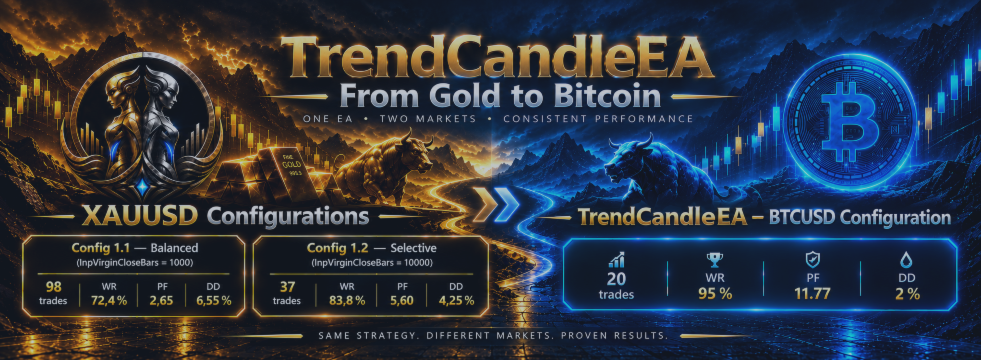
The table below compares the two configurations over the exact same 9-month period, on the same broker, with the same EA build.
| Metric | XAU — Config 1.2 (Selective) | BTC Configuration |
|---|---|---|
| Symbol | XAUUSD | BTCUSD |
| Timeframe | M30 | M30 |
| Period | 2026.01 → 2026.09 | 2026.01 → 2026.09 |
| Trades | 37 | 20 |
| Win rate | 83,78 % | 95,00 % |
| Profit Factor | 5,60 | 11,77 |
| Balance DD max | 4,25 % | 1,02 % |
| Equity DD max | 5,06 % | 2,05 % |
| Net profit | +79,7 % | +12,0 % |
| Sharpe Ratio | 31,21 | 17,59 |
| Long / Short | 37 / 0 | 7 / 13 |
Both configurations deliver positive expectancy with very controlled drawdown. The BTC configuration trades less often, has a higher win rate, a higher Profit Factor and a much lower drawdown — but a lower absolute return over the same period, because it trades roughly half as often. The BTC config is also the only one of the two that traded in both directions during the test window.
11. Conclusion
Migrating from the XAU configuration to the BTC configuration is not a matter of scaling a few points-based parameters. It requires a full recalibration of the filter stack, driven by Bitcoin's specific market behaviour: higher volatility, longer trends, more frequent fakeouts, and a fundamentally different microstructure.
Thirty-one inputs change between the two configurations. Thirty-one others remain untouched. The summary table in section 6 is designed to be used as a direct reference during configuration.
Traders who already run the XAU configuration successfully can add the BTC configuration alongside it, provided they respect the two golden rules: a distinct InpMagic (1004 instead of 1003) and a distinct InpTradeComment ( BtcTrendCandle instead of XauTrendCandle ).
Always validate on a demo account before going live, and always use risk-based position sizing.
Thank you for reading. Feedback, bug reports and suggestions are welcome in the comments section.