

Principle 1. Deterministic Risk Over the Fallacy of Averaging
The cardinal law of institutional quantitative trading is unequivocal: "No trade is permitted to exist without an immutable, predefined Stop Loss."
In The Silent Investor architecture:
• Every position enters the market with a strictly calculated downside boundary.
• Stop-Loss and Take-Profit thresholds dynamically adjust to macroeconomic price volatility (Scaled Pips).
• Positions transition to Break-Even upon momentum confirmation and trail dynamically.
When a breakout premise is invalidated, the system liquidates the position at a modest, controlled loss (0.5%–1.0% of capital) and frees equity, permanently avoiding toxic floating drawdown build-up.
Principle 2. Decoupled Tri-Engine Synergy
Rather than staking capital on a single speculative logic, the portfolio concurrently runs three decoupled algorithms with orthogonal mathematical profiles from a single M15 chart:
1. Engine A — Structural Support/Resistance Breakout (H8/M30):
• Profit Contribution: 69.7%
• Win Rate: 64.6%
• Methodology: Identifies confirmed multi-hour fractal consolidation bands with pending stop orders armed on the breakout perimeter.
2. Engine B — Volatility Burst Micro-Momentum (M15):
• Profit Contribution: 16.5%
• Win Rate: 64.4%
• Methodology: Scans for anomalous ATR range expansions and executes immediate market orders upon confirmed velocity surges.
3. Engine C — Mean-Exhaustion Pivot Scalper:
• Profit Contribution: 13.8%
• Win Rate: 73.0%
• Methodology: Capitalizes on localized price overextensions.
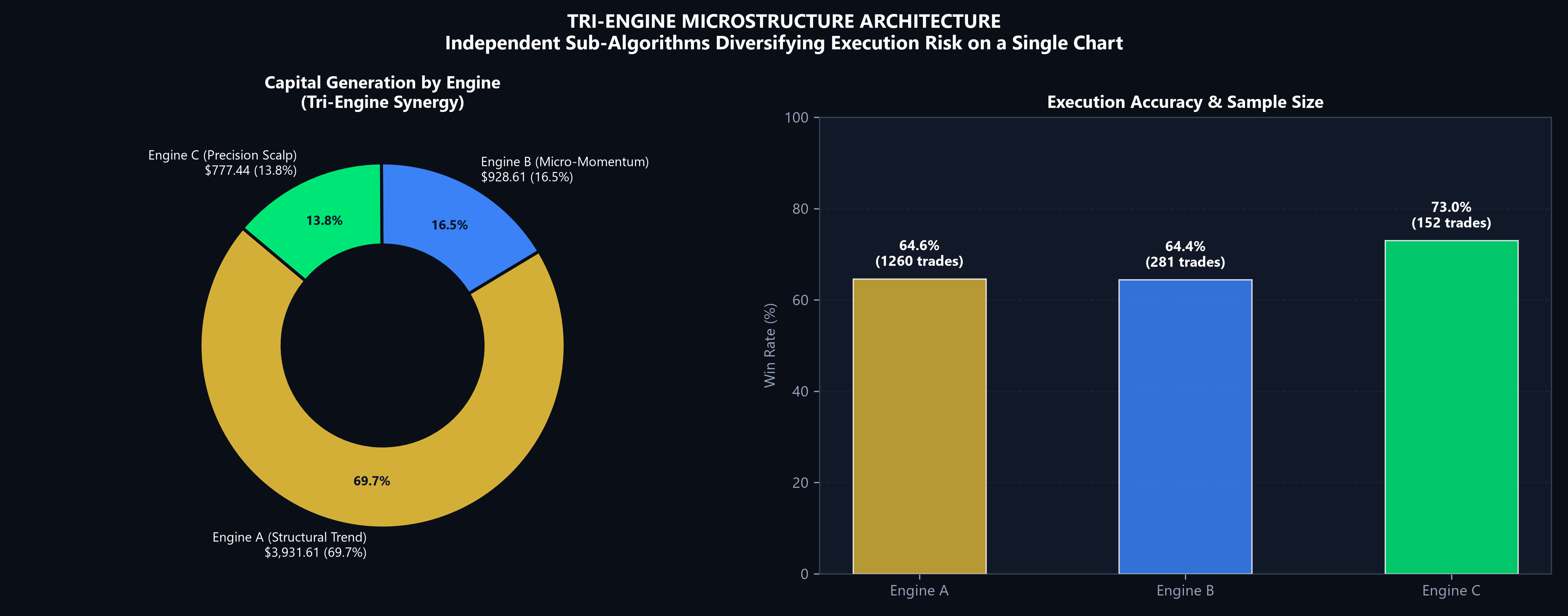
When one engine encounters sideways market chop or logs a minor correction, the other two non-correlated engines compensate, producing a remarkably smooth composite equity curve.
Principle 3. Non-Linear Volatility Scaling (Market Regime Architecture)
A pivotal technical innovation is the dynamic distance adaptation to prevailing gold price regimes.
At a reference gold price of $1,900, a 100-pip stop distance equals $10.00 of asset movement. When gold inflates to $2,700, that same 100 pips ($10) becomes excessively constricted, vulnerable to routine intraday bid-ask spread noise.
The built-in ValueFactor() routine dynamically computes:
Factor = CurrentMarketPrice / ReferenceBasePrice
All breakout buffers, stop losses, and trailing triggers scale proportionally in real-time. This guarantees identical mathematical efficacy whether trading Gold at $1,100 in 2016 or $2,700+ in 2026.
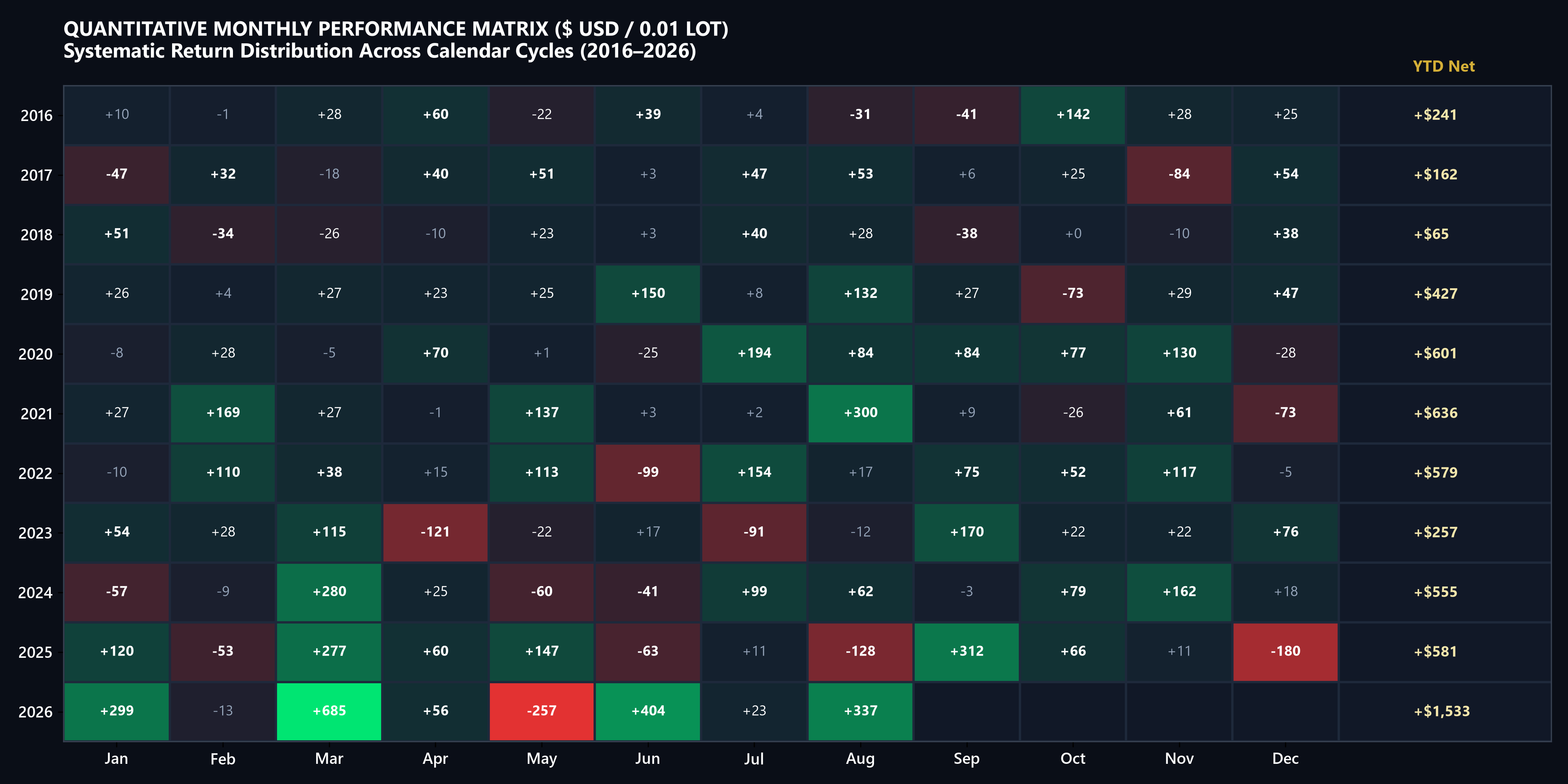
10-Year Stress Audit Performance Breakdown (2016–2026):
Testing executed on IC Markets Global real ticks ("Every tick based on real ticks" model, floating spreads, commissions modeled):
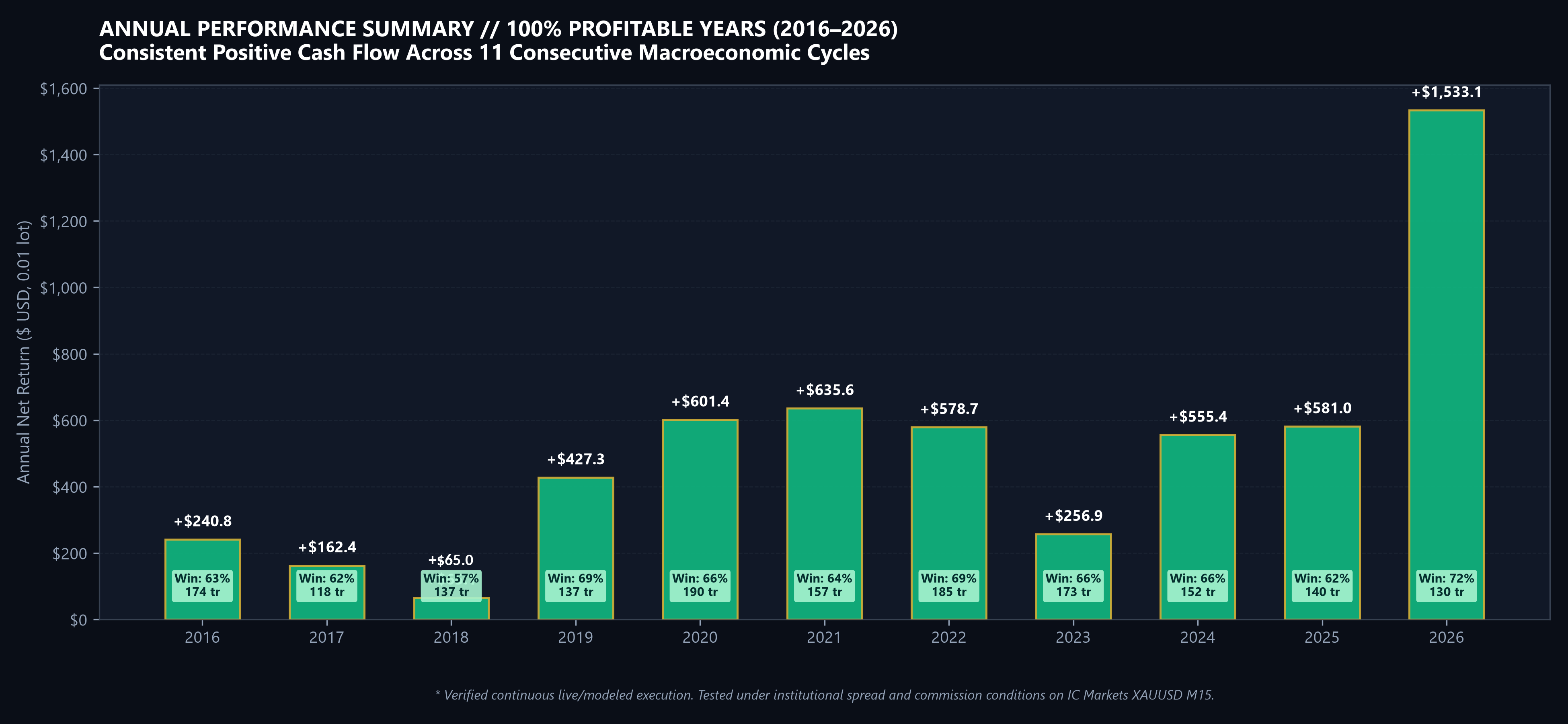
• 2016: +$240.8 (+2.4%)
• 2017: +$162.4 (+1.6%)
• 2018: +$65.0 (+0.7%)
• 2019: +$427.3 (+4.3%)
• 2020: +$601.4 (+6.0%) — the pandemic volatility of 2020 was traversed without a losing year
• 2021: +$635.6 (+6.4%)
• 2022: +$578.7 (+5.8%)
• 2023: +$256.9 (+2.6%)
• 2024: +$555.4 (+5.6%)
• 2025: +$581.0 (+5.8%)
• 2026 (8 months): +$1,533.1 (+15.3%)
Figures are net profit per calendar year on a fixed 0.01 lot with a $10,000 baseline; the percentage is the return on that baseline. Total for the period: +$5,637.62 (+56.38%).
Summary: 11 out of 11 calendar years closed in net profit.
Sortino Ratio registered at 3.27, reflecting an overwhelming dominance of upside volatility over drawdowns.
Prop Firm Challenge Compliance (FTMO, FundedNext, Funding Pips)
For traders pursuing institutional funded accounts, capping daily drawdowns below 5% and overall drawdown below 10% is paramount.
The Silent Investor incorporates a native Risk Guard subsystem:
1. Automatically computes daily equity baselines against broker server time.
2. Anchors peak equity and daily thresholds via MT5 GlobalVariables (resilient against VPS reboots or terminal crashes).
3. Executes immediate basket liquidation and halts further order placement upon reaching user-defined thresholds.
Conclusion
Algorithmic gold trading must not resemble Russian roulette with hopes of miraculous trend reversals. Institutional stability is won through tail-risk control, deterministic stop-losses, and multi-engine synergy.
The Silent Investor EA and validated factory presets are available on the MQL5 Market:
[Link to The Silent Investor EA Product Page on MQL5 Market]
For institutional investors seeking the full quantitative Factsheet PDF or Strategy Tester reports, feel free to reach out via direct message.