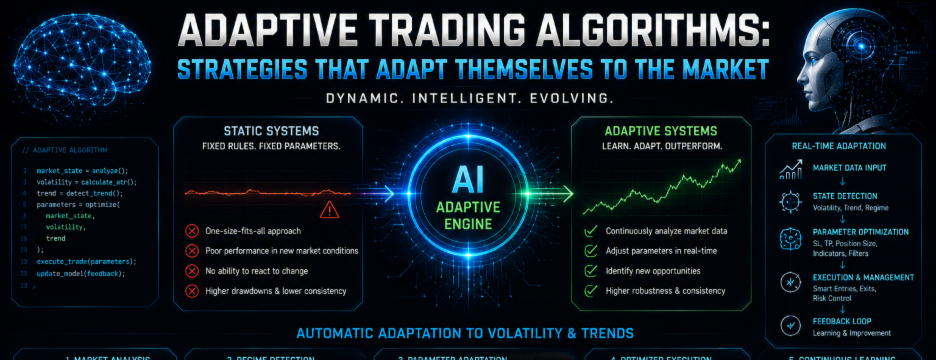
Adaptive Trading Algorithms: Strategies That Genuinely Change Themselves as the Market Changes

Adaptive Trading Algorithms: Strategies That Genuinely Change Themselves as the Market Changes
A strategy performs beautifully for months. Nothing in the headlines changed, no dramatic news event, no obvious shift anyone could point to. Yet the same rules that once produced clean, consistent profit begin bleeding steadily, trade after trade. This is not bad luck, and it is not a flaw in the original idea. It is the predictable outcome of running a static system in a market that never stops evolving. Understanding the real difference between static and adaptive trading algorithms is one of the most consequential distinctions a trader can ever learn, because it explains exactly why this keeps happening to otherwise sound strategies.
This article defines the fundamental divide between static and adaptive trading systems, breaks down precisely what automatic adaptation to volatility and trend actually looks like in practice, and explains the concrete advantages genuinely adaptive systems hold over classical, fixed rule Expert Advisors.
Static Versus Adaptive Trading Systems: The Fundamental Divide
A static trading system is calibrated once, typically against a single historical dataset, and then executes its fixed logic indefinitely regardless of whether the conditions that inspired that logic still exist. A classic moving average crossover system tuned during a strongly trending year will keep executing the exact same crossover rule during a subsequent range bound year, with no internal mechanism to notice the shift or adjust its own behavior in response. It simply repeats its original instructions with unthinking consistency, into conditions it was never actually designed for.
An adaptive system operates on a fundamentally different principle. It perceives current conditions, incorporates ongoing feedback from live outcomes, and genuinely changes its own parameters, thresholds, or in the most advanced cases its own internal structure, in response to what it observes. The difference is not a matter of degree. It is a difference in category, between a system that repeats an instruction and a system that learns.
What Genuine Automatic Adaptation to Volatility Actually Looks Like
Automatic volatility adaptation means the system's own exposure adjusts mechanically as market conditions change, without requiring any manual intervention from the trader. ICONIC BTC AI+ and ICONIC GOLD AI+ both calculate stop distance dynamically from current ATR readings while sizing positions from a fixed percentage of account equity, meaning that as volatility widens, stop distance widens with it and position size mechanically shrinks to compensate, and the reverse happens automatically as volatility contracts. No trader needs to notice the shift and manually resize. The mathematics enforces the adjustment on every single trade.
Adaptation extends beyond risk sizing into how the systems place their pending structure itself. Rather than arming breakout levels once and leaving them static indefinitely, ICONIC BTC AI+ applies a smart re arm process that refreshes pending order levels at regular intervals as the market genuinely evolves, ensuring the structure being traded reflects current conditions rather than a stale calibration from hours earlier. ICONIC TITAN AI extends this same philosophy into its own signal generation, continuously retraining its neural ensemble through an ongoing walk forward process that feeds live hit rate statistics back into the model, meaning its own calibration shifts over time based on genuine accumulated evidence rather than freezing at whatever state it held on the day it was first deployed.
What Genuine Automatic Adaptation to Trend Actually Looks Like
Trend adaptation requires a system to recognize not just whether price is moving in a direction, but how genuinely orderly that movement actually is, and to adjust its own willingness to trade accordingly. ICONIC BTC AI+ and ICONIC GOLD AI+ compute a trend linearity measurement, an R squared statistic over recent bars of a higher timeframe, dynamically gating trade eligibility based on how clean the current trend genuinely is rather than assuming every level touch during any perceived direction is automatically tradeable.
The most sophisticated expression of this appears inside ICONIC KYBERNETIC AI+, where a regime filter tracks a running profitability estimate for specific trend strength buckets over time, and can override its own original threshold assumption in either direction as genuine evidence accumulates, reopening a bucket once wrongly assumed too weak, or closing one once wrongly assumed favorable. The system's own definition of what counts as sufficiently trending to justify a trade genuinely shifts based on real, accumulated experience, rather than remaining fixed at whatever assumption was programmed in on day one.
The Deeper Layer: Systems That Rewire Their Own Intelligence, Not Just Their Settings
Beyond adjusting externally visible settings such as stop distance or a trend threshold, the deepest form of adaptation changes a system's actual internal structure. ICONIC BTC AI+ and ICONIC GOLD AI+ are built on differentiable plasticity with Hebbian neuromodulation, meaning the neural architecture continuously rewires the strength of its own internal connections in response to live market feedback, an adaptation happening inside the model itself rather than merely in an external parameter it references.
ICONIC KYBERNETIC AI+ applies a related but architecturally distinct depth of self modification, an exponentially weighted recursive least squares readout with a forgetting factor that keeps its reservoir perception layer genuinely regime adaptive rather than frozen, alongside a self calibrating confidence gate built on Adaptive Conformal Inference that continuously regulates its own threshold against a stated accuracy target rather than trusting a fixed number set once during development. These are systems adapting at the level of their own internal machinery, not merely reacting to a single external volatility reading.
The Concrete Advantages Over Classical Expert Advisors
A classical Expert Advisor, built around fixed indicator crossovers or a hardcoded rule set calibrated once against a single historical backtest, carries a specific and largely unavoidable disadvantage. It has no internal mechanism to notice that the market has drifted away from the conditions it was originally tuned for, and it will continue executing its original logic with the same unthinking consistency regardless of how much the underlying regime has changed. This guarantees a slow, quiet degradation over time, requiring the trader or developer to manually notice the decline and re optimize the system by hand, a cycle that repeats indefinitely as the market keeps evolving beyond each new calibration.
- Continuous recalibration against live evidence replaces the manual re optimization cycle a classical EA eventually demands, since the system itself is built to notice and respond to drift rather than requiring a human to catch the decline after the fact.
- Genuine regime awareness allows an adaptive system to recognize when current conditions no longer suit its own assumptions, adjusting its behavior or its willingness to trade at all, rather than blindly persisting through a regime it was never designed for.
- Reduced manual maintenance burden frees the trader from the endless cycle of babysitting parameters, since a genuinely adaptive architecture is specifically built to absorb ongoing change rather than requiring constant external intervention to remain relevant.
Awareness Layer: Adaptive Perception Alongside Adaptive Execution
Adaptation matters as much in how a system perceives opportunity as in how it manages risk once a position is open. ICONIC TITAN AI exemplifies this on the perception side, scanning every relevant timeframe in parallel through an ensemble of neural networks that is itself continuously retrained through an ongoing walk forward process, rather than a fixed set of indicator rules calibrated once and left unchanged. Pairing an adaptive signal layer with adaptive execution engines gives a trader genuine awareness and genuine autonomous discipline operating on the same underlying philosophy, systems built to keep learning rather than systems frozen at the moment they were released.
Frequently Asked Questions About Adaptive Trading Algorithms
What is the difference between a static and an adaptive trading system? A static system executes fixed rules indefinitely regardless of whether market conditions have changed, while an adaptive system perceives current conditions and genuinely changes its own parameters or internal structure in response to live feedback.
How does a trading system automatically adapt to volatility? By calculating stop distance and position size dynamically from current volatility readings such as ATR, so that exposure mechanically adjusts, widening stops with proportionally smaller size during volatile periods and the reverse during calmer conditions, without requiring manual intervention.
How does a trading system automatically adapt to trend conditions? Through measurements such as trend linearity statistics that gate trade eligibility based on how genuinely orderly current movement is, combined with online learning that tracks which trend conditions have actually proven profitable and adjusts the system's own thresholds accordingly over time.
Why do classical Expert Advisors eventually stop working? Because they are calibrated once against historical data and have no internal mechanism to notice when the market drifts away from those original conditions, requiring manual re optimization that the system itself cannot perform on its own.
What is the deepest form of adaptation a trading system can have? Architectures that continuously rewire the strength of their own internal neural connections in response to live feedback, changing the system's actual structure rather than merely adjusting an external parameter it references.
Stop Maintaining a Strategy. Deploy One That Maintains Itself.
The uncomfortable truth about classical, static trading systems is that their decline is not a possibility to guard against. It is a mathematical certainty, delayed only by how long current conditions happen to resemble whatever the system was originally calibrated for. Genuinely adaptive architecture is the only durable answer to a market that never stops evolving, systems that notice drift, recalibrate against live evidence, and in the deepest implementations, rewire their own internal intelligence rather than waiting for a human to intervene.
Explore systems engineered around exactly this principle, from the volatility and trend adaptive execution of ICONIC BTC AI+ and ICONIC GOLD AI+, through the self calibrating, regime learning architecture of ICONIC KYBERNETIC AI+, to the continuously retrained signal awareness of ICONIC TITAN AI, at iconicfx.tech.
Risk Disclaimer. Trading foreign exchange, cryptocurrencies, commodities and other leveraged financial instruments carries a high level of risk and may not be suitable for all investors. The high degree of leverage can work against you as well as for you. Past performance is not indicative of future results. Automated trading systems, indicators and Expert Advisors do not guarantee profits and can produce losses. ICONIC.FX provides software tools only and does not provide investment advice, portfolio management or financial recommendations. You are solely responsible for your own trading decisions. Seek advice from an independent licensed financial advisor if you have any doubts.



![[EURUSD]: Weekly Liquidity Activation Points (LAP), October 12-16, 2026](https://c.mql5.com/6/1035/splash-preview-777305.png "[EURUSD]: Weekly Liquidity Activation Points (LAP), October 12-16, 2026")