Blog Level: Advanced
Walk-Forward Testing: Avoiding Over-Optimized Strategies
Walk-forward testing is the gold standard for validating a mechanical FX trading strategy before you risk real capital. Instead of optimizing parameters once on all available historical data, you repeatedly optimize on a rolling "in-sample" window and immediately test the result on a fresh "out-of-sample" window — simulating exactly how a live strategy is periodically re-tuned. If your strategy holds up across all those out-of-sample slices, you have genuine evidence of robustness; if it collapses, you've found a curve-fit before it costs you real money.
Why Simple Backtesting Is a Trap
You've built a EUR/USD strategy. You run an optimization across 10 years of hourly data, tweak the RSI period from 5 to 30, the ATR multiplier from 1.0 to 3.0, and the EMA length from 20 to 200. After 10,000 parameter combinations, you land on RSI(14), ATR(2.2), EMA(89). Backtested Sharpe: 2.1. You go live. Within three months, the strategy bleeds 18%.
What happened? Curve fitting — also called overfitting or data snooping bias. The optimizer found the settings that explained historical noise best. It didn't find a durable edge; it found a historical artifact.
The brutal math: with enough parameter combinations, you will always find a combination that looks great on in-sample data purely by chance. The more degrees of freedom you give the optimizer, the worse this problem gets.
Walk-forward testing attacks this problem directly.
The Core Mechanics
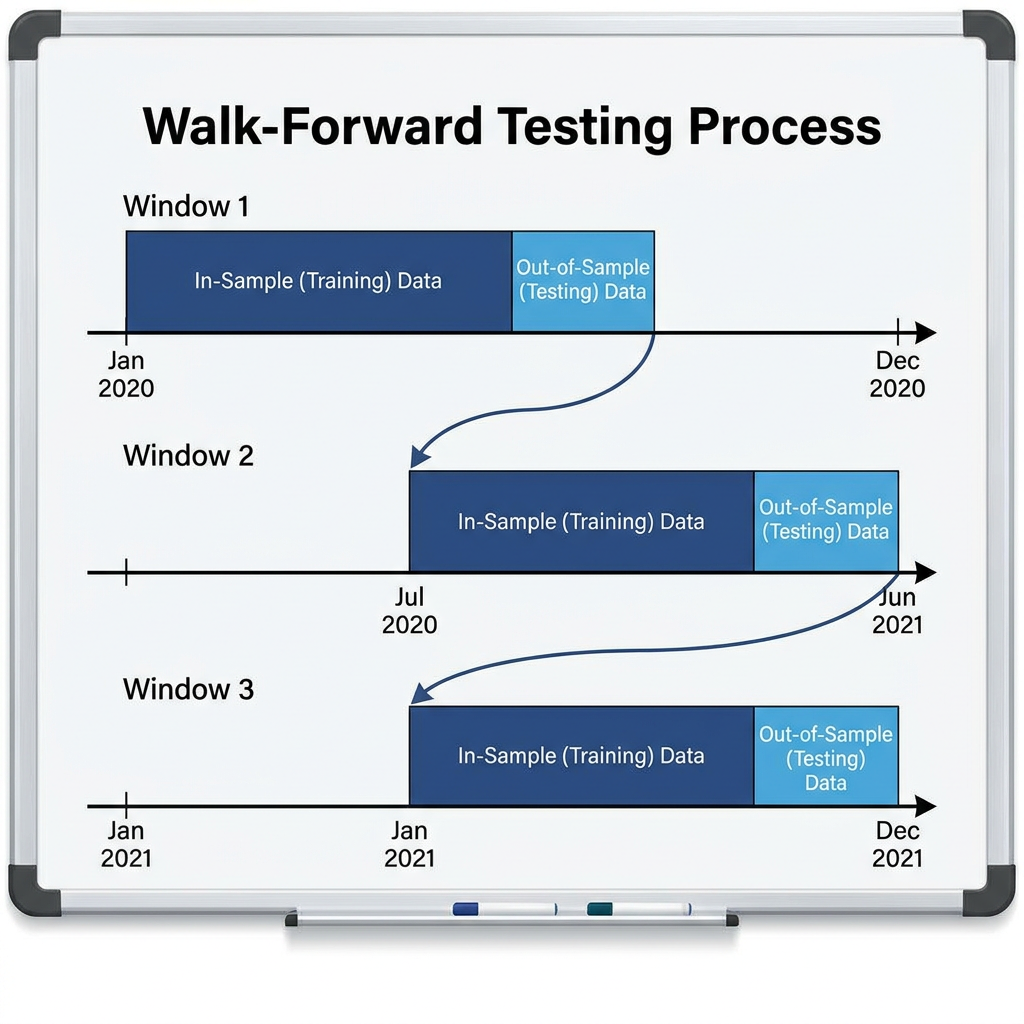
Walk-forward testing divides your historical data into overlapping segments and runs a disciplined sequence of optimize → test → advance.
The Two Windows
- In-Sample (IS) window — the data used to optimize parameters. The optimizer can see this. Think of it as your "training set."
- Out-of-Sample (OOS) window — the data used to evaluate those parameters. The optimizer never touches this. Think of it as your "exam."
A common starting ratio is 4:1 IS to OOS (e.g., 12 months IS, 3 months OOS). Some traders prefer 3:1; some go as wide as 6:1. The exact ratio matters less than applying it consistently.
The Walk-Forward Loop
Here is the exact sequence:
- Take the first IS window (say, Jan 2020 – Dec 2020).
- Optimize your strategy parameters on that window. Record the winning parameter set.
- Apply those frozen parameters to the OOS window (Jan 2021 – Mar 2021). Record the OOS performance.
- Advance the windows by one OOS period (slide everything forward 3 months).
- Repeat steps 1–4 until you run out of data.
- Stitch all the OOS segments together. This is your walk-forward equity curve.
The walk-forward equity curve is the only curve that matters for your decision. It tells you what your strategy actually did when it encountered data it had never seen.
Anchored vs. Rolling Walk-Forward
These are the two main variants. Know which one you're running.
Rolling Walk-Forward
The IS window moves forward at a fixed size. You always train on, say, the most recent 12 months.
- Advantage: The strategy adapts to recent regime changes. If EUR/USD volatility collapsed post-2022, a rolling IS window captures that.
- Disadvantage: Older data is discarded entirely. You may be throwing away useful structural information.
Anchored Walk-Forward
The IS window grows over time — the start date is fixed, but the end date advances.
- Advantage: Uses all available historical data at each step. Generally produces more stable parameter estimates.
- Disadvantage: Recent market regimes may get drowned out by older data, making the strategy slow to adapt.
Practical rule: Use rolling walk-forward if your strategy is regime-sensitive (carry, trend-following). Use anchored walk-forward if you believe your edge is structural and timeless (e.g., a pure mean-reversion arbitrage between highly correlated pairs).
A Worked Example: GBP/USD Breakout Strategy
Let's make this concrete. You're testing a volatility-breakout strategy on GBP/USD daily bars, 2018–2025 (7 years = 28 quarters of data).
Setup:
- IS window: 8 quarters (2 years)
- OOS window: 2 quarters (6 months)
- Optimization target: maximize Calmar ratio (annualized return / max drawdown)
- Free parameters: ATR breakout multiplier (1.0–3.0), trailing stop ATR multiplier (1.0–2.5)
Walk-forward passes:
| Pass | IS Period | OOS Period | OOS Net P&L | OOS Max DD |
|------|-----------|------------|-------------|------------|
| 1 | Q1 2018–Q4 2019 | Q1–Q2 2020 | +$4,820 | −8.2% |
| 2 | Q3 2018–Q2 2020 | Q3–Q4 2020 | +$2,110 | −5.6% |
| 3 | Q1 2019–Q4 2020 | Q1–Q2 2021 | −$1,340 | −12.1% |
| 4 | Q3 2019–Q2 2021 | Q3–Q4 2021 | +$3,670 | −6.9% |
| 5 | Q1 2020–Q4 2021 | Q1–Q2 2022 | −$890 | −9.4% |
| 6 | Q3 2020–Q2 2022 | Q3–Q4 2022 | +$5,200 | −7.1% |
| 7 | Q1 2021–Q4 2022 | Q1–Q2 2023 | +$1,980 | −4.8% |
| 8 | Q3 2021–Q2 2023 | Q3–Q4 2023 | +$2,770 | −6.3% |
| 9 | Q1 2022–Q4 2023 | Q1–Q2 2024 | −$620 | −10.5% |
| 10 | Q3 2022–Q2 2024 | Q3–Q4 2024 | +$3,150 | −5.9% |
Stitched OOS total: +$20,850 across 5 years of live-simulation data. 8 out of 10 passes profitable. Max drawdown never exceeded 12.1%. These are numbers worth respecting.
Now compare: the single-pass backtest on all 7 years, optimized globally, showed +$41,200 and max DD of only −4.3%. That's a mirage — it reflects what the optimizer found by fitting the entire dataset, not what the strategy would have produced in real time.
The Walk-Forward Efficiency Ratio
One key metric separates serious practitioners from hobbyists: the Walk-Forward Efficiency (WFE) ratio.
> WFE = OOS Annualized Return ÷ IS Annualized Return
- WFE above 0.70 → robust. The strategy retains most of its IS performance when it hits new data.
- WFE of 0.40–0.70 → marginal. Usable but warrants wider parameter ranges or fewer free variables.
- WFE below 0.40 → curve-fitted. Stop here and redesign.
In the example above, if the average IS annualized return across passes was 22% and the OOS annualized return was 16.4%, your WFE is 16.4/22 = 0.75 — that's solid.
Also track the OOS Consistency Rate: the percentage of OOS windows that were profitable. Anything below 60% is a red flag even if the total OOS P&L is positive — it means the wins are clustered in a few lucky windows.
Parameter Stability Analysis
Walk-forward testing also gives you something a single backtest never can: a distribution of optimized parameter values across all IS passes.
After your 10 passes above, plot the winning ATR breakout multiplier for each pass. If you see:
1.8, 1.9, 2.1, 1.8, 2.0, 1.9, 2.2, 1.8, 2.0, 1.9
→ That's a stable cluster around 1.9–2.0. This parameter is genuinely meaningful.
If you see:
1.1, 2.9, 1.4, 2.8, 1.2, 3.0, 1.5, 2.7, 1.3, 2.9
→ That's erratic. The optimizer is hunting noise, not signal. This parameter is meaningless — strip it out or tighten its bounds.
Parameter stability analysis is one of the most underused diagnostics in retail quant trading.
Practical Implementation Notes
- Minimum OOS data requirement: Never run a walk-forward with fewer than 100 trades across all OOS windows combined. Below that, statistical noise overwhelms signal.
- Optimization target matters: Maximize Calmar or Sortino ratios, not raw return. Raw return optimizations notoriously find blow-up-prone parameter sets that just happened to avoid disasters in the IS window.
- Use a single objective function. Multi-objective optimization on walk-forward (e.g., maximize return AND minimize drawdown simultaneously) dramatically increases the risk of inadvertently over-fitting to compound objectives.
- Control degrees of freedom: Every free parameter you add multiplies the optimization space. A strategy with 2 parameters needs far less data than one with 6. A rough heuristic: you want at least 30 IS-window trades per free parameter.
- Software options: Python with vectorbt or backtesting.py allow manual walk-forward loops. Dedicated platforms like StrategyQuant X, Amibroker, or MetaTrader's built-in optimizer (with scripting) handle the windowing automatically.
Key Takeaways
- Walk-forward testing simulates the live experience of periodically re-optimizing a strategy on recent data, producing an honest OOS equity curve.
- The only performance numbers that matter for a go/no-go decision are out-of-sample results.
- Use a 4:1 IS:OOS ratio as a starting point; adjust based on how frequently your strategy's optimal parameters are expected to shift.
- Walk-Forward Efficiency above 0.70 is a meaningful robustness benchmark.
- Parameter stability across passes is as informative as raw OOS performance — erratic parameter distributions reveal noise-fitting.
- Rolling walk-forward suits regime-sensitive strategies; anchored walk-forward suits strategies with structural, time-invariant edges.
- More free parameters demand more data. Keep your models lean.
Common Mistakes
- Optimizing on the full dataset before walk-forward testing. Fix: treat the OOS segments as sacred — no parameter decisions should ever be informed by looking at OOS data first.
- Using too short an OOS window. Fix: ensure each OOS slice contains enough trades to be statistically meaningful (minimum ~30 trades per OOS period).
- Cherry-picking the walk-forward variant (rolling vs. anchored) based on which gives a better result. Fix: choose your variant based on your market thesis before running the test, not after seeing the numbers.
- Ignoring loss-making OOS windows. Fix: investigate every losing OOS period — they often reveal a specific regime (e.g., low-volatility range) your strategy cannot handle, which is critical live-trading intelligence.
- Treating WFE as a pass/fail binary. Fix: use WFE as one signal among several (OOS consistency rate, parameter stability, OOS Sharpe) rather than a single decision gate.
- Over-tightening parameter ranges to inflate WFE. Fix: set parameter ranges based on logical market reasoning before optimization; never adjust them reactively to improve walk-forward metrics.
- Forgetting transaction costs in the OOS simulation. Fix: always include realistic spread, commission, and slippage — for EUR/USD at 1 standard lot ($10/pip), even 0.5 pips of extra slippage per trade compounds to thousands of dollars over hundreds of trades.
Generated by OMG FOREX - Huseyin Furkan Ozturk · 2026-05-29 · ~1630 words